By Marie Dennis
“The peace of the risen Jesus is unarmed. His was an unarmed struggle in the midst of concrete historical, political and social circumstances.” (Pope Leo XIV, 2026 World Day of Peace)
Much has been written about Pope Leo’s clear, persistent call for unarmed peace and his repeated rejection of war, all war. Recently framed almost exclusively in contrast to the belligerence of the current U.S. Administration, the depth of his prophetic invitation to humanity to embrace Gospel nonviolence has been mostly missed.
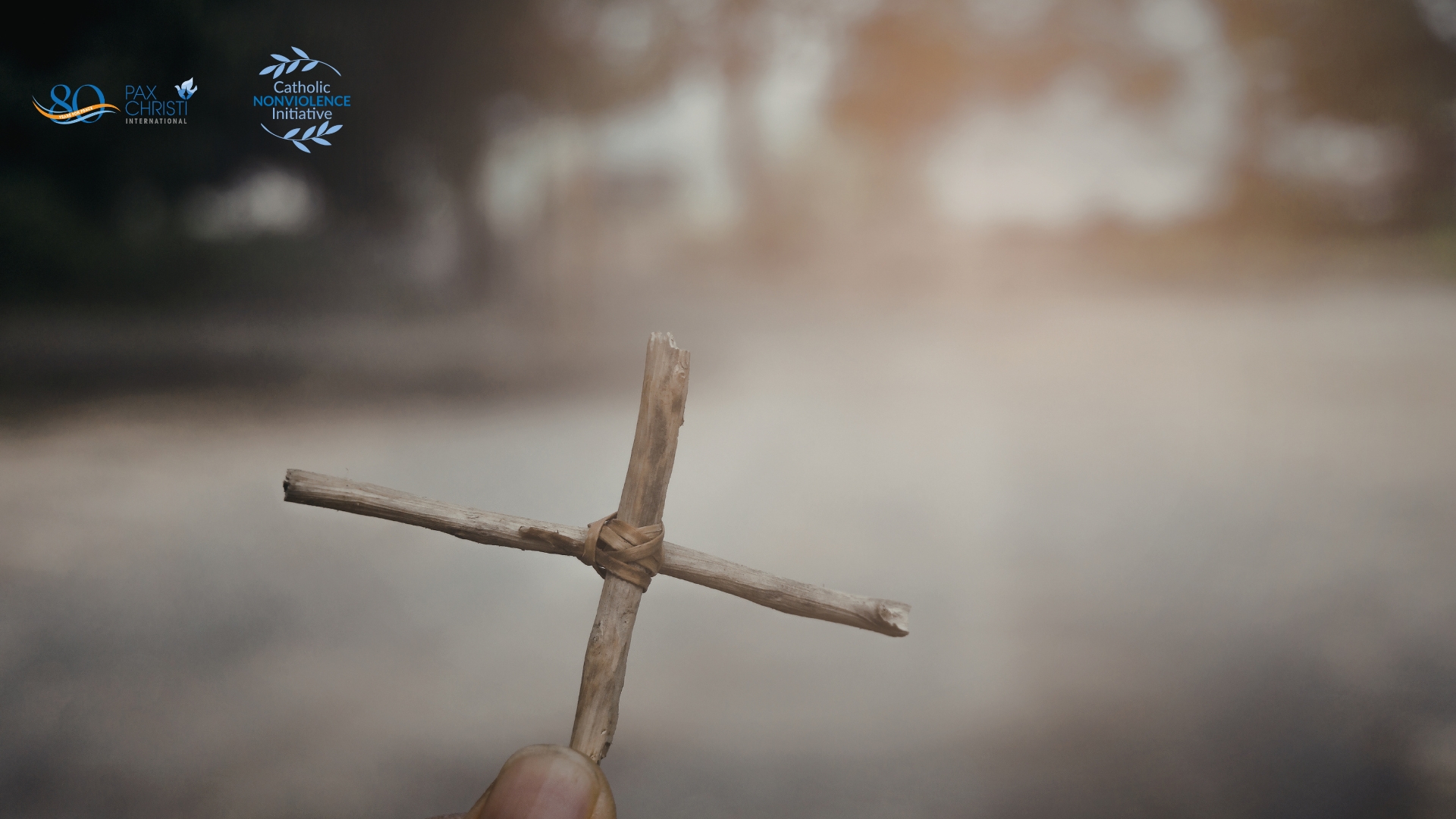
Yet, with a thought-provoking sentence in his Urbi et Orbi message, “The power with which Christ rose is entirely nonviolent,” Pope Leo, as he has done repeatedly since he was elected, offered a way forward for a world overwhelmed by violence: the way of nonviolence that imitates Jesus’ witness and words. In the immediate aftermath of what was total violence on Calvary, Jesus’ first words to his friends were “Peace be with you.” Crucifixion, an instrument of terror, had been transformed by Jesus into a powerful symbol of nonviolence.
Author and theologian James Douglass, in The Nonviolent Coming of God (2006 Wipf and Stock Publishers), wrote, “The inconceivable change that occurred at Jesus’ cross was that an empire’s terrifying deterrent was transformed through the nonviolent resistance of love, truth, and forgiveness. When Jesus suffered and died on the cross … [the] cross as deterrent became the cross as life. Through the cross, Jesus entered into the crucifixion of the world. In so doing, he revealed the other side of violence, which is suffering, as a way of resistance – a way of transforming violence into life itself.”
Jesus made it possible for humanity to imagine the power of life over death, of good over evil, of nonviolence over violence, of love. Through the nonviolent power of the Resurrection, God responded to the violence of the cross, the violence of the world, with a powerful force that was entirely nonviolent.
But Gospel nonviolence is not just not violent. It is actively engaged in preventing or interrupting the violence that is imbedded in our world by the way we relate to each other, by the way so many are bruised, broken, killed by systemic violence, and by the way we humans treat the earth. This nonviolence is characterized by radical inclusion, the foundational message of the Sermon on the Mount, and it energetically promotes just peace, the new story, the beloved community, the New Creation.
“As I was sent, so I send you” … to transform a broken world, to spread the Good News, to share hope. Animated by the Holy Spirit to follow his example of nonviolent action transforming the violence of first century Palestine, Jesus’ followers finally had the courage to leave the security of the “upper room” and to risk proclaiming the Gospel in the public square, despite the danger that lingered there.
After Pentecost, the discipleship community matured, making efforts to put into practice the way of life they had been learning from the many lessons Jesus taught and the witness of his life. They did not have to say that they were nonviolent because that was how they so clearly lived and what made it possible to endure the persecutions that would immediately ensue. They chose neither fight nor flight, but Jesus’ “third way”: nonviolence.
Pax Christi’s Catholic Nonviolence Initiative believes that movement of the Spirit in these times is visible in a deeper understanding of and commitment to Gospel nonviolence.
Reporting on a recent interview with Cardinal Robert McElroy, Archbishop of Washington DC, author Austen Ivereigh, the biographer of Pope Francis, said, “Theologically, a case needs to be made – and demonstrated – that nonviolence as practiced by Jesus is not a renunciation of power, but trust in the true power of the universe, in God’s own weapons of love, trust, and patience. Peace cannot be brought about by those who wage war, only by its victims; and resort to war is a form of despair, a pessimism that cannot build us back better but can only corrode and embitter us.” (The Tablet, 25 March 2026)
Cardinal McElroy has described major shifts in Catholic thinking related to war and violence. “First,” he said, “the continuation of wars among nations and within societies, enlisting devastating weapons and resulting in countless deaths have pointed to the need to fundamentally renew and prioritize the claim of nonviolent action as the primary framework for Catholic teaching on war and peace. Secondly, the continuous misuse of the just war tradition and its susceptibility to functioning as a justification for – rather than a restraint upon – warfare, challenges the Church to refine this ethical framework if it is to provide morally informed guidance in addressing those situations where nonviolence fails.”
The current public discussion about war, especially the war in Iran, is generating deeper reflection on the consequences of centering nonviolence in Catholic teaching and practice, and of articulating a new ethical framework. “What matters now,” according to Cardinal McElroy, “is to institutionalise active nonviolence “to show how it’s effective and to build institutions in society that operate from that stance.”
Marie Dennis is the Co-Director of Pax Christi International’s Catholic Institute for Nonviolence

The articles are always uplifting and inspirational because they speak truth. It is a shame that the non violent gospel is not preached from the pulpit.
Thanks Marie,
I have the (happy) feeling we’re finally moving beyond a binary Just War Theory (if you think of it, the expression Just War Theory consists of an oxymoron and a hedging). Differentiating between pacifism and passivism, nonviolence seems to be emerging as not merely an attitude but also a real, proactive strategy. This is really helpful.
Elias