By Ken Butigan
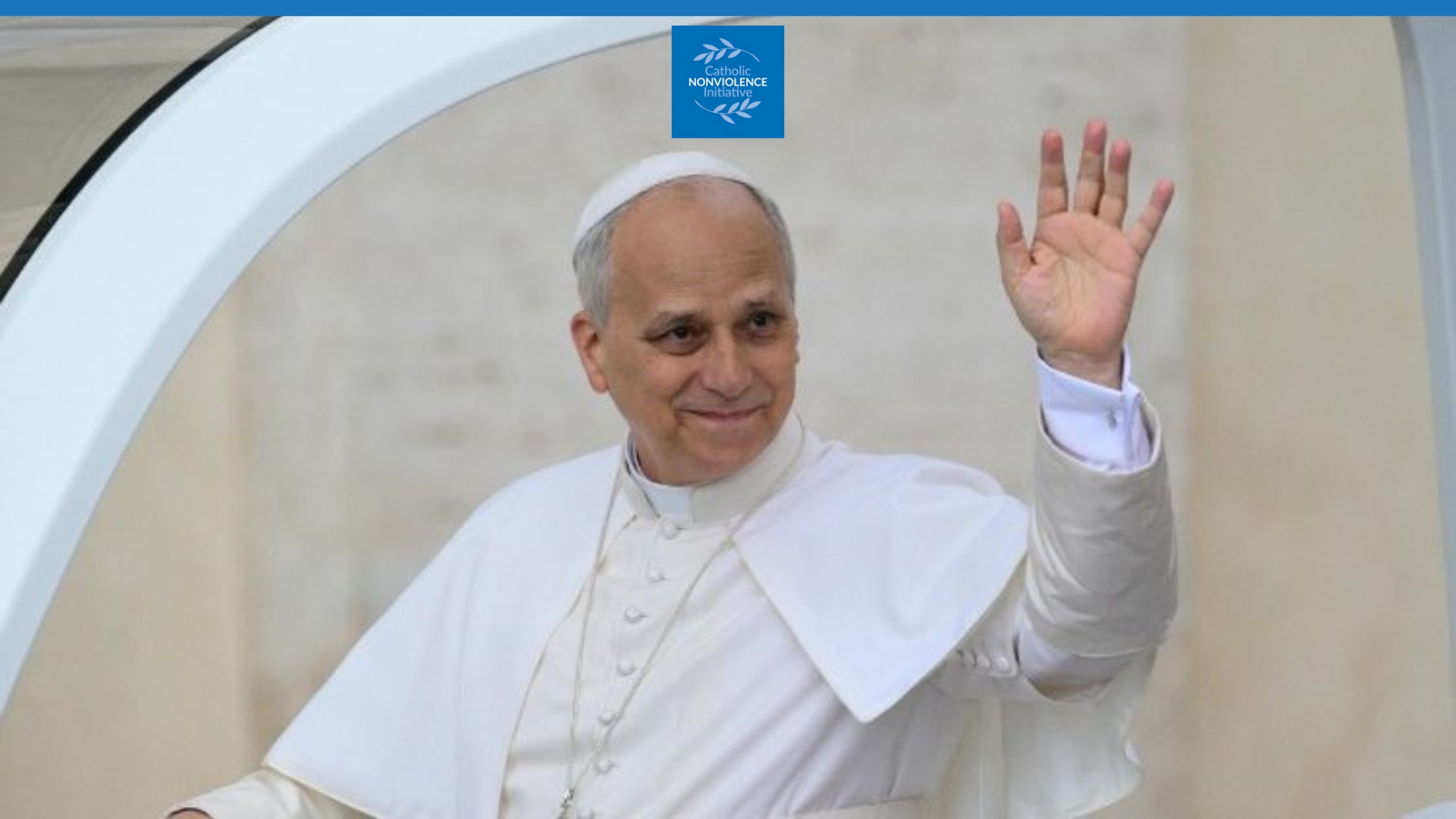
In his first moments as pontiff, Pope Leo emphasized that nonviolence is at the core of the Gospel. After blessing the entire world with the phrase Jesus shared with his disciples after his resurrection— “Peace be to you all” —Pope Leo broke open its meaning by proclaiming that Christ’s peace is “unarmed and disarming, humble and persevering.”
Since then, His Holiness has underscored the spirit of Jesus’ Nonviolence almost daily in his many cries for peace and explicitly in a range of statements: The next generation needs “witnesses of a different, nonviolent lifestyle”; we are in need of “the most credible protagonists of nonviolent processes of peacebuilding.” “In the midst of the many challenges facing our world at this time, including widespread armed conflict, division among peoples, and the challenges of forced migration, efforts to promote nonviolence are all the more necessary.” Regarding the wars in Ukraine and Gaza, Pope Leo said, “…we are working, let’s say, on soft diplomacy, always inviting, encouraging the pursuit of nonviolence through dialogue and seeking solutions because these problems cannot be solved by war.”
His Holiness also has said, “Nonviolence can destroy the abuse of power”; and “let us educate ourselves in nonviolence, let us learn the art of reconciliation.” During Holy Week 2026, Pope Leo proclaimed many facets of the message of Gospel Nonviolence, including when he urged the world to lay down its weapons, renounce indifference to the suffering of others, and take up the nonviolent path based on a love which “creates and generates,” “forgives and redeems.” In his Easter message, the pope emphasized that Jesus showed Nonviolence is true power over evil, when he declared, “The power with which Christ rose is entirely nonviolent.”
In this time of deep crisis, for instance, the dioceses of Spain have been called to spread this vision of Gospel Nonviolence across the country, in which:
- Catholics are formed from the beginning of their lives to understand and appreciate the power of active nonviolence and the connection of nonviolence to the heart of the Gospel—and trained to understand the real-life implications of “love your enemies.”
- Every Catholic parish integrates Gospel nonviolence throughout the life of the church—in its preaching, sacraments, ministries, spirituality, formation process and its work to foster just peace in its neighbourhood, community and society.
- All Catholics are alerted to signs of impending violence wherever and at whatever scale—and ware trained to transform the conflict and prevent violence.
- Catholics everywhere are encouraged to study, join, and organise nonviolent campaigns to achieve the just and peaceful world and the healthy planet for which we all long.
- Catholics advocated for less spending on military and more on diplomacy, unarmed civilian protection, early warning systems, trauma healing, trauma-informed programmes and training in conflict transformation, as well as on just and sustainable development, education, environmental healing.
How might we integrate Nonviolence in this way at every level of the Church in dioceses around the world? Pope Leo has pointed the way by sharing his hope that every community become a “house of peace”:
- “The relationship with Christ calls on us to develop a pastoral focus on the theme of peace. Indeed, the Lord sends us into the world to bring his same gift: ‘Peace be with you!’, and to become its creators in everyday life. I am thinking of parishes, neighbourhoods, areas within the country, the urban and existential peripheries. There, where human and social relationships become difficult and conflict takes shape, perhaps subtly, a Church capable of reconciliation must make herself visible. The apostle Paul urges us, “If possible, on your part, live at peace with all” (Rm 12:18); it is an invitation that entrusts a tangible portion of responsibility to every person. I hope, then, that every diocese may promote pathways of education in nonviolence, mediation initiatives in local conflicts, and welcoming projects that transform fear of the other into an opportunity for encounter. May every community become a ‘house of peace’, where one learns how to defuse hostility through dialogue, where justice is practiced and forgiveness is cherished.” (Address of the Holy Father to The Italian Episcopal Conference, 17 June 2025)
- “…it is more necessary than ever to cultivate prayer, spirituality, and ecumenical and interreligious dialogue as paths of peace and as languages of encounter within traditions and cultures. Throughout the world, it is to be hoped that every community become a ‘house of peace,’ where one learns how to defuse hostility through dialogue, where justice is practiced and forgiveness is cherished.’ Now more than ever, we must show that peace is not a utopia by fostering attentive and life-giving pastoral creativity.” (Message of the Holy Father Leo XIV for the 59th World Day of Peace, January 1, 2026)
- [In the 2026 World Day of Peace message] the Pope reiterates that the Gospel links peace and nonviolence. “The peace of the risen Jesus is unarmed,” he writes, “His was an unarmed struggle in the midst of concrete historical, political and social circumstances.” … Religions, he adds, have a responsibility to avoid using faith to justify violence or war and instead to be “houses of peace,” where hostility is addressed through dialogue, justice and forgiveness. (Vatican News: Pope Leo calls for an unarmed peace amid the threat of war, December 18, 2025)
What might this look like at the diocesan and parish level?
- Emphasise at all stages and venues of parish life the necessity of living Gospel nonviolence, of promoting justice, peace and reconciliation. Nurture the spirituality of nonviolence. Support the development of right relationships within the family, the parish, the larger community, with the Earth and with the self.
- Prioritise peace education in the spirit of Gospel nonviolence. Equip families to learn together how to communicate and live nonviolently.
- Support training in nonviolent communication, mediation, and parenting skills dealing with social media and discipline in the home.
- Build nonviolent peacemaking skills in the parish and local community.
- Provide information about the Church’s teachings on nonviolence and just peace.
- Elevate the language of nonviolence within the Church and in Church teachings.
- Lift up nonviolent peacemakers as heroes, heroines and saints of the Church.
- Organise forums, community-based training and popular education programmes on nonviolence as a spirituality, a way of life and an effective approach to conflict transformation.
- Collaborate locally to create peace teams which can deploy unarmed civilian protection units to situations of hostile conflict or violence.
- Create an information hub on local, national and international nonviolent actions for just peace where knowledge and information can be shared quickly about successful civic organising in different contexts.
- Offer safe meeting spaces for people to come together, begin organising, exchange ideas, conduct fundraising and come up with approaches for constructive civil resistance actions.
“Peace is not a spiritual utopia: it is a humble path, made up of daily gestures that interweave patience and courage, listening and action, and which demands today, more than ever, our vigilant and generative presence.” (Pope Leo XIV)
Ken Butigan is Co-Director of the Catholic Institute for Nonviolence. He is also a Strategic Consultant at Pace e Bene Nonviolence Service. He recently retired from DePaul University after two decades of teaching in its Peace, Justice and Conflict Studies Program.
Previous articles by Ken Butigan


Beautiful and so helpful.
Gratefully,
Sister Mary Lou Geraets