
By Ken Butigan
The following presentation was delivered at the Building Bridges Initiative: International Encounter for Peace and Reconciliation held at Loyola University in Chicago on March 7. See Vatican News’ coverage of the conference, including Pope Leo’s message to the gathering, here.
The art historian Matthew Jackson once said, “Let’s say it’s the year 2300 and we’re looking back at the art of the 20th century. My guess is that the most influential artist of the past hundred years will not have been Andy Warhol or Pablo Picasso. That distinction will belong to Martin Luther King Jr., a visionary performance artist with an impeccable sense of timing.” (Matthew Jesse Jackson, “The Greatest Artist of the 20th Century?” Blackbook, October/November, 2006.)
As we explore “how art can inspire peace and what art can do to help us see and heal,” as the title of this section puts it, I invite us to get started by reflecting on what Dr. Jackson is getting at in this quote.
In light of his statement, let’s imagine that Dr. King was an artist.
Let’s imagine that the all the nonviolent actions, demonstrations, campaigns, and actis of nonviolent civil disobedience were particular artistic productions designed to make us think, imagine, and be converted to real justice and real peace.
Let’s imagine that what he and his many colleagues did in Montomery and Binginham, Selma and Washington, DC, and right here in Chicago were special kinds of theatrical productions designed to reach the soul, the way great art does.
Imagine that these plays were being performed for the entire country.
Imagine that the entire country was sitting in the audience, watching these plays as they dramatized the realities of white supremacy and systemic racism, but also Black resistance and resilience.
But let’s take this idea one step further.
Let’s imagine that these plays were so compelling, so powerful, and so real that the people in the audience were no longer sitting in their seats watching them but now were suddenly on the stage itself playing in them. They were no longer simply theater-goers – simply spectators — but actors in these very gripping plays.
Imagine them—imagine us—reading the tired old script of Jim Crow racism. Playing the roles of a very old playbook.
And then, at a certain moment, the directors of the play – Ella Baker, Fannie Lou Hamer, John Lewis, Dorothy Cotton, Jim Lawson, and Dr. King himself – start handing out a new script to each of us. A script where the actors are delivering lines proclaiming freedom…and equity…and human rights…and democracy…and justice for all. And not only uttering these slogans but concretely breaking those terms open, those proclaimations of liberation, in clear and complicated and true-to-life speech and scenes, speech that translates this vision of justice into concrete reality.
A play that shatters the old script of violence using the force and power of active and lively and embodied nonviolence.
I believe that this is what happened in that movement 60 years ago.
It was more than a political struggle. It was an artistic struggle – the power of transformative drama – reaching into the soul of the country in the way that only art can do.
And it was a nonviolent artistic struggle, meaning, it took violence out of one side of the equation so that it would dramatically expose the violence of the system of cruelty and domination and, at the same time, dramatically reveal the potential for nonviolent solutions and nonviolent healing and a true nonviolent peace.
And, like all art, it was not the final word. It unleashed an ongoing artistic process of liberation that would have to be dramatic over and over again, right up till today.
Why do I begin our reflection on Art and Peace and Reconciliation with this image of the Social Change Agent as an Artist? As an Artist of Peace? As a dramatic Artist of Nonviolent Liberation, played out on the stage of our society?
Because ultimately Nonviolent Social Change is possible only when a society has decided to make a shift from its old ways of injustice and violence. This is possible, generally speaking, only when a powerful conversation has been unleashed. And, I submit, the most compelling way to prompt that deep and abiding and transformative conversation is through Art.
Here I mean by “art” a creative medium or process—visual, auditory, verbal, performative—that engages our minds and hearts. Now sometimes art is used to reinforce the status quo. But the most exciting art is the art that helps us see beyond the old scripts. That helps us imagine the alternative. That summons us to discovering or crafting meaning. Ultimately, that points us in a new direction.
Art can help us imagine a very different social order. But it goes beyond a future image. Indeed, the very process of building a new society is itself an artistic process.
And, in keeping with the theme of our gatherimg today, Art is capable of Building Bridges. I would say that this is one of its key jobs: building the bridge between people and communities amd fifferent societies. The kind of Art that Dr. King made in the United States was also going on throughout Latin America and around the world.
Art is not only a vision of a future world we have never seen before – it is the process of making and remaking that world here and now.
I would suggest that we are all artists invited to remake this world by making the peace it so desperately needs.
Fortunately, we have recently been encouraged in this double vocation—of artmaking and peacemaking— by none other than Pope Leo, who since his election has repeatedly called all of us to become unarmed and disarming “artisans of peace,” as when he has said:
- “Never before has it been more urgent than now that we become artisans of peace, working for the common good, for what benefits everyone and not just a few.”
- “…the well-known humanitarian tragedies should urge us to be artisans of peace, armed with the healing balm required by the open wounds at the very heart of humanity.”
- “Be artisans of peace, heralds of peace, witnesses of peace.”
What does he mean by this?
It is first important to understand what Pope Leo means by “peace” itself.
In the first moments of his pontificate in May, Pope Leo drew on this passage from the Gospel when he blessed the entirety of humanity with the words of the risen Christ, “Peace be with you all.” His Holiness went on to dramatically break open the meaning of Jesus’s words by declaring that, in a world convulsing daily with violence and injustice, Christ’s peace is “unarmed and disarming, humble and persevering. It comes from God who loves us all unconditionally.”
This short but robust declaration taught us anew that the peace of Christ is not achieved by conquest or domination. It is, instead, God’s call for us to abandon deeply-ingrained patterns of violence; to break the cycle of revenge, retaliation and escalation; to love our neighbors; to love our enemies; to heal divisions; and to overcome evil with good.
Pope Leo in his first year as pope has himself been an “artisan of peace” by inviting people everywhere to dramatize, visualize, and embody peace that is “unarmed and disarming,” in the spirit demonstrated by the great artisan of peace, Jesus, the theater producer par excellence, when he dramatized loving our enemies (Mt 5:44), turning the other cheek (Mt 5:39); and telling Peter, at the most dramatic moment of all, to put down his sword.
Nonviolence combines the rejection of violence with the power of love in action. Jesus was not just the great teacher of nonviolence, he was the great artist of nonviolence, dramatizing before the eyes of his disciples and the poor and the powers-that-be in real time the revelation of nonviolent love and the things that make for peace (Luke 19:41).
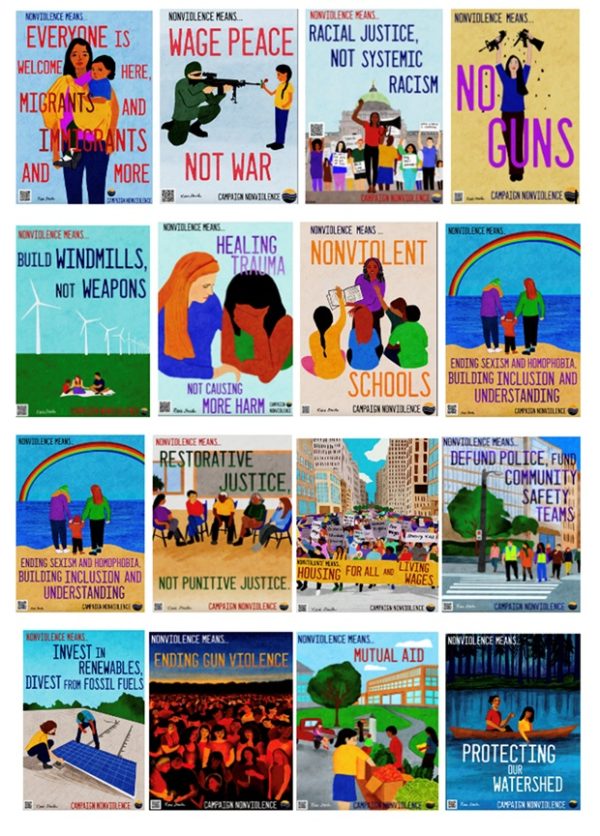
To close, I would like to share with you one artist’s approach to being an “artisan of peace.” My colleague at Pace e Bene Nonviolence Service, Rosie Davila, who decided to bring the specificity of nonviolence to life in her series of images called “Nonviolence Means….” Rosie’s work is a way for us to mull on how being “unarmed and disarming” is not only possible but so necessary in this time of crisis and opportunity. (See Ms. Davila’s images here.)
You can also see a powerful series of webinars that were streamed and recorded this past fall entitled “The World Will Be Saved By Beauty: Nonviolence and the Transformative Power of the Arts,” presented by the Catholic Nonviolence Initiative here. I invite you to experience these insightful presentations on nonviolence and the visual arts, music, film, theater, poetry and dance!
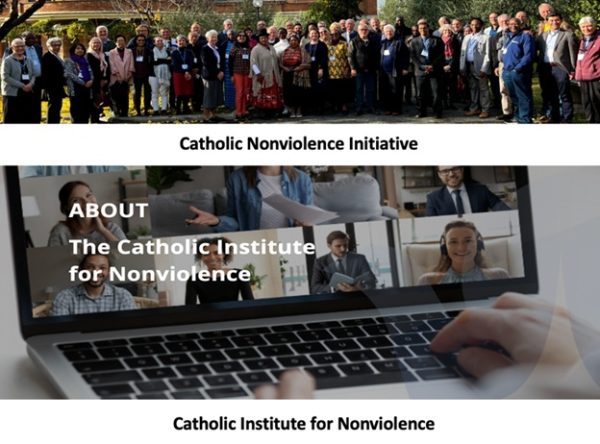
Finally, for the past decade Pax Christi International’s Catholic Nonviolence Initiative have worked to advance nonviolence in the Church and the world, all in the spirit of all of us becoming “artisans of peace”.
In 2024, with the blessing of Pope Leo, Pax Christi launched the Catholic Institute for Nonviolence. We are grateful that Dr. Emile Cuda and Cardinal Blase Cupich — presenters at this conference — are members of the institute Advisory Council. The institute’s mission is to offer the Church research and resources on the theology, spirituality, formation, and pastoral dimensions of being “artisans of peace and nonviolence.
In this time of calamity, we are all called to be “artisans of peace” bringing forth the fruit of justice and a faithful, nonviolent shift.
Thank you.
Ken Butigan is a Senior Advisor at Pax Christi’s Catholic Nonviolence Initiative and the Catholic Institute for Nonviolence. He is also a Strategic Consultant at Pace e Bene Nonviolence Service. He recently retired from DePaul University after two decades of teaching in its Peace, Justice and Conflict Studies Program.
Previous articles by Ken Butigan

Leave A Comment