
Across the globe, people of faith and peacebuilders are gathering to mark 80 years since the atomic bombings of Hiroshima and Nagasaki.
From August 3 to August 10, Giulia Bordin, Pax Christi International’s Advocacy Officer, is in Hiroshima and Nagasaki as part of the Pax Christi Korea delegation, representing our movement during this historic anniversary.
On this page, we will be collecting and sharing events, reflections, and calls to action from our global network. From local commemorations to high-level advocacy, these moments remind us of our shared responsibility to work toward nuclear abolition.
Follow updates from the ground and see how communities around the world are honouring this call to peace.
The Co-Presidents and Secretary General of Pax Christi International wrote a heartfelt message of remembrance, solidarity with the Hibakusha, and hope for a future free from the threat of nuclear weapons. Read it here.

A Journal From Hiroshima and Nagasaki
Updates from Giulia Bordin, Advocacy Officer at Pax Christi International, reporting from Hiroshima and Nagasaki. You can also follow the journey through our Instagram Stories, saved in the ‘Japan 2025‘ highlight on our profile. Click on each date below to view the full journal entry
 Yesterday we reached Hiroshima. This week, we will join commemorative and reflective moments in both Hiroshima and Nagasaki, together with our colleagues from Pax Christi Korea.
When we arrived, we were welcomed in Hiroshima by Bishop Alexis Mitsuru Shirahama, originally from Nagasaki, appointed Bishop of Hiroshima by Pope Francis in 2016. In the centre of the picture, the painting displays the words ‘Peace in the world, setting an even more meaningful tone for our stay in Japan.
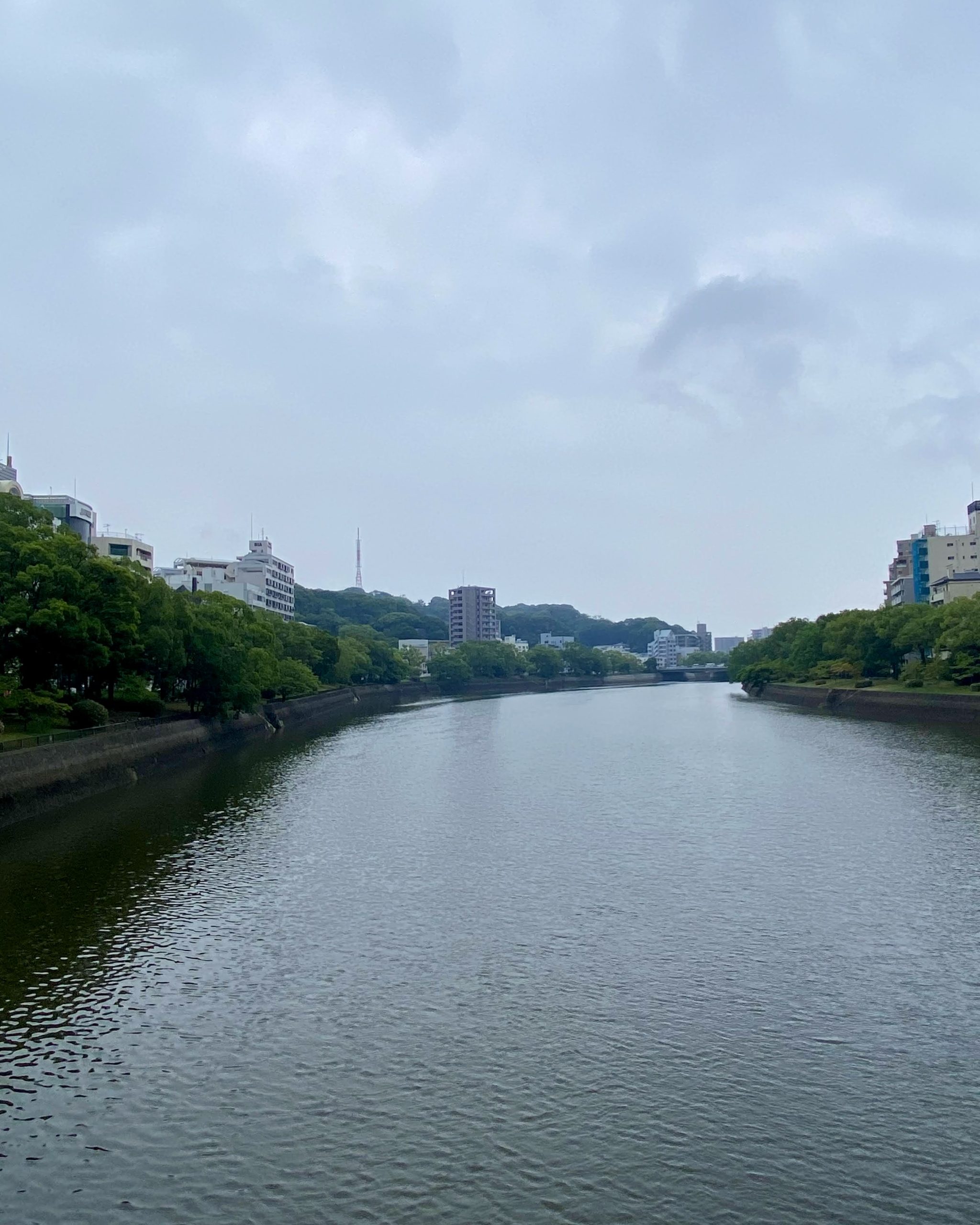
Hiroshima is called the city of rivers. However, although the water is clean, people don’t swim in them. After the atomic bomb fell in 1945, thousands fled to the rivers, burned, desperate for relief. Many died in there. These rivers became silent witnesses to immense suffering. Today, these rivers are places of remembrance and reflection. They are not just part of the city’s landscape. They are part of its memory.
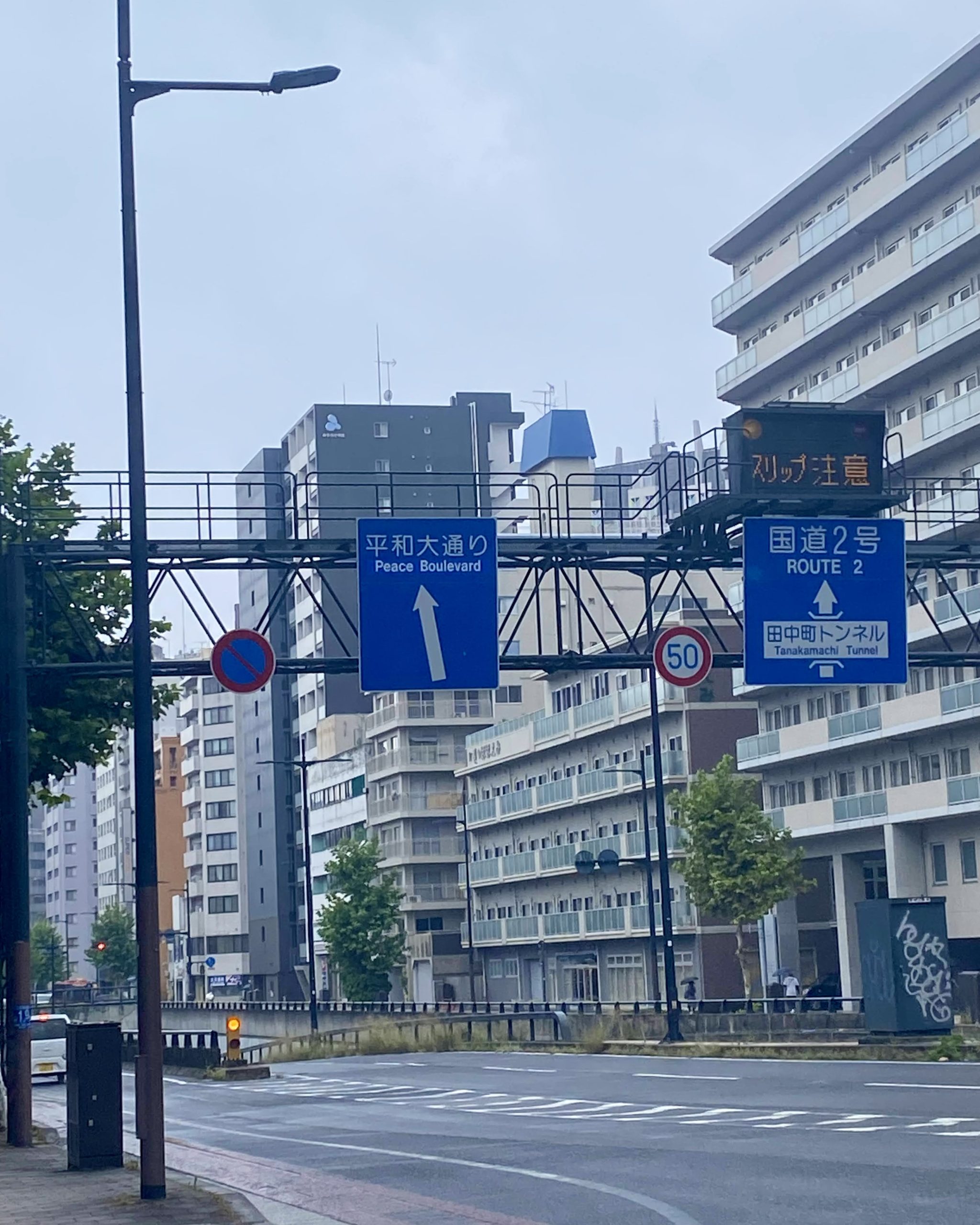
Peace Boulevard in Hiroshima was created in the aftermath of the atomic bombing as part of the city’s reconstruction. It is a firebreak to prevent future fires and also a symbol of peace and hope, connecting the Peace Memorial Park and the Atomic Bomb Dome. The area where it now stands was once densely populated but was completely destroyed. Survivors, students, and volunteers helped clear the rubble, and trees were donated from all over Japan to line the new street.
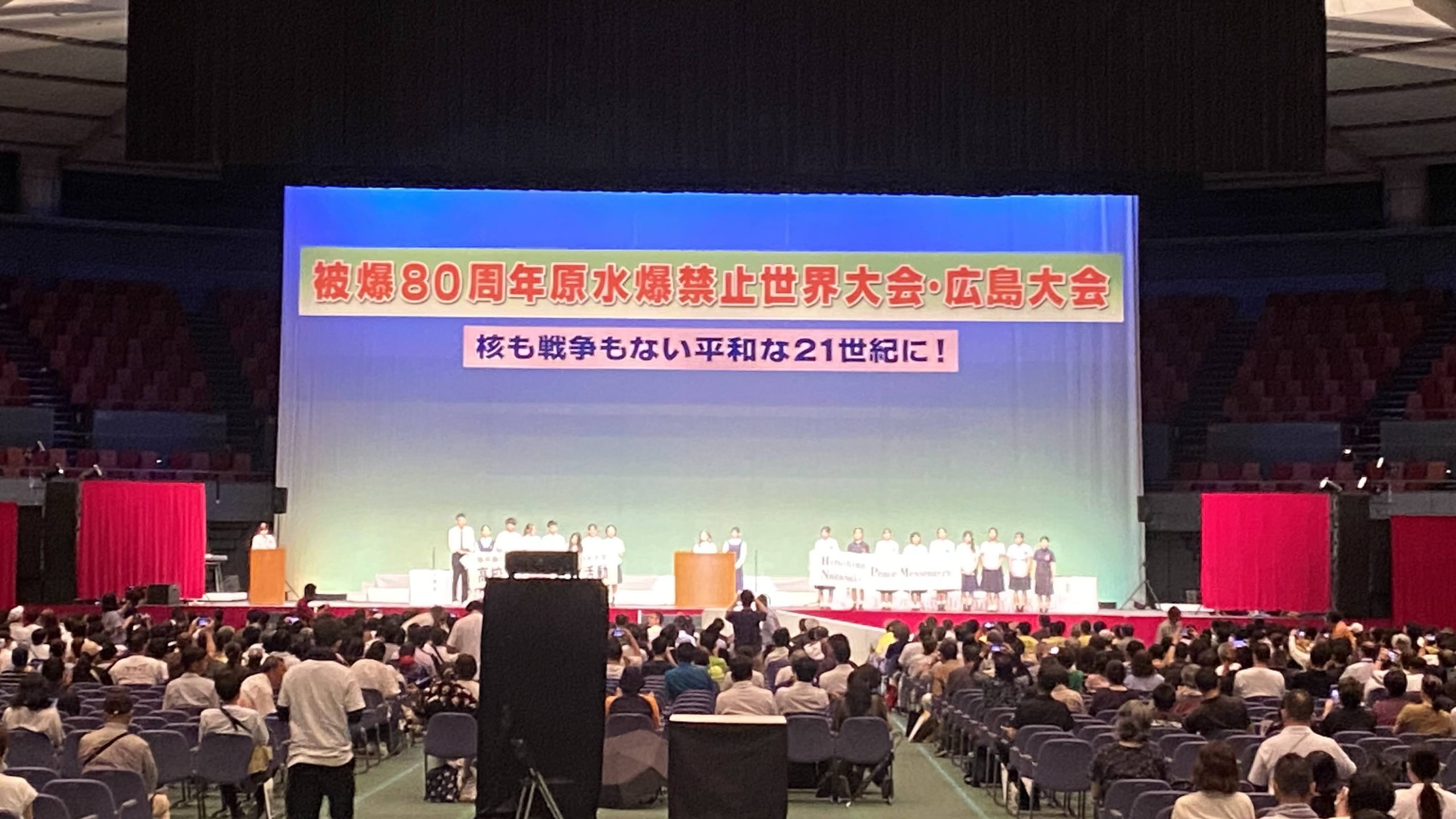
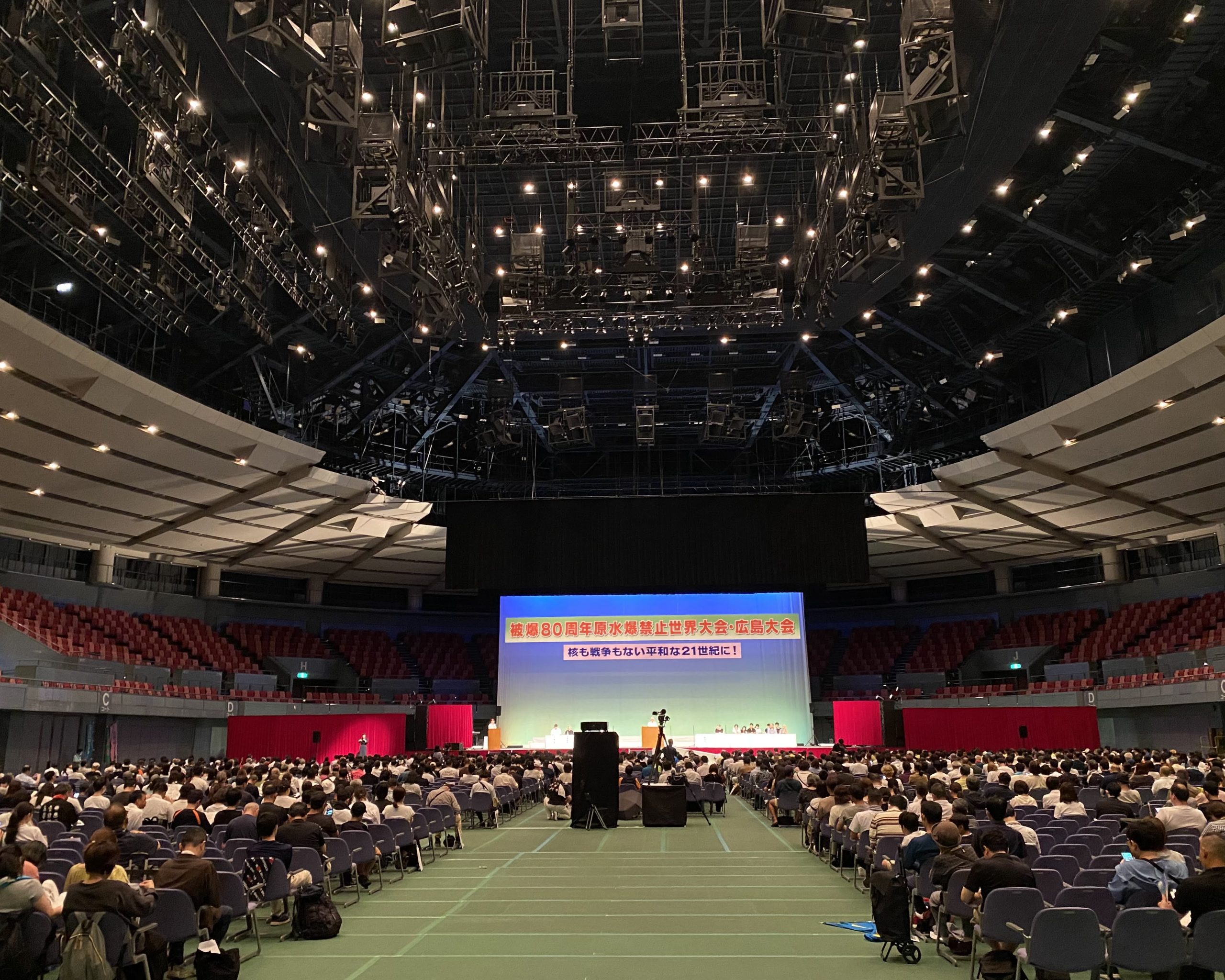
In the afternoon, we joined the 80th World Conference Commemorating the Anniversary of the Hiroshima and Nagasaki Atomic Bombings together with Pax Christi Korea. We heard the testimony of one of the Hibakusha, the survivors of the bombs explosions.
The 1000 High School Students Campaign, a group of young delegates from Hiroshima and Nagasaki who share survivors’ stories and call for a world without nuclear weapons, shared their call and objectives.
Together we sang “We Shall Not Forgive the Atomic Bomb”, a song about the suffering lived because of the bombing and the consequent necessity of a nuclear free world.


Today we started with a visit to the Hiroshima Peace memorial Park. It is located in what was once the city’s busiest downtown commercial and residential district. The park was built precisely where the explosion happened.
 The U.S. selected Hiroshima partly because of its military significance but also because it had not yet been heavily bombed, so the effects of the atomic bomb could be clearly assessed. Its terrain, flat with surrounding hills, would amplify the blast effects. Additionally, the U.S. wanted to create a “psychological impact” on Japan’s leadership and the public, in fact, at that time, Hiroshima was both a military and a civilian area.
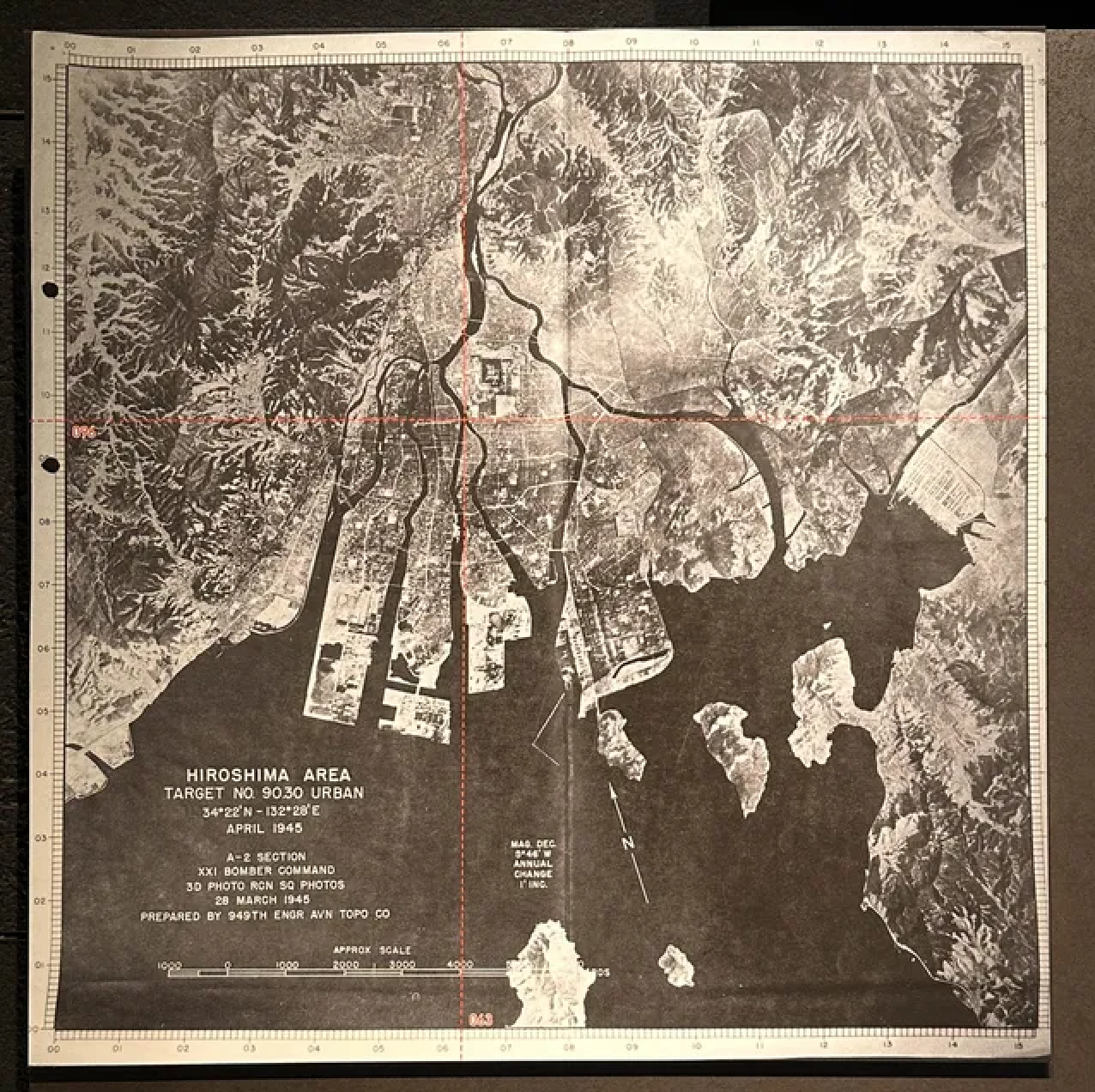
The bomb was aimed at the T-shaped Aioi bridge (see the top part of the map in the picture), but the wind caused it to fall slightly off, therefore attacking the city centre. If the goal of the U.S. in dropping the bomb was purely to end the war, dropping it after the T-mark, in a less populated area, could have reduced civilian deaths. Dropping it before, in the densely populated city center, suggests that the objective of the attack was a different one.
Additionally, the use of a uranium bomb in Hiroshima and a plutonium bomb in Nagasaki suggests the attacks may have also served as tests to observe the different effects of each type.
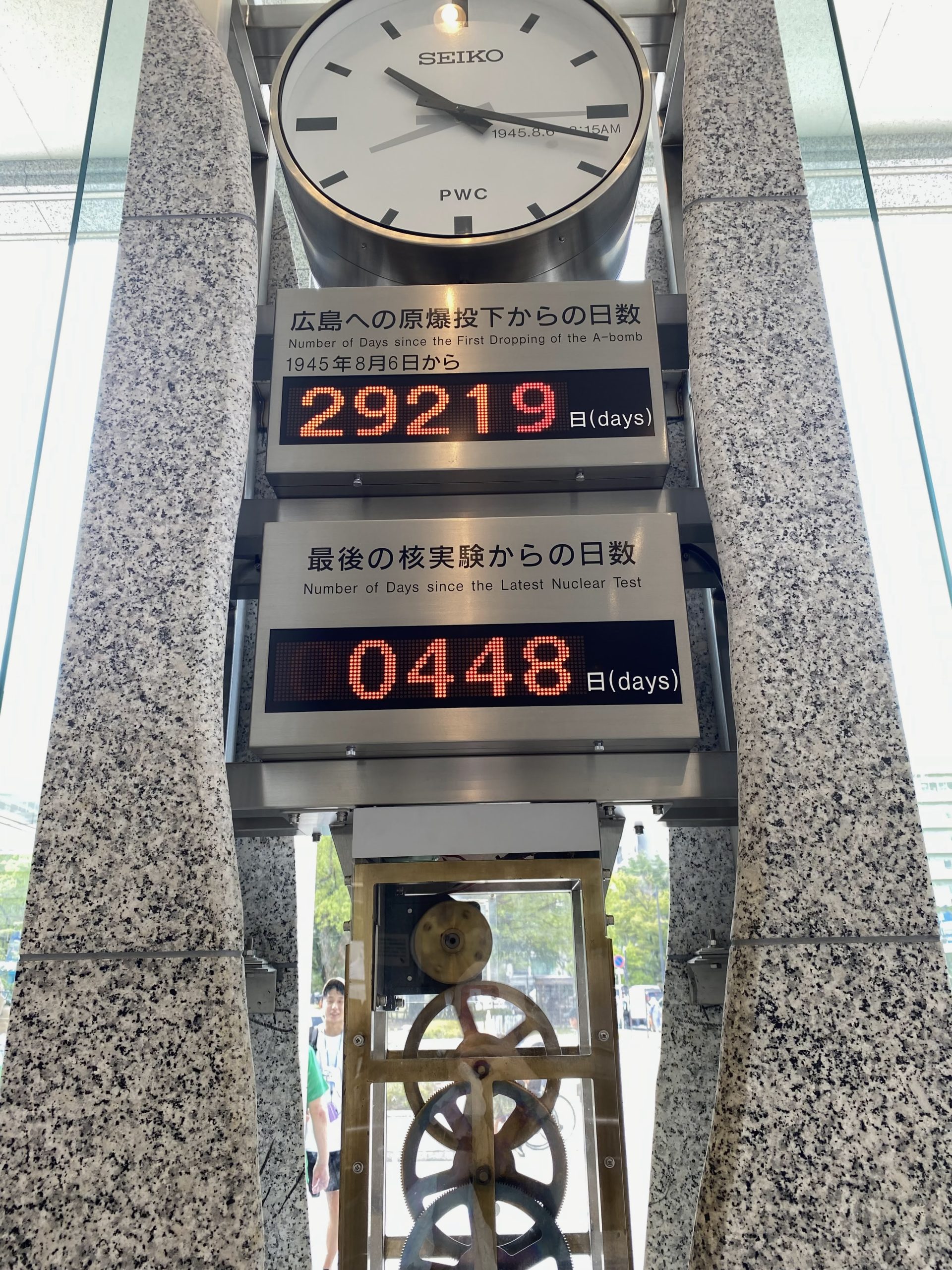
 The Peace Watch is a clock at Hiroshima Peace Memorial Museum that shows the number of days since the last nuclear test. It resets to zero if a new test occurs, serving as a reminder of the ongoing threat of nuclear weapons and the need for disarmament.
Sankichi Toge was a Hiroshima survivor and poet whose “Poems of the Atomic Bomb” (1951) vividly describes the bombing’s horrors. Despite post-war censorship, his work gained international attention at peace events like the Berlin Youth Festival, becoming a powerful voice for nuclear disarmament and peace.
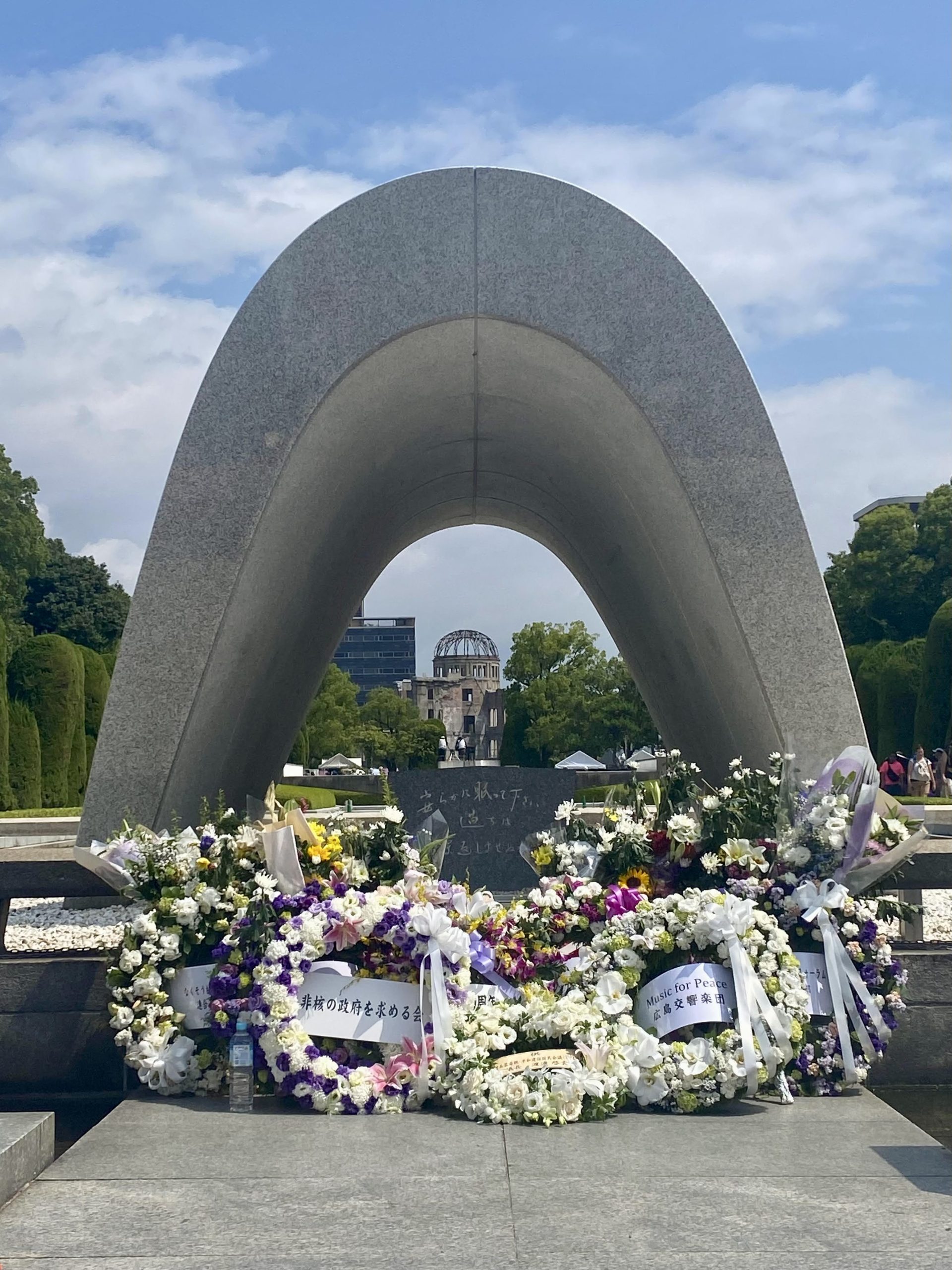 Beneath the memorial building in Hiroshima Peace Park lies a book listing the names of all those who died as a result of the bombing, including those who passed away later from related injuries or illnesses. This list is updated annually and honours victims regardless of their background.
In the stone it is engraved the phrase: “Take good rest, we will not let these wars happen again.”
The pond present behind the memorial symbolises the desperate thirst of survivors immediately after the bombing. Many victims begged for water, but people were afraid to give it, fearing it might do more harm. Later, it was understood that water could have eased their suffering, which brought deep guilt to survivors and rescuers. Offering water at the pond during the annual commemoration serves both to honour the victims’ last wish and to acknowledge this sorrow and guilt.
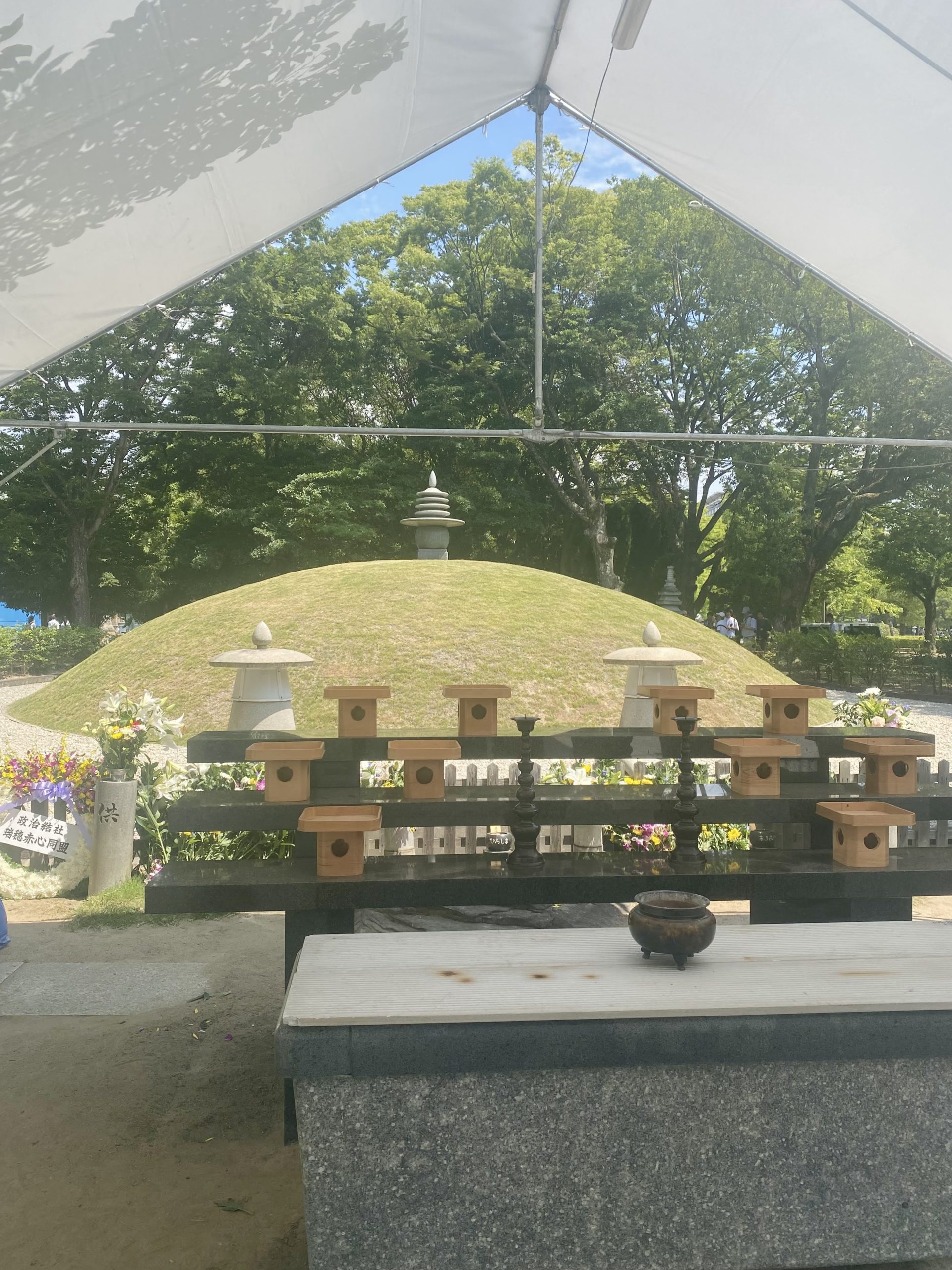
 The Atomic Bomb Memorial Mound in Hiroshima holds the ashes of thousands of unknown victims. It is a place of remembrance where interfaith commemorations are often held, promoting peace and the hope to prevent future nuclear tragedies. Many are the commemorations and events happening around the park. Many are also praying.
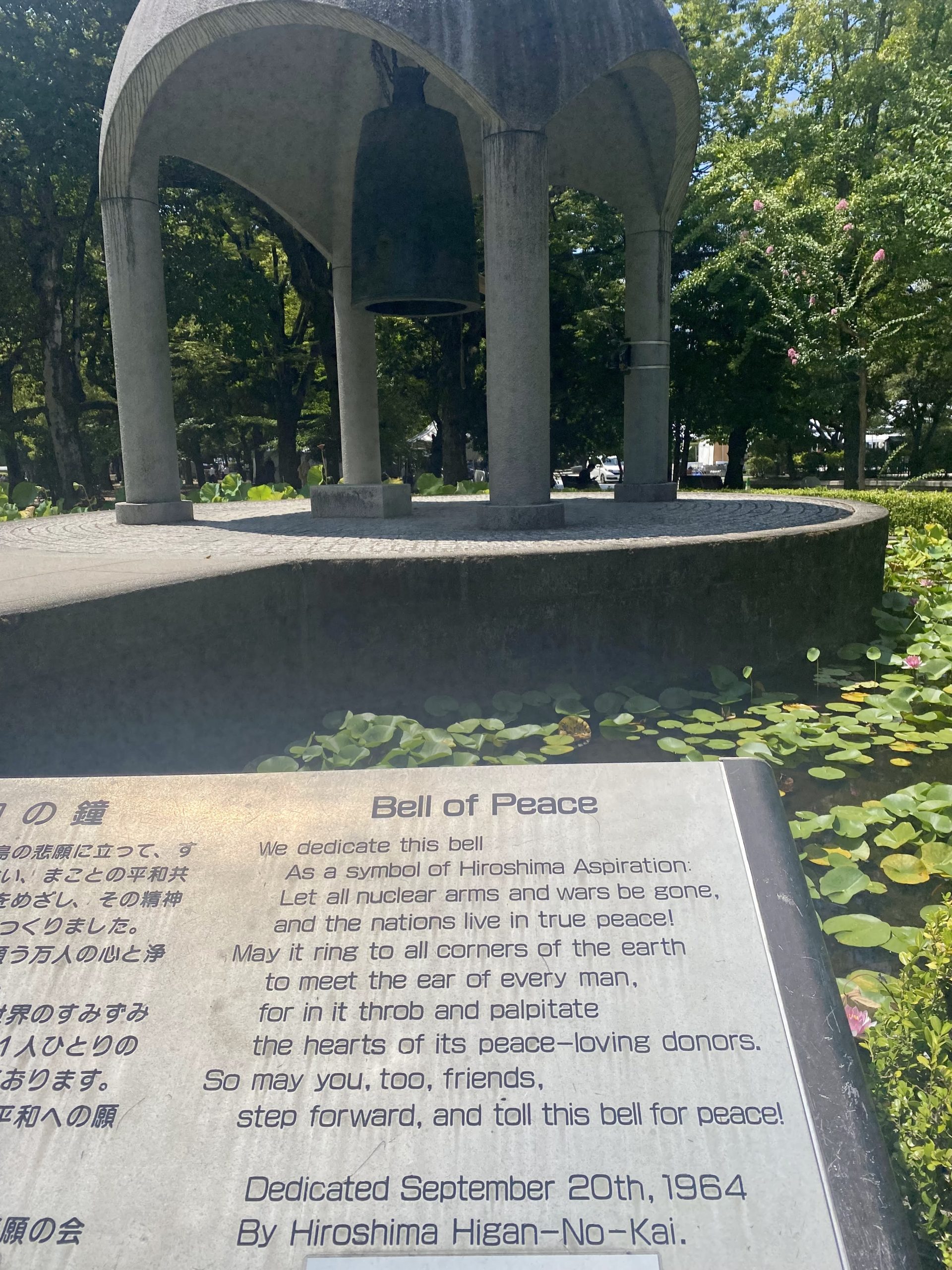
The Bell of Peace was donated by the people of Japan and the world as a symbol of hope and peace. Visitors ring the bell to pray for the abolition of nuclear weapons and for lasting world peace. Ringing the bell is a solemn act during memorial ceremonies, reminding people to remember the victims and commit to a future without war and nuclear weapons. The bell bears an inscription that reads: “Let all the souls here rest in peace, for we shall not repeat the evil“.
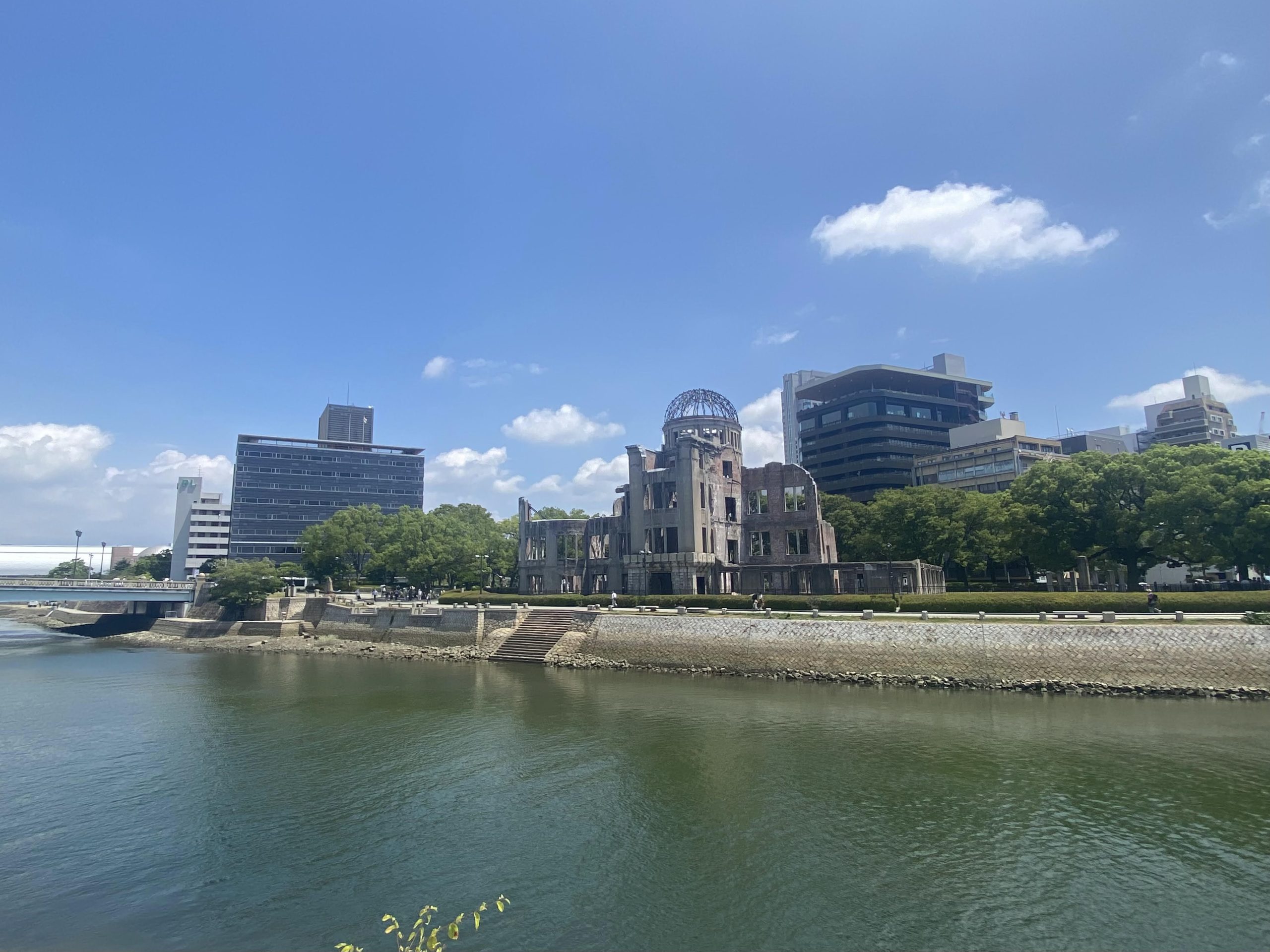
The Atomic Bomb Dome is the preserved ruin of the Hiroshima Prefectural Industrial Promotion Hall, the only building left standing near the bomb’s hypocenter.
In the afternoon, we joined a moment of reflection and commemoration organised by the Korean community. Here, every person holds a flower and deposits it at the interfaith altar to commemorate the lives lost. The interfaith moment included prayers from Catholics, Protestants, and Buddhists.


Around 70,000 Koreans, most of them forced laborers under Japanese colonial rule, were in Hiroshima and Nagasaki during World War II. When the atomic bombs were dropped in August 1945, about 20,000 Koreans died, with thousands more injured. Korean survivors faced harsh discrimination in both Japan and Korea and were largely excluded from official support and recognition for decades. Only in recent years have their experiences been acknowledged through memorials and efforts to include them in the broader history of the bombings.
Today’s update from Hiroshima ends here. Tomorrow, we will join and follow the events remembering the bombing of Hiroshima on 6 August 1945 at 8:15 AM local time.
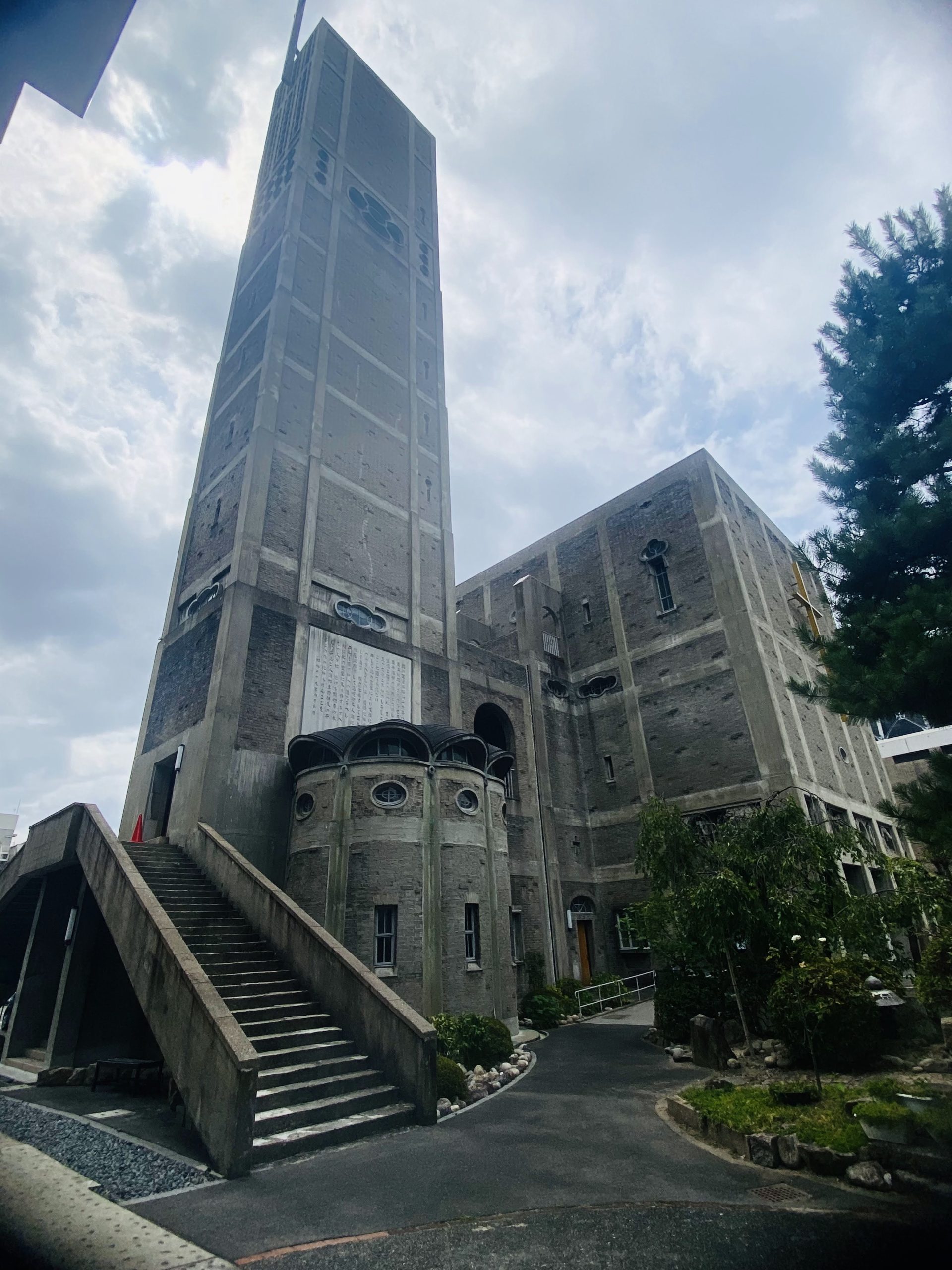 After surviving the atomic bombing of Hiroshima in 1945, Fr Lassalle envisioned a cathedral for peace. With support from around the world and Pope Pius XII, the Memorial Cathedral for World Peace was built and completed on 6 August 1954.
“This church was erected in memory of the victims of the first atomic bomb, dropped on Hiroshima on 6 August 1945, and as a sign of peace for all nations, symbolizing the true and only way that leads to peace with God and man: the way of truth, not of deception; of justice, not of violence; of love, not of hate. Therefore all who enter this church are earnestly requested to offer their prayers for the eternal repose of the departed and for peace among the peoples of the world. The sixth day of August in the year 1954.”
The cathedral has a very simple style to reflect the need to focus on praying for peace.
The Resurrecting Christ symbolises hope, renewal, and peace rising from the devastation of war, reflecting the cathedral’s mission to honour life, not just mourn loss.
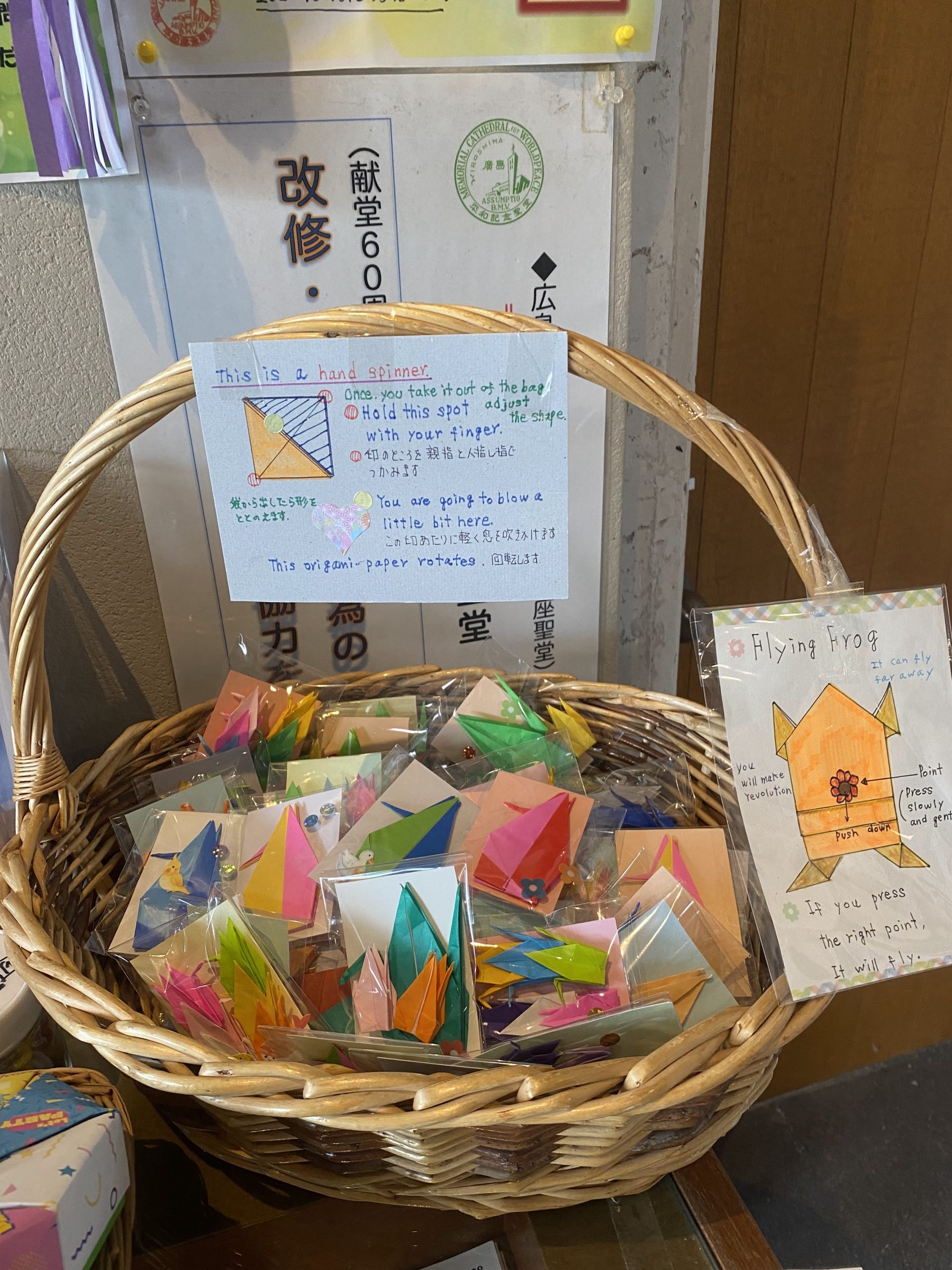
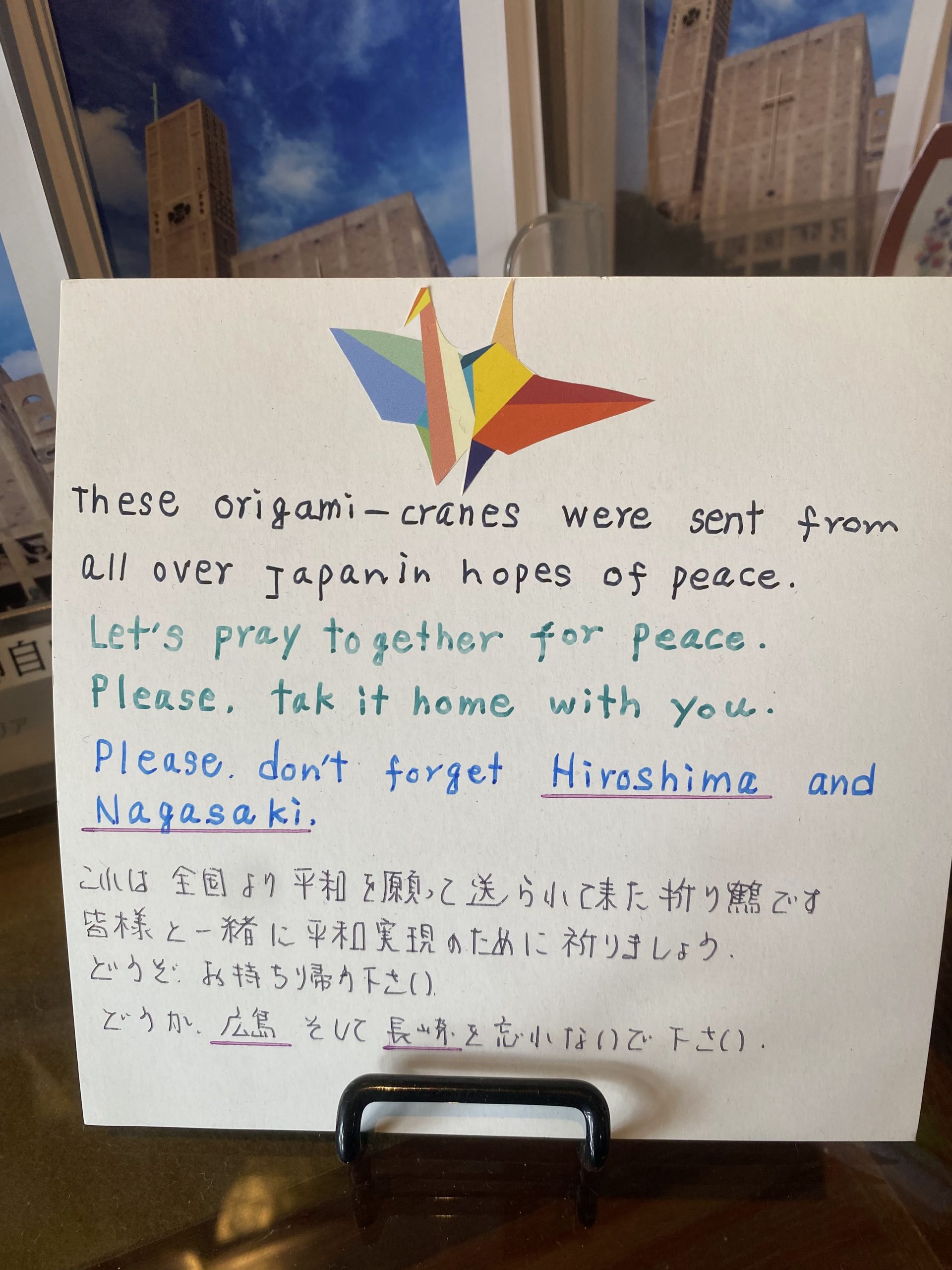
Origami cranes are everywhere in the cathedral, as a symbol of peace and hope, honouring the memory of Sadako Sasaki.

Yesterday, August 5, 2025, at the Cathedral, we attended the joint Mass liturgy of Korean, U.S., and Japanese bishops. And today, during the Mass for the Souls of Atomic Bomb Victims, a joint celebration by bishops from Korea, the United States, and Japan, we presented our joint declaration for a nuclear-free, peaceful Asia-Pacific region.


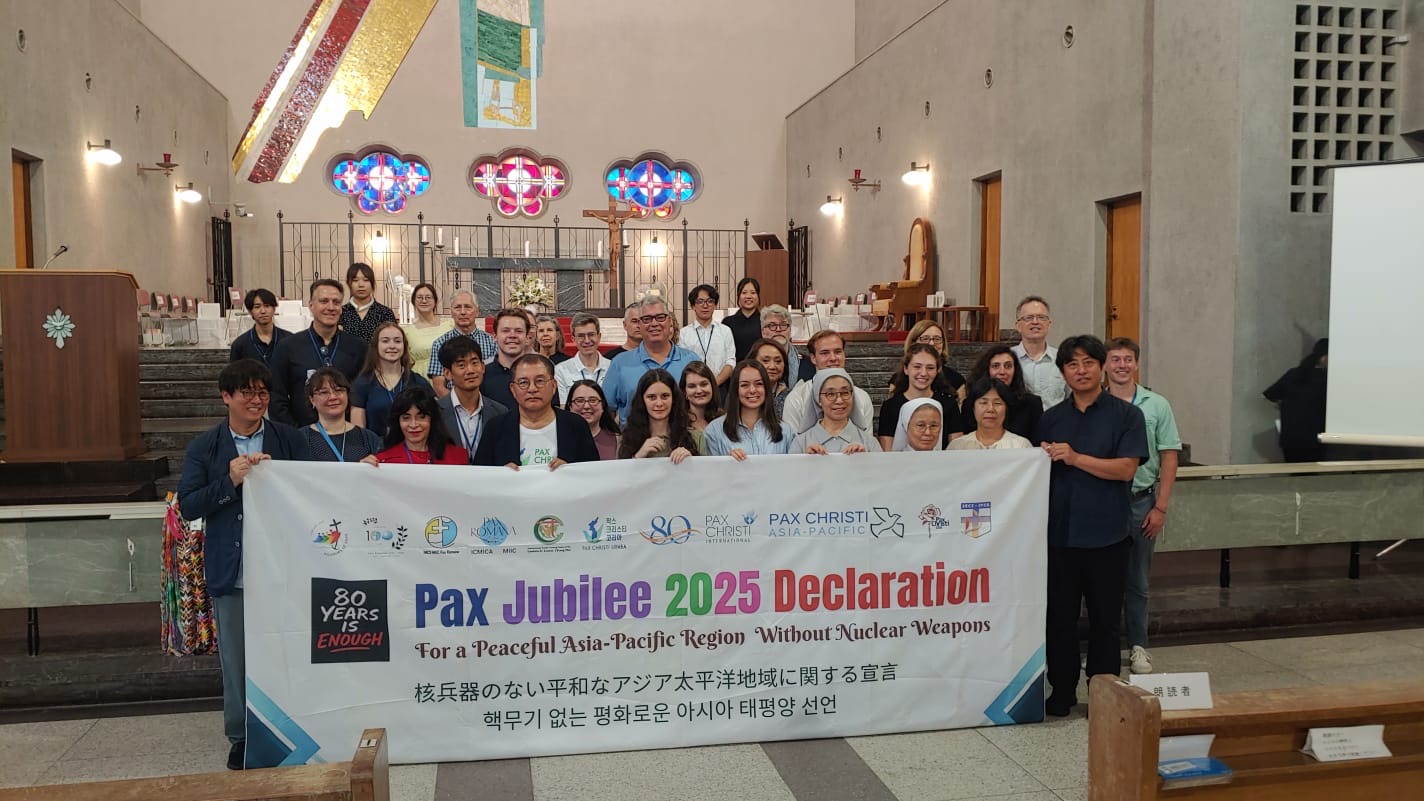
Read more on the declaration and contact us if you want to sign it.
“It is thus my prayer that this solemn anniversary will serve as a call to the international community to renew its commitment to pursuing lasting peace for our whole human family, ‘a peace that is unarmed and disarming’.” Pope Leo XIV

Anselmo Lee, Pax Christi Korea; Bishop Peter Kang, Pres. Catholic Bishops’ Conf. Korea; Giulia Bordin, Pax Christi International; Bishop Alexis Shirahama, Bishop of Hiroshima; Mariko Komatsu, SDGs Japan
In the summer of 1945, cities across Japan were being burned nightly. On 5 August, leaflets warned that Hiroshima would be next. Many fled to the hills, spending an anxious night under the stars. That night, 200 B-29 bombers (US warplanes) flew over, circled Hiroshima, then turned away.
By dawn, the air-raid alarm was cancelled. Relieved that nothing had happened the night before, citizens returned home for breakfast. Soon, workers headed to factories, students to schools. Hiroshima was full of life.
(Based on “An Appeal of All Voices” by Sankichi Toge)
On 6 August 1945, at 08:15 local time, a uranium atomic bomb dropped by the US exploded over Hiroshima.


The bomb hit 160 meters from the Hiroshima Prefectural Industrial Promotion Hall, today called the Atomic Bomb Dome, one of the few buildings left standing near the bomb’s hypocenter. The building was instantly destroyed, together with the people inside it.
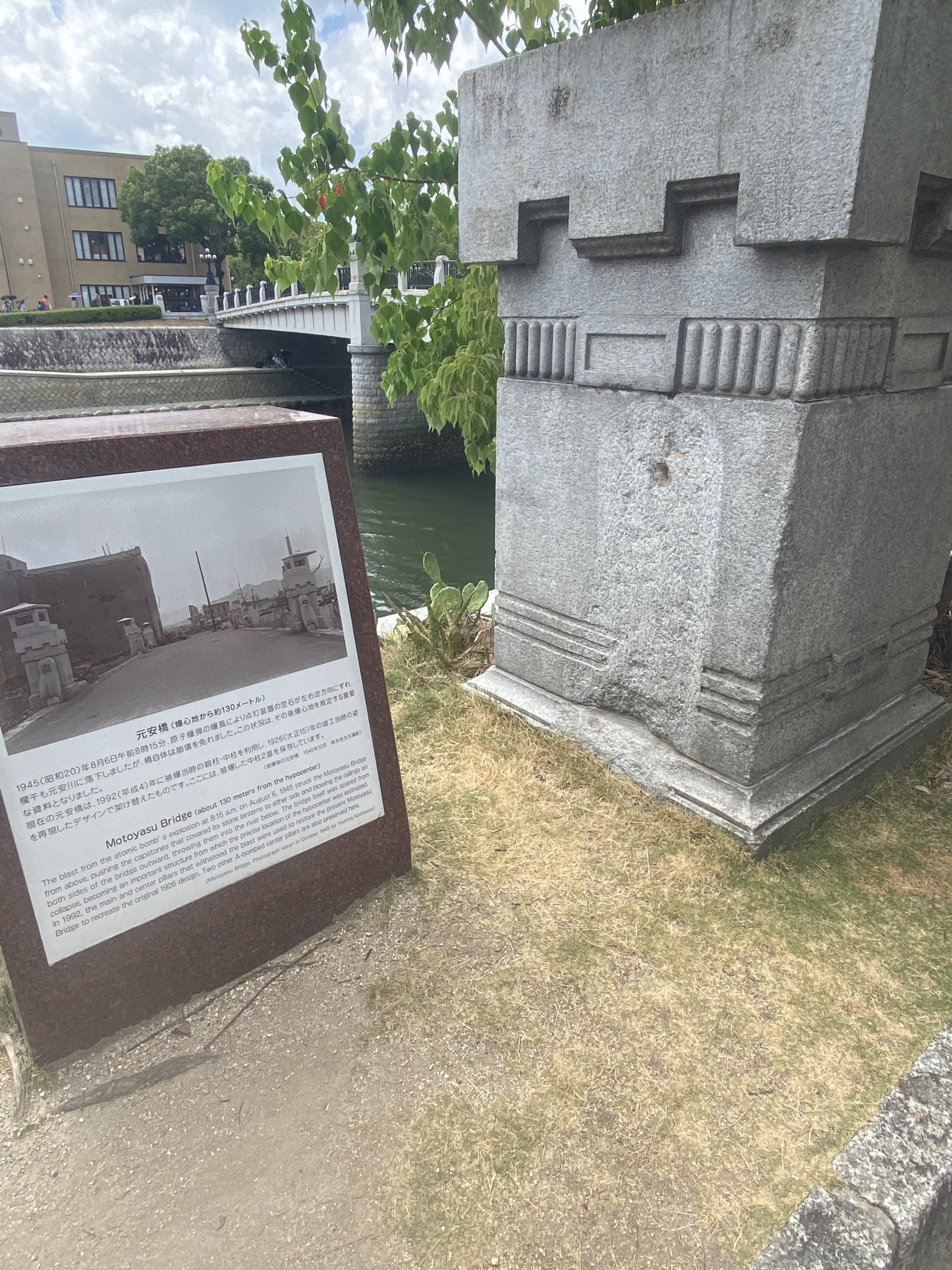 The Motoyasu Bridge is about 130 meters east of the Dome. Despite the explosion, this bridge survived mostly intact. It became a vital crossing point for rescue and relief efforts after the bombing.
The temperature at the hypocenter reached about 4,000°C, and was 1,800°C even at 1,000 meters away. Thousands of bodies were found in the river. Thousands more were buried under the rubble.
After the hit and the instant trauma, the screams of desperation started to emerge. Survivors searched desperately for water to ease their severe burns. But water was scarce, and many feared giving it might worsen injuries. The uranium bomb’s intense heat caused devastating burns, while radiation caused sickness invisible to the eye. Survivors and rescuers alike were affected. Many died within days; others lived with painful radiation illnesses for years. Some effects are still visible today.
Before 1946, the full human impact of the atomic bomb was largely silenced due to wartime censorship and post-war restrictions. That changed when the newspaper Peace Front was published in 1946, one of the first to openly expose the bomb’s cruelty and share survivors’ stories. They also published the famous and inspiring poem by Sankichi Toge, August 6th:
“We will not forget.
We will never forget the fire that burned the city, the sky that rained death.”
In the 1950s, peace movements grew worldwide, opposing atomic and hydrogen bombs.
Their efforts helped prevent nuclear weapons from being used in the Korean and Vietnam wars.
Today, in a world where nuclear weapons still threaten humanity, peace movements remain vital, reminding us that only collective action can build a safer, peaceful future.
And thanks also to the power of togetherness, the origami crane became the symbol of hope and peace after these atrocious attacks.
But why?
 Sadako Sasaki was just two years old when the atomic bomb fell on Hiroshima. She survived the blast but later developed leukaemia caused by radiation exposure. While hospitalised, Sadako began folding origami cranes, inspired by a Japanese legend that folding 1,000 cranes grants a wish. She wished for healing and peace.
Though she passed away at 12, Sadako asked her classmates to continue folding cranes to spread hope and to call for a world without nuclear weapons.
The Children’s Peace Monument in Hiroshima honours Sadako and all child victims. The bell’s surface, shaped like an origami crane, is inscribed with: “A thousand paper cranes” and “Peace on the earth and in the heavens,” written by Nobel laureate Dr. Hideki Yukawa, Japan’s first Nobel Prize-winning physicist and a committed advocate for peace.
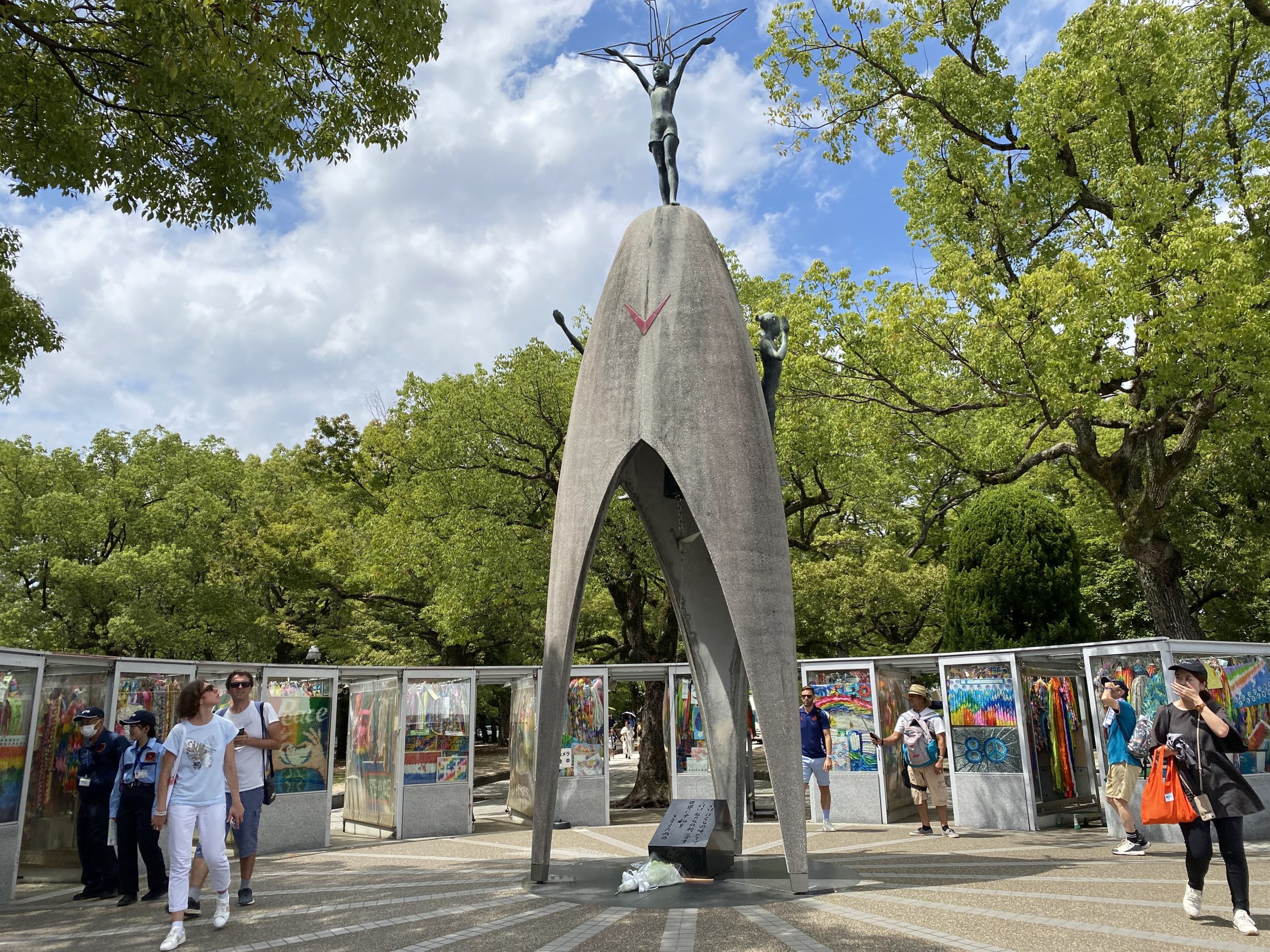
Engraved on the monument’s stone is the phrase:
“This is our cry.
This is our prayer.
For building peace in this world.”
Eighty years after Hiroshima, the call to speak out and act against violence and injustice remains urgent. And there is still much to be done.
The atomic bomb dropped on Hiroshima in 1945 had a blast yield of about 15 kilotons, devastating the city and killing tens of thousands. Between October 2023 and May 2025, over 100,000 tons of explosives were dropped on Gaza, far exceeding Hiroshima’s blast in sheer volume.
This is why we believe in a world free from nuclear weapons, where war is not seen as inevitable, and where nonviolence is always considered a valid and powerful option.
Together, let’s make Sadako’s dream a reality, for the generations of today and tomorrow.
Every year on this day in Hiroshima, thousands of paper lanterns are gently floated down the Motoyasu River, near the Hiroshima Peace Memorial Park, in a solemn ritual known as Toro Nagashi.
This ritual is rooted in traditional Buddhist and Obon customs, where lanterns are used to guide the spirits of the dead back to the afterlife.
Each lantern is inscribed with messages of peace, prayers, or the names of lost loved ones. As they drift down the river, they symbolise the souls of those who perished in the bombing being guided to rest.
In recent years, messages of peace have also been projected into the sky during the ceremony. In the pictures below, you can see a dove holding an olive branch and an origami crane, universal symbols of peace and hope.


It is also possible to take part in the ceremony virtually, by lighting a digital lantern. We lit one on behalf of Pax Christi International.
The gentle drifting of the lanterns expresses not only remembrance and the souls being guided to peace, but also the hope for a world free of nuclear weapons. And that hope continues to float into the future.
Today, we are leaving Hiroshima and continuing our journey toward Nagasaki. Meanwhile, let us delve further into the evolution of a nuclear attack, drawing on the testimonies of the Hibakusha and historians.
As nuclear weapons remain a present and pressing reality in today’s world, understanding their devastating effects is more important than ever.
Bearing witness to their human and historical impact may help strengthen the call for their total abolition.
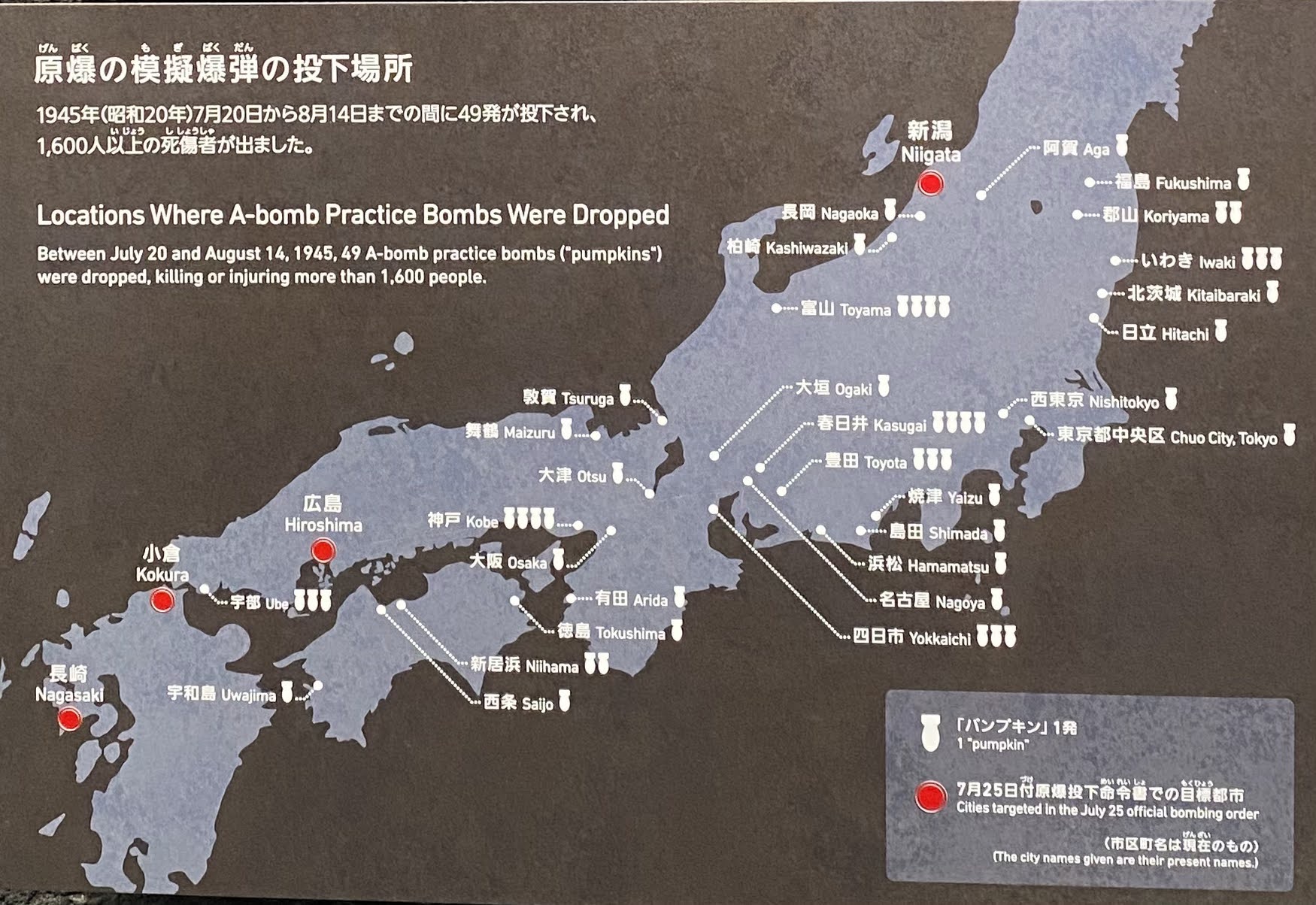
To prepare for the use of the atomic bomb in combat, a special bomb unit was organized, and a series of training sessions was conducted in a desert in the United States. In 1945, the unit moved to Tinian, one of the Mariana Islands. For more realistic training and to help bombardiers familiarize themselves with local geography, A-bomb practice bombs (called “pumpkins”) were dropped on Japanese cities.
The Target Committee, comprising military and scientific experts, met in April and May 1945 to select atomic bomb targets. From an initial list of 17, they narrowed it down to Kyoto, Hiroshima, Yokohama, and Kokura, based on factors like city size, topography, and psychological impact.
With President Truman’s approval, the Interim Committee was formed in May and met in June. They decided the bomb should be used on “a war plant surrounded by workers’ homes” and that it be used without prior warning. Some scientists opposed this, submitting a report urging restraint, but the committee maintained its position.
Before dawn on August 6, weather planes flew from Tinian Island to Hiroshima, Kokura, and Nagasaki, followed by three B-29s: the Enola Gay with the bomb, an observation plane, and a photography plane. With clear skies over the primary target, the Enola Gay proceeded to Hiroshima and dropped the atomic bomb at 8:15 AM, exploding 600 meters above Shima Hospital.


The atomic bomb dropped on Hiroshima was packed with enriched uranium containing around 50 kilograms of uranium-235. However, the cube in the picture below (left side) represents the amount of uranium-235 that actually underwent fission, somewhat less than one kilogram. You can also see the size of the bomb dropped on Hiroshima compared to the height of an adult and a child.

The explosion took seconds to create immediate and long-term devastation in a large area.
What happened in seconds
🔴 0–1 second: Approximately 70,000–80,000 people died instantly from the blast, heat, or were vaporized.
🔴Minutes to hours: Thousands more died from burns, injuries, and collapsing buildings.
🔴 Days to weeks: Many died from acute radiation sickness (vomiting, bleeding, weakness).
🔴 Months to years: Long-term deaths followed from cancer and radiation-related illnesses.
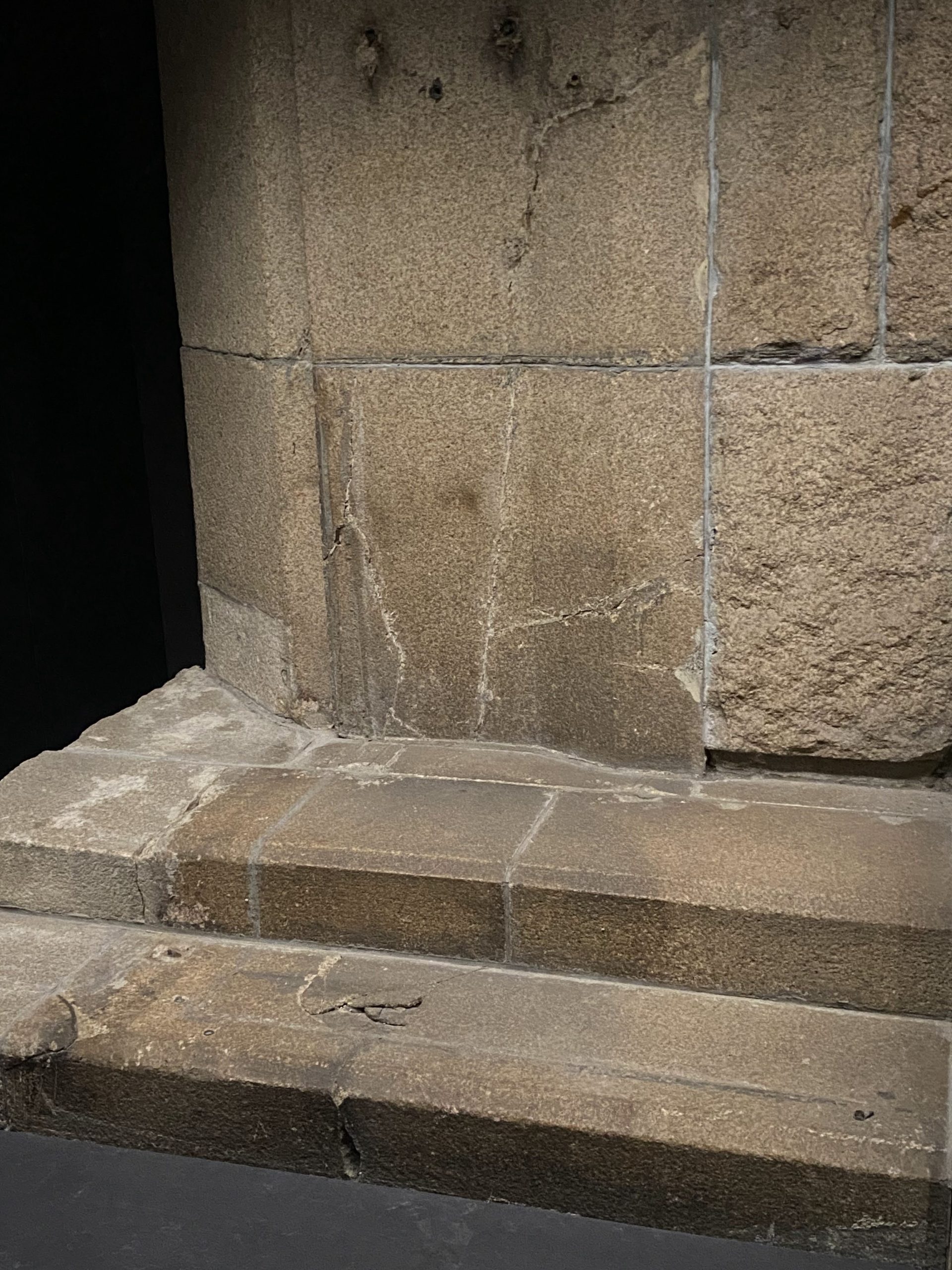
These stone steps (picture on the left) were at Hiroshima’s Sumitomo Bank entrance. A person sitting there during the blast died instantly. The intense heat turned the steps white, but the spot beneath them stayed dark, like a shadow.
After the atomic bomb exploded, a dark rain, called black rain, fell over the city. This rain was mixed with dust, ashes, and radioactive particles from the blast. People caught in the black rain were exposed to harmful radiation, which caused sickness and long-term health problems. The rain also polluted the land and water around Hiroshima.
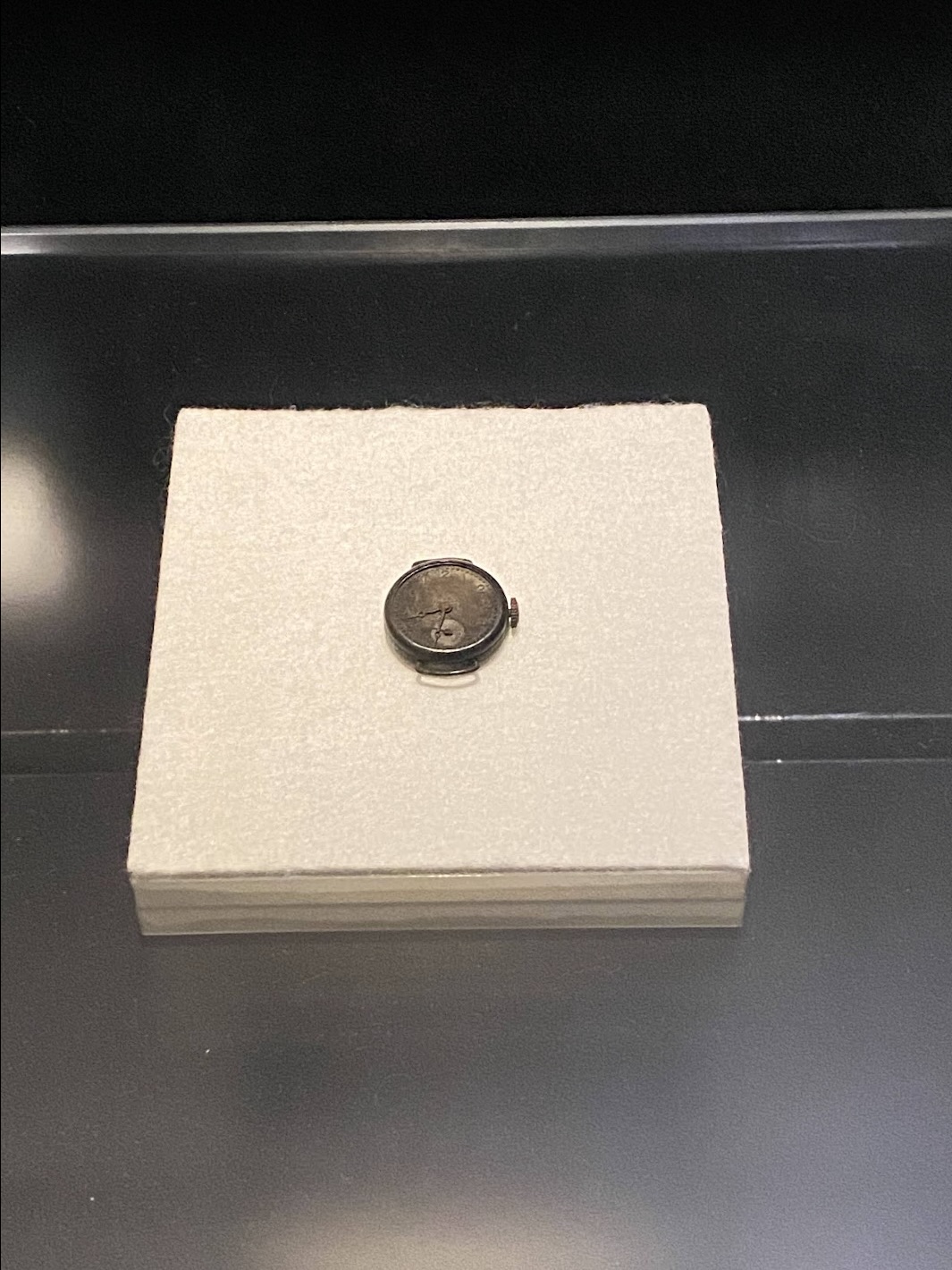
Itsu Ishii, 49, was demolishing buildings when the atomic bomb hit. Her son, Shigetoshi, 19, found her badly burned in the river and tried to carry her to a hospital, but she died on the way. The wristwatch she wore (third picture) stopped at 8:33 AM, the moment of the blast. “My brother found our mother in the river, her upper body badly burned. As he swam with her on his back toward the hospital, she died before they could reach the shore.” Michiko Ishii
No one is safe in the event of a nuclear explosion. Even those bringing aid were injured, yet still wished, and had, to provide assistance.
Nuclear weapons, and their unsustainable consequences if used, still constitute a major threat to humanity’s existence.
What Can You Do?
Support ICAN and the TPNW
ICAN is a global campaign that helped create the Treaty on the Prohibition of Nuclear Weapons (#TPNW), the first international law banning nuclear weapons. Support it by spreading the word, signing petitions, and urging your leaders to sign the TPNW!

Support Mayors for Peace
Mayors for Peace is a network of cities calling for a world without nuclear weapons. Encourage your city to join! Local voices matter and help build global pressure.

Support local initiatives
Local initiatives such as Green Legacy Hiroshima, a global initiative that distributes seeds from trees that survived the atomic bombing of Hiroshima. These “hibaku-jumoku”, silent witnesses to the devastation, carry the memory and message of the hibakusha: of suffering, resilience, and hope. By planting them around the world, GLH offers a living symbol of peace and a heartfelt reminder never to repeat the horrors of nuclear war.

Join Our Advocacy Efforts
Take part in our initiatives and events. Follow us and share the message.
Together, we can build a future free from nuclear weapons!

Last night we reached Nagasaki, Japan.
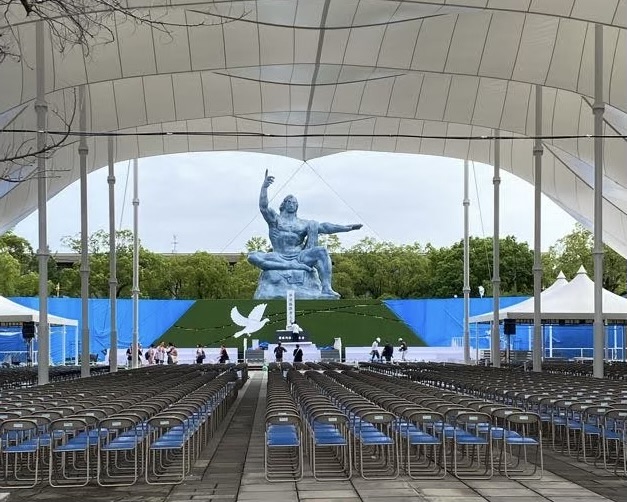
The Peace Statue‘s right hand indicates the threat of nuclear weapons, while the left one symbolises peace, and his closed eyes express prayerfulness for those who are victims of war. The Peace Park is preparing to host tomorrow’s commemoration ceremony.
-

- Peace Statue
-

- Peace Park
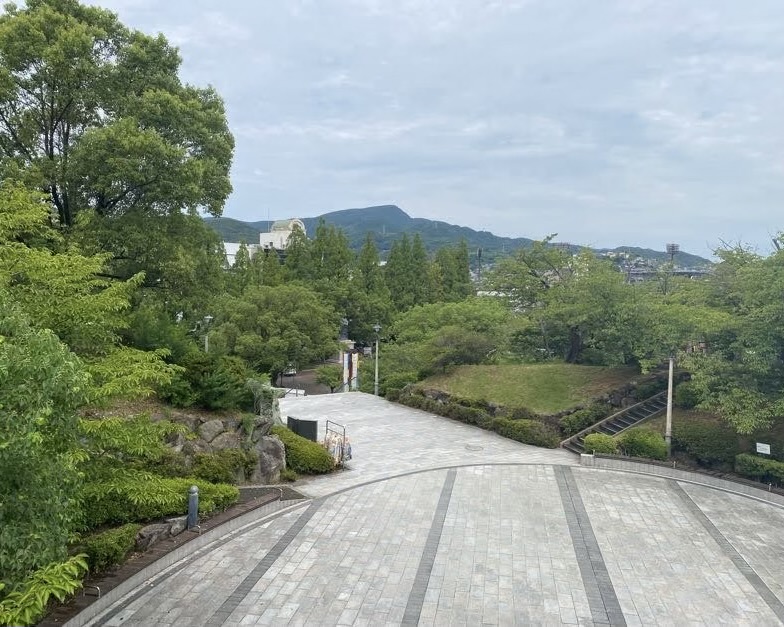
On 9 August 1945, a plutonium atomic bomb detonated about 500 metres above northern Nagasaki. The explosion killed an estimated 40,000 people instantly.
Within seconds, scorching temperatures and an expanding fireball triggered infernos, inflicting burns up to four kilometres away. The blast wind flattened buildings and hurled debris across the city. Radiation proved deadly even to those uninjured, killing most within a kilometre, and lasting health effects persisted in survivors for decades.
Nagasaki, a mountain-ringed port on Kyushu’s western tip, had a long history as a gateway for foreign trade.
On 9 August 1945, after cloud cover hid its primary target of Kokura, the B-29 Bockscar turned to Nagasaki. Through a gap in the clouds, the crew spotted the Mitsubishi Nagasaki Arms Factory and released the world’s second atomic bomb.
The bomb was detonated about 500 metres above Nagasaki deliberately. An airburst at that height was calculated to cause maximum destruction.
Indeed, when a nuclear weapon explodes in the air rather than on the ground:
1. The blast wave spreads farther because it radiates outwards in all directions before hitting the ground, covering a much larger area.
2. Heat rays travel unobstructed, igniting fires across the city.
3. Radiation is dispersed widely, increasing casualties over a broader radius.
4. A ground burst, by contrast, would waste much of its energy digging a crater and hurling earth into the air, causing less widespread structural damage.

In Nagasaki’s case, 500m was chosen based on calculations from the Hiroshima bombing three days earlier, to optimise the bomb’s effect on buildings and people across the hilly city.
“Let’s ring the Nagasaki Bell for world peace!” – The Nagasaki Hibakusha Certificates Friend Association (established in 1967) erected this Nagasaki Bell on August 5, 1977, based on the Angelus bell of Urakami Cathedral, in order to mark Nagasaki as the last city to be hit by an atomic bomb.
“The Nagasaki Bell is a symbol of our oath never to cause war. As the last city to experience an atomic bomb, we pray that peace will spread throughout the world in concentric circles from our city with the ringing of the Nagasaki Bell, and we hope that you will spread the word as well.”
-

- Nagasaki Bell
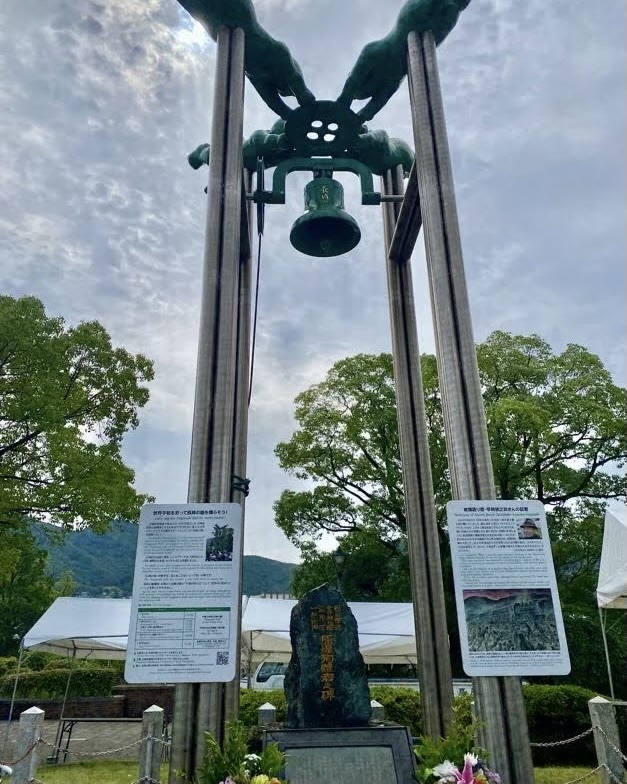
-

- Urakami Cathedral

Urakami Cathedral, the grandest church in East Asia at the time, was located on a small hill about 500 metres northeast of the atomic bomb hypocenter.
The explosion of the atomic bomb destroyed it; only a wall remained.
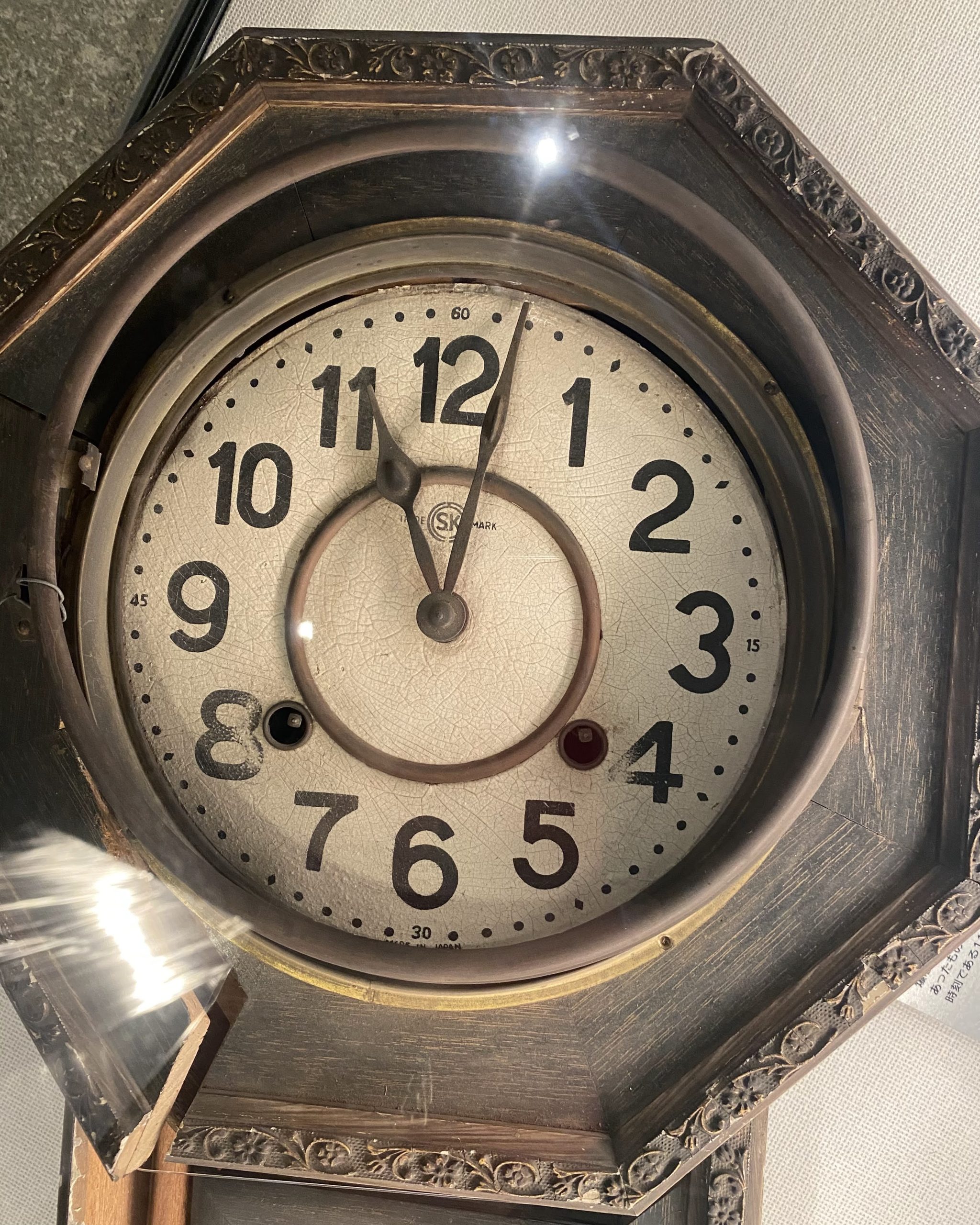
At 11:02am, on the 9th August 1945, a plutonium atomic bomb exploded approximately 500m above the location of this monolith (pictured on the left below). In addition to origami cranes, white flowers are left on memorials to remember lives lost.
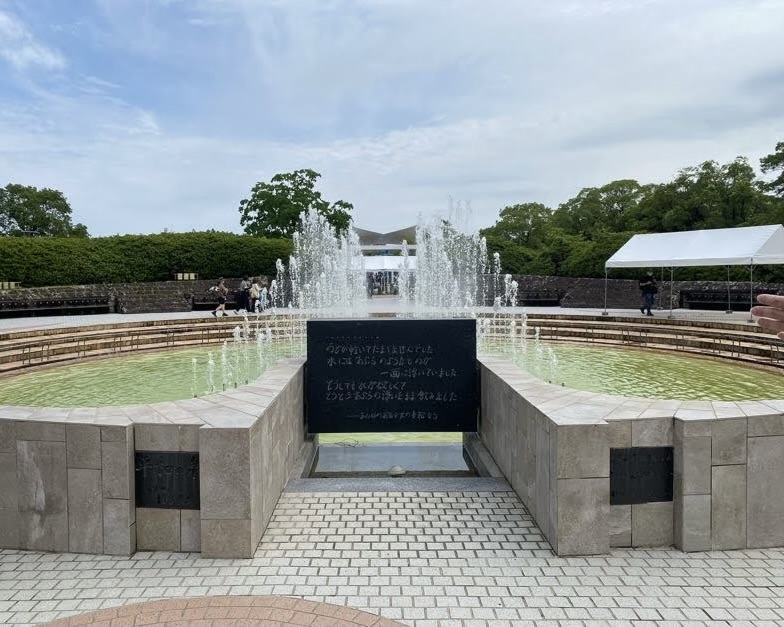
The connection with water is very strong also in Nagasaki. This fountain (pictured on the right below) is a place to pray for those victims who passed away whilst begging for water.
The ever-changing shape of the water evokes the beating wings of the dove of peace and the crane. The crane is representative of Nagasaki Port, which is known as the “Crane Port” because of its shape.
-

- Nagasaki Hypocenter

-

- Nagasaki Peace Park
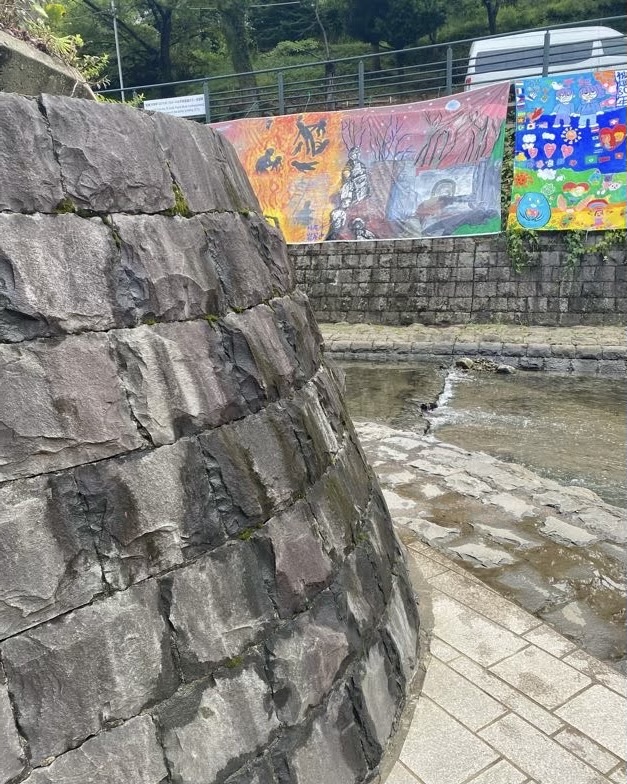
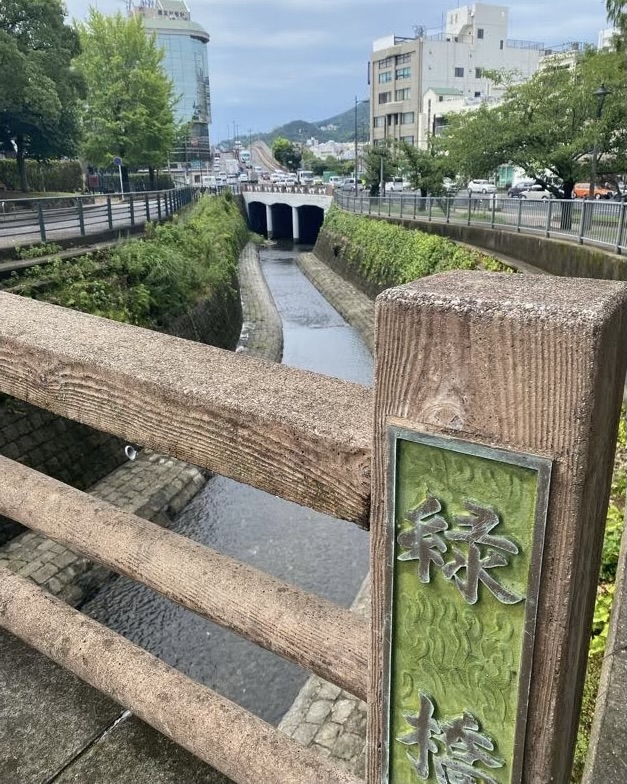
During the bombing, rivers like the Nakashima provided water for survivors to cool burns and escape fires, though contamination made survival difficult.
Today, along the riverside memorials, posters made by students, as large as Picasso’s Guernica, educate visitors on the bombing’s impact, water’s vital role, and messages of peace.
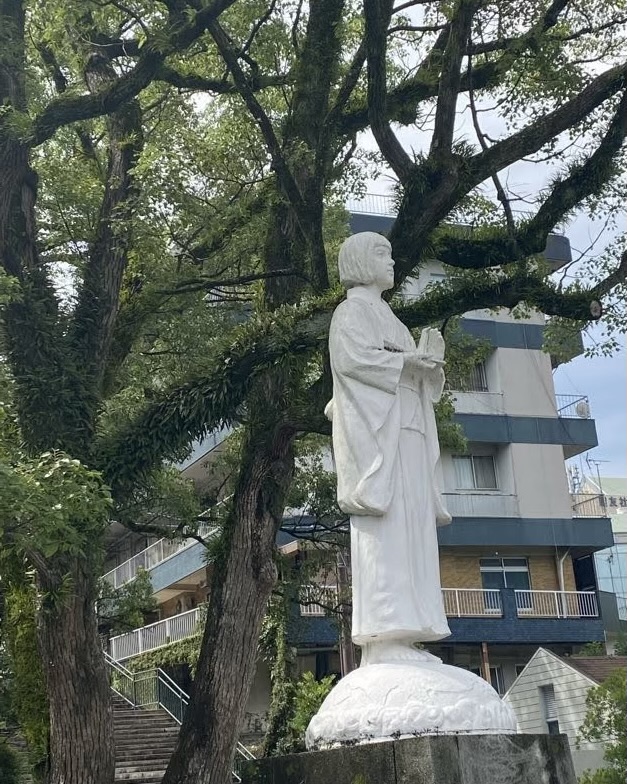
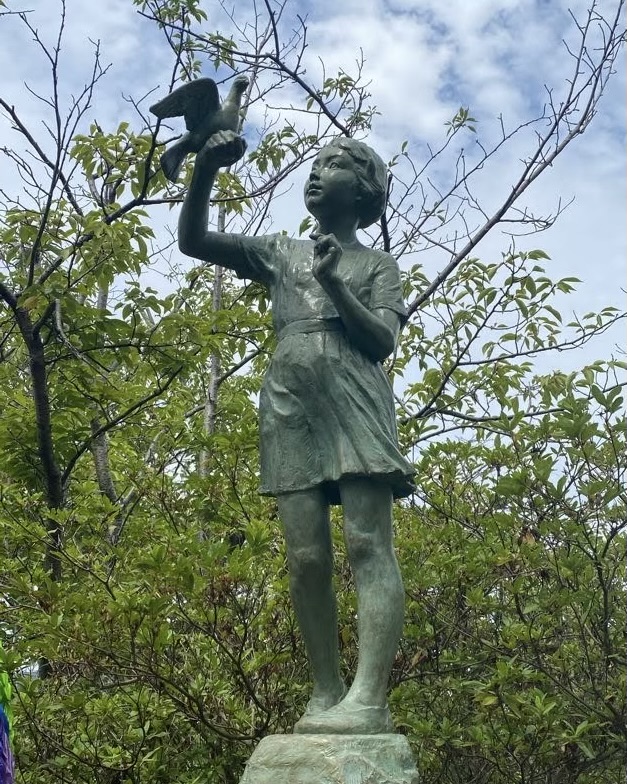
The bombings devastated families, leaving many children orphaned and survivors facing stigma. Schools were destroyed, disrupting education and serving as shelters. Surviving children suffered lasting health problems and trauma, but many became peace advocates. Memorials and education programmes in Hiroshima and Nagasaki honour their stories.
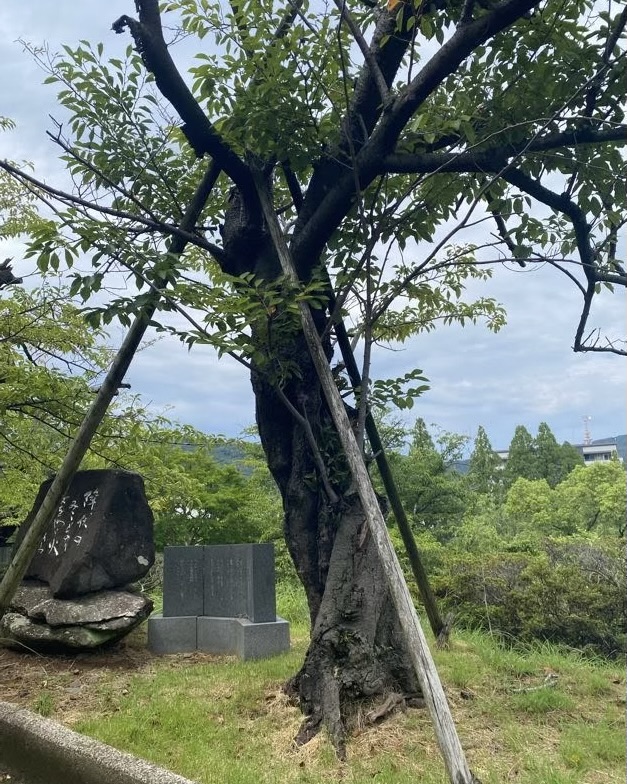
About 50 trees in Nagasaki, known as hibakujumoku, survived the atomic bombing in 1945 despite severe damage. They are protected as a natural monument and as living beings who carry the trauma of the bombing with scars on their trunks.
As the hibakusha age and sadly pass away, these trees keep reminding future generations of the bombing’s impact and the resilience of life. They offer a lasting, natural legacy that embodies hope, healing, and peace. They play a vital role in keeping the memory and lessons of the hibakusha alive.
The Nagasaki Kusunoki Project protects these hibakujumoku, raising awareness of their history and the effects of atomic bomb radiation to pass on a message of resilience and hope for peace to future generations.
“Our stories live on to remind the world to choose peace.” – Masahiro Kobayashi, Hibakusha from Nagasaki
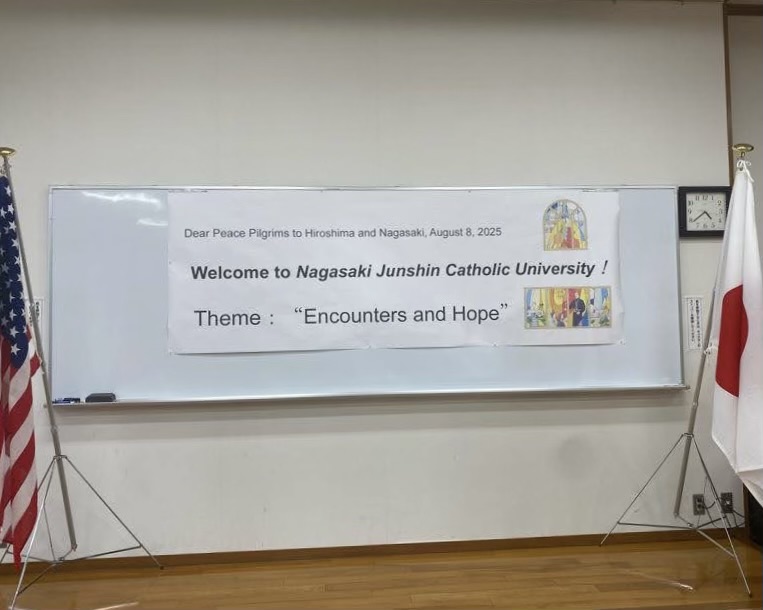
In the afternoon we joined as listeners one of the sessions organised jointly by U.S. and Japanese universities. Approximately 30 students spent the week together between Hiroshima and Nagasaki, while sharing moments of reflection and dialogue. A report on their results will be shared soon.
We were able to join briefly a Civil Society Talk, which featured Melissa Parke, Executive Director at ICAN.

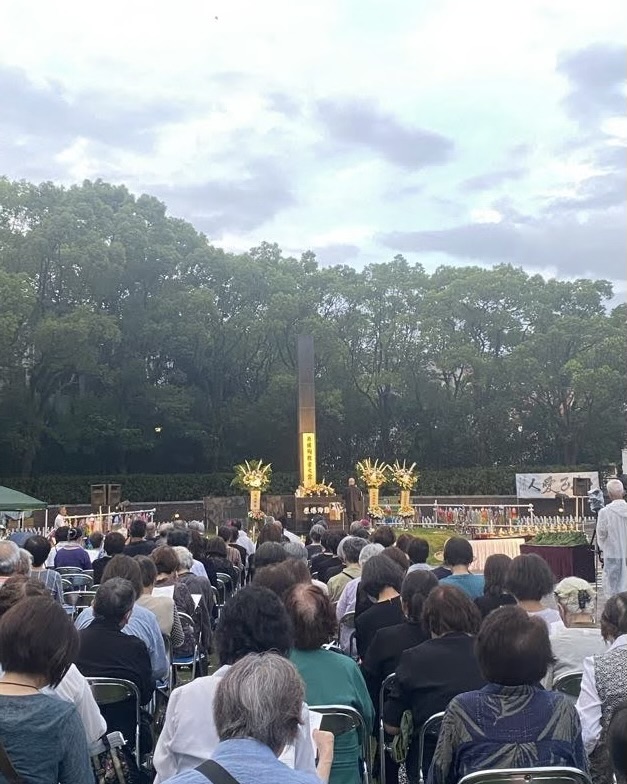
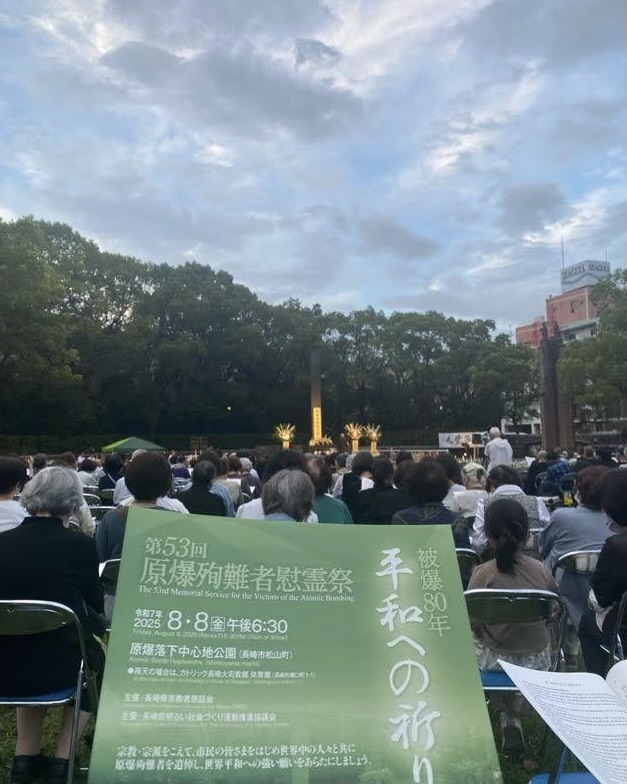
In the evening, we took part in the Memorial Service for the Victims of the Atomic Bombing. U.S. Archbishop Paul Etienne shared words of comfort among other entities’ representatives. Also present from the United States were Cardinal Blase J.Cupich, Cardinal Robert McElroy, and Archbishop John C. Wester.
We also left flowers on behalf of Pax Christi International and Pax Christi Korea to remember all victims of war, and to accompany those currently suffering because of violence.
That’s a wrap for today! We will come back tomorrow for our last day in Nagasaki, commemorating the victims of the bombing in Nagasaki.
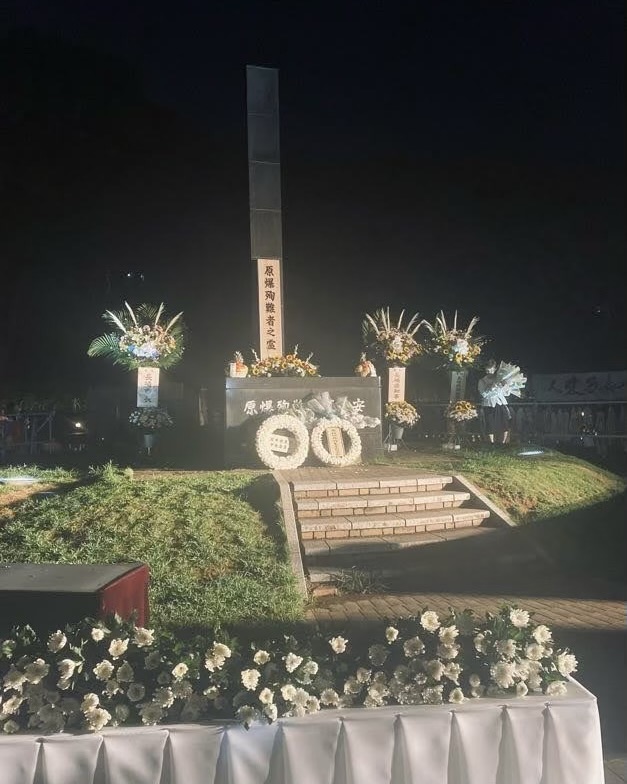
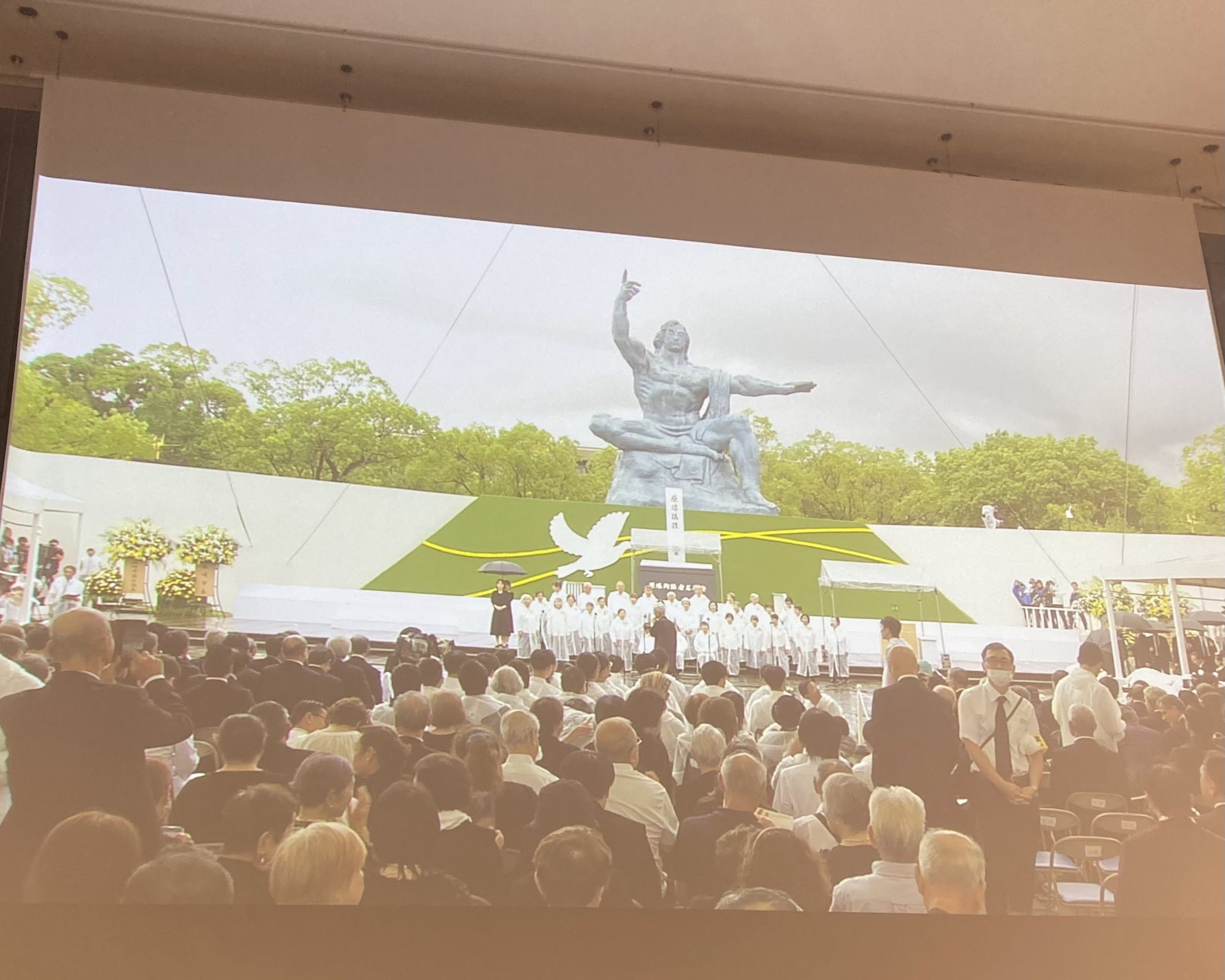
Today we followed live the commemoration ceremony at Nagasaki. The Hibakusha’s choir opened the ceremony.
Water was brought to the thirsty victims, as a memento of their suffering and a way to ease their pain. And the Bell of Peace was rung, followed by a moment of silence at 11:02 to mark the moment of the bombing.
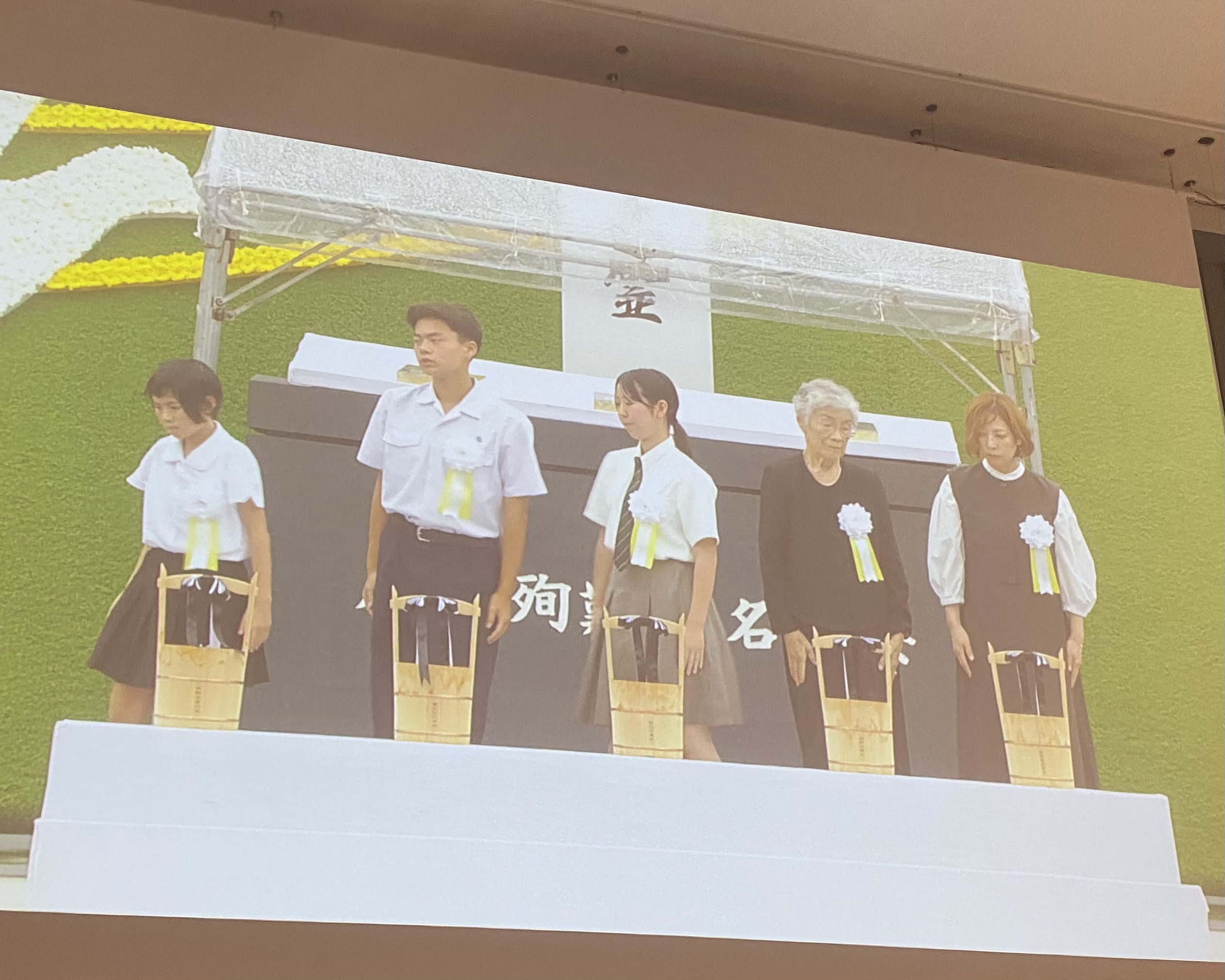

During the ceremony, the speech of Shiro Suzuki, Mayor of Nagasaki, gave us courage and strength to continue our work for a nuclear-free world. Below are a few extracts of his speech. You can read the full speech here.
On August 9th, 1945, an atomic bomb was dropped on this city. Now, 80 years since that day, who could have possibly imagined that our world would become like this? Immediately cease from disputes in which “force is met with force.” Conflicts around the world are intensifying in a vicious cycle of confrontation and fragmentation. If we continue on this trajectory, we will end up thrusting ourselves into a nuclear war. This existential crisis of humanity has become imminent to each and every one of us living on Earth.
“Humanity can rid itself of nuclear weapons.” With this strong hope, the hibakusha continued to raise their voices, inspiring the empathy of a great number of citizens and eventually leading to the idea of the “global citizen” to become deeply rooted in Nagasaki. This phrase expresses the desire to build a peaceful future together, beyond the barriers of race or national borders as citizens of one big “city” called “Earth.”
To the people of the world, all of whom are global citizens (…) if we join together it will lead to a great force to open a path to the future. The hibakusha have shown this through their actions.
The first step is to know the other person. We must repeatedly conduct dialogue and exchanges, understand each other, and little by little build up trust. This is our major role as civil society. As global citizens, let us build up empathy and trust, and turn it into the power to create peace.
To the leaders of all the world’s nations, who are also all global citizens. Now I ask you to go back to the keystone values of the Charter of the United Nations, and restore multilateralism and the rule of law. In order to make Nagasaki the last atomic bombing site, it is essential to show a specific course of action for achieving the abolition of nuclear weapons. Procrastination can no longer be tolerated.
I hereby declare that in order to make Nagasaki the last atomic bombing site now and forever, we will go hand-in-hand with global citizens and devote our utmost efforts towards the abolition of nuclear weapons and the realization of everlasting world peace.

As we saw yesterday, on August 9th 1945, the Nagasaki atomic bomb destroyed Urakami Cathedral during a well-attended Mass before the Feast of the Assumption, killing all inside and devastating the city’s Christian community. Today, the rebuilt cathedral stands on its original site as a place of worship and a symbol of their resilience.

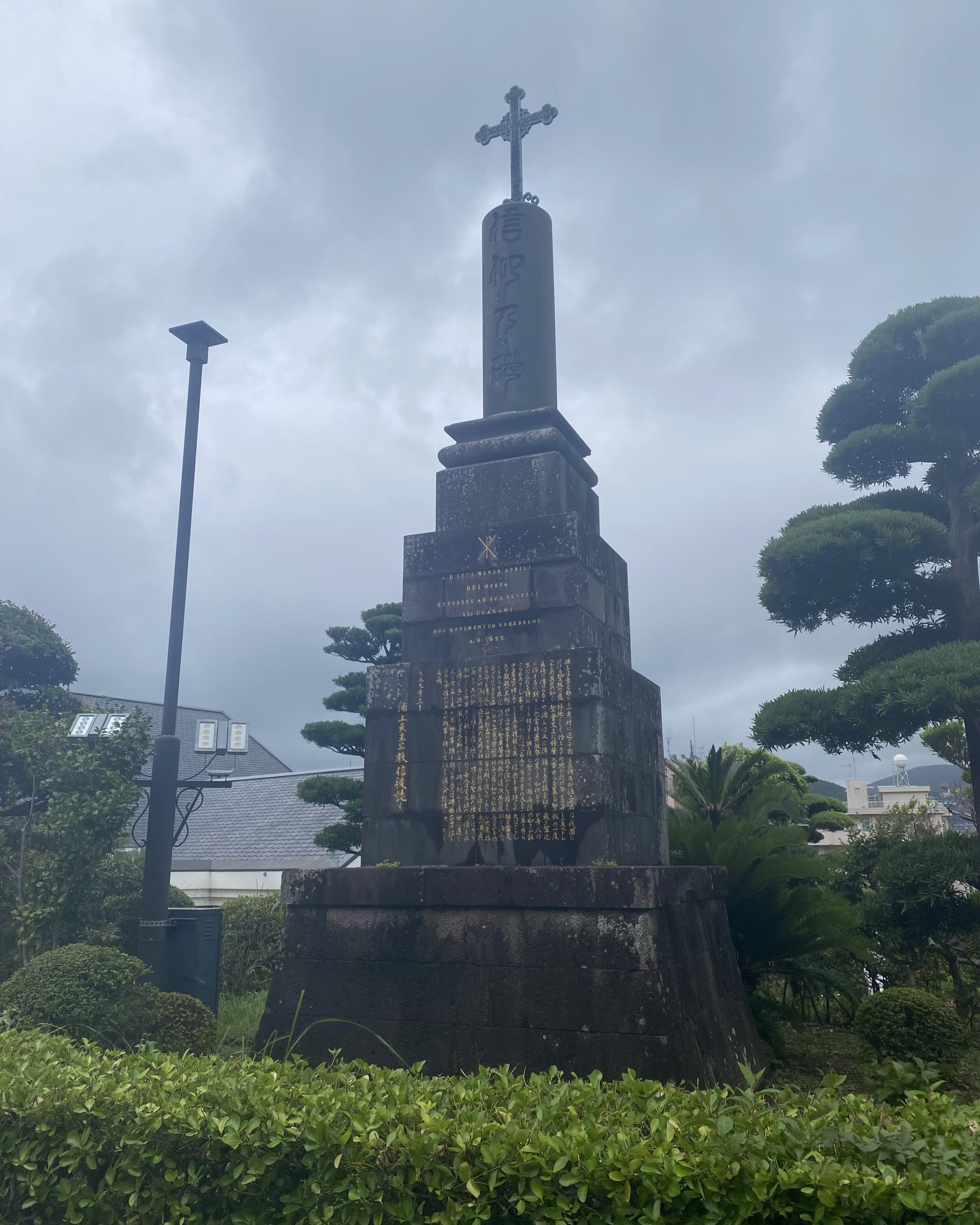
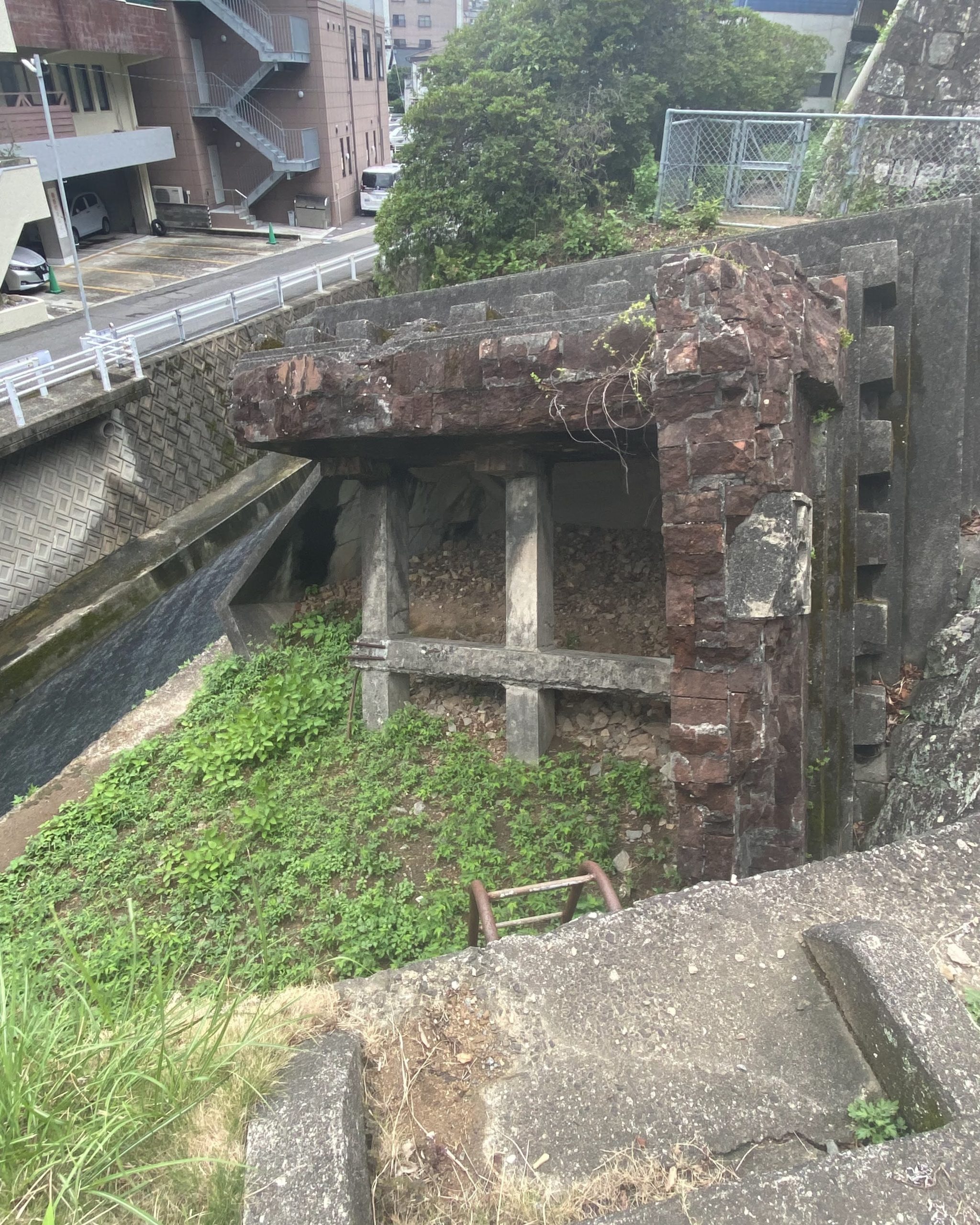
Testimony of Sachiko Yamaguchi (nine years old at the time of the bombing)
“What on earth has happened?” said my mother, holding her baby tightly in her arms. “Is it the end of the world?” We knelt in the air-raid shelter, praying to God with all our hearts. Injured people came into the shelter one after another muttering, “Urakami is a sea of fire.” What was going to become of us?
Since the shelter was bad for the baby, we departed for the house of an acquaintance in Mikumi-gochi… But when we arrived in Mikumi-gochi we found that the houses in the valley had also been destroyed.
Where could we go to find a house in which my mother and her newborn baby could rest? Large groups of people were huddling together, trembling in the shade of the mountain and other places.
Desperately thirsty, I went to draw water but found an oil-like substance floating all over it. People told me that the oil had rained down from the sky. But I wanted a drink so badly that I gulped the water down just as it was.”
This morning at 11:02 a.m. a bell tolled with the newly restored St. Kateri Bell of Hope. In the evening, we joined a commemorative Mass and a candlelight vigil from the church to the hypocenter. During the Mass, we presented the Pax Jubilee 2025 Declaration to the Bishop of Nagasaki.


The vigil ended at the hypocenter beside the two remaining survivors of the original cathedral, the lone standing wall and the charred head of the Crucifixion statue: both powerful symbols of suffering and faith.
We walked together to remember the pain, to say #NoToNuclearWeapons, while carrying the Light of Peace in solidarity.

During our time in Japan, we were honoured to meet Archbishop John Wester of Santa Fe and Archbishop Paul Etienne of Seattle. Both have been steadfast in their call for nuclear disarmament, inspiring communities to work together for a more peaceful world.


As our time in Japan draws to a close, we carry home the voices of the Hibakusha, the symbols of resilience, and the shared commitment to a world free from nuclear weapons. Thank you for following us!
Yesterday we reached Hiroshima. This week, we will join commemorative and reflective moments in both Hiroshima and Nagasaki, together with our colleagues from Pax Christi Korea.
When we arrived, we were welcomed in Hiroshima by Bishop Alexis Mitsuru Shirahama, originally from Nagasaki, appointed Bishop of Hiroshima by Pope Francis in 2016. In the centre of the picture, the painting displays the words ‘Peace in the world, setting an even more meaningful tone for our stay in Japan.
Hiroshima is called the city of rivers. However, although the water is clean, people don’t swim in them. After the atomic bomb fell in 1945, thousands fled to the rivers, burned, desperate for relief. Many died in there. These rivers became silent witnesses to immense suffering. Today, these rivers are places of remembrance and reflection. They are not just part of the city’s landscape. They are part of its memory.
Peace Boulevard in Hiroshima was created in the aftermath of the atomic bombing as part of the city’s reconstruction. It is a firebreak to prevent future fires and also a symbol of peace and hope, connecting the Peace Memorial Park and the Atomic Bomb Dome. The area where it now stands was once densely populated but was completely destroyed. Survivors, students, and volunteers helped clear the rubble, and trees were donated from all over Japan to line the new street.
In the afternoon, we joined the 80th World Conference Commemorating the Anniversary of the Hiroshima and Nagasaki Atomic Bombings together with Pax Christi Korea. We heard the testimony of one of the Hibakusha, the survivors of the bombs explosions.
The 1000 High School Students Campaign, a group of young delegates from Hiroshima and Nagasaki who share survivors’ stories and call for a world without nuclear weapons, shared their call and objectives.
Together we sang “We Shall Not Forgive the Atomic Bomb”, a song about the suffering lived because of the bombing and the consequent necessity of a nuclear free world.
Today we started with a visit to the Hiroshima Peace memorial Park. It is located in what was once the city’s busiest downtown commercial and residential district. The park was built precisely where the explosion happened.
The U.S. selected Hiroshima partly because of its military significance but also because it had not yet been heavily bombed, so the effects of the atomic bomb could be clearly assessed. Its terrain, flat with surrounding hills, would amplify the blast effects. Additionally, the U.S. wanted to create a “psychological impact” on Japan’s leadership and the public. Hiroshima was both a military and a civilian area.
The bomb was aimed at the T-shaped Aioi bridge (see the top part of the map in the picture), but the wind caused it to fall slightly off, therefore attacking the city centre. If the goal of the U.S. in dropping the bomb was purely to end the war, dropping it after the T-mark, in a less populated area, could have reduced civilian deaths. Dropping it before, in the densely populated city center, suggests that the objective of the attack was a different one.
Additionally, the use of a uranium bomb in Hiroshima and a plutonium bomb in Nagasaki suggests the attacks may have also served as tests to observe the different effects of each type.
The Peace Watch is a clock at Hiroshima Peace Memorial Museum that shows the number of days since the last nuclear test. It resets to zero if a new test occurs, serving as a reminder of the ongoing threat of nuclear weapons and the need for disarmament.
Sankichi Toge was a Hiroshima survivor and poet whose “Poems of the Atomic Bomb” (1951) vividly describes the bombing’s horrors. Despite post-war censorship, his work gained international attention at peace events like the Berlin Youth Festival, becoming a powerful voice for nuclear disarmament and peace.
Beneath the memorial building in Hiroshima Peace Park lies a book listing the names of all those who died as a result of the bombing, including those who passed away later from related injuries or illnesses. This list is updated annually and honours victims regardless of their background.
In the stone it is engraved the phrase: “Take good rest, we will not let these wars happen again.”
The pond present behind the memorial symbolises the desperate thirst of survivors immediately after the bombing. Many victims begged for water, but people were afraid to give it, fearing it might do more harm. Later, it was understood that water could have eased their suffering, which brought deep guilt to survivors and rescuers. Offering water at the pond during the annual commemoration serves both to honour the victims’ last wish and to acknowledge this sorrow and guilt.
The Atomic Bomb Memorial Mound in Hiroshima holds the ashes of thousands of unknown victims. It is a place of remembrance where interfaith commemorations are often held, promoting peace and the hope to prevent future nuclear tragedies. Many are the commemorations and events happening around the park. Many are also praying.
The Bell of Peace was donated by the people of Japan and the world as a symbol of hope and peace. Visitors ring the bell to pray for the abolition of nuclear weapons and for lasting world peace. Ringing the bell is a solemn act during memorial ceremonies, reminding people to remember the victims and commit to a future without war and nuclear weapons. The bell bears an inscription that reads: “Let all the souls here rest in peace, for we shall not repeat the evil“.
The Atomic Bomb Dome is the preserved ruin of the Hiroshima Prefectural Industrial Promotion Hall, the only building left standing near the bomb’s hypocenter.
In the afternoon, we joined a moment of reflection and commemoration organised by the Korean community. Here, every person holds a flower and deposits it at the interfaith altar to commemorate the lives lost. The interfaith moment included prayers from Catholics, Protestants, and Buddhists.
Around 70,000 Koreans, most of them forced laborers under Japanese colonial rule, were in Hiroshima and Nagasaki during World War II. When the atomic bombs were dropped in August 1945, about 20,000 Koreans died, with thousands more injured. Korean survivors faced harsh discrimination in both Japan and Korea and were largely excluded from official support and recognition for decades. Only in recent years have their experiences been acknowledged through memorials and efforts to include them in the broader history of the bombings.
Today’s update from Hiroshima ends here. Tomorrow, we will join and follow the events remembering the bombing of Hiroshima on 6 August 1945 at 8:15 AM local time.
After surviving the atomic bombing of Hiroshima in 1945, Fr Lassalle envisioned a cathedral for peace. With support from around the world and Pope Pius XII, the Memorial Cathedral for World Peace was built and completed on 6 August 1954.
“This church was erected in memory of the victims of the first atomic bomb, dropped on Hiroshima on 6 August 1945, and as a sign of peace for all nations, symbolizing the true and only way that leads to peace with God and man: the way of truth, not of deception; of justice, not of violence; of love, not of hate. Therefore all who enter this church are earnestly requested to offer their prayers for the eternal repose of the departed and for peace among the peoples of the world. The sixth day of August in the year 1954.”
The cathedral has a very simple style to reflect the need to focus on praying for peace.
The Resurrecting Christ symbolises hope, renewal, and peace rising from the devastation of war, reflecting the cathedral’s mission to honour life, not just mourn loss.
Origami cranes are everywhere in the cathedral, as a symbol of peace and hope, honouring the memory of Sadako Sasaki.
Yesterday, August 5, 2025, at the Cathedral, we attended the joint Mass liturgy of Korean, U.S., and Japanese bishops.
And today, during the Mass for the Souls of Atomic Bomb Victims, a joint celebration by bishops from Korea, the United States, and Japan, we presented our joint declaration for a nuclear-free, peaceful Asia-Pacific region.
Read more on the declaration and contact us if you want to sign it.
“It is thus my prayer that this solemn anniversary will serve as a call to the international community to renew its commitment to pursuing lasting peace for our whole human family, ‘a peace that is unarmed and disarming’.” Pope Leo XIV
Anselmo Lee, Pax Christi Korea; Bishop Peter Kang, Pres. Catholic Bishops’ Conf. Korea; Giulia Bordin, Pax Christi International; Bishop Alexis Shirahama, Bishop of Hiroshima; Mariko Komatsu, SDGs Japan
In the summer of 1945, cities across Japan were being burned nightly. On 5 August, leaflets warned that Hiroshima would be next. Many fled to the hills, spending an anxious night under the stars. That night, 200 B-29 bombers (US warplanes) flew over, circled Hiroshima, then turned away.
By dawn, the air-raid alarm was cancelled. Relieved that nothing had happened the night before, citizens returned home for breakfast. Soon, workers headed to factories, students to schools. Hiroshima was full of life.
(Based on “An Appeal of All Voices” by Sankichi Toge)
On 6 August 1945, at 08:15 local time, a uranium atomic bomb dropped by the US exploded over Hiroshima.
The bomb hit 160 meters from the Hiroshima Prefectural Industrial Promotion Hall, today called the Atomic Bomb Dome, one of the few buildings left standing near the bomb’s hypocenter. The building was instantly destroyed, together with the people inside it.
The Motoyasu Bridge is about 130 meters east of the Dome. Despite the explosion, this bridge survived mostly intact. It became a vital crossing point for rescue and relief efforts after the bombing.
The temperature at the hypocenter reached about 4,000°C, and was 1,800°C even at 1,000 meters away. Thousands of bodies were found in the river. Thousands more were buried under the rubble.
After the hit and the instant trauma, the screams of desperation started to emerge. Survivors searched desperately for water to ease their severe burns. But water was scarce, and many feared giving it might worsen injuries.
The uranium bomb’s intense heat caused devastating burns, while radiation caused sickness invisible to the eye. Survivors and rescuers alike were affected. Many died within days; others lived with painful radiation illnesses for years. Some effects are still visible today.
Before 1946, the full human impact of the atomic bomb was largely silenced due to wartime censorship and post-war restrictions. That changed when the newspaper Peace Front was published in 1946, one of the first to openly expose the bomb’s cruelty and share survivors’ stories. They also published the famous and inspiring poem by Sankichi Toge, August 6th:
“We will not forget.
We will never forget the fire that burned the city, the sky that rained death.”
In the 1950s, peace movements grew worldwide, opposing atomic and hydrogen bombs.
Their efforts helped prevent nuclear weapons from being used in the Korean and Vietnam wars.
Today, in a world where nuclear weapons still threaten humanity, peace movements remain vital, reminding us that only collective action can build a safer, peaceful future.
And thanks also to the power of togetherness, the origami crane became the symbol of hope and peace after these atrocious attacks.
But why?
Sadako Sasaki was just two years old when the atomic bomb fell on Hiroshima. She survived the blast but later developed leukaemia caused by radiation exposure.
While hospitalised, Sadako began folding origami cranes, inspired by a Japanese legend that folding 1,000 cranes grants a wish. She wished for healing and peace.
Though she passed away at 12, Sadako asked her classmates to continue folding cranes to spread hope and to call for a world without nuclear weapons.
The Children’s Peace Monument in Hiroshima honours Sadako and all child victims. The bell’s surface, shaped like an origami crane, is inscribed with: “A thousand paper cranes” and “Peace on the earth and in the heavens,” written by Nobel laureate Dr. Hideki Yukawa, Japan’s first Nobel Prize-winning physicist and a committed advocate for peace.
Engraved on the monument’s stone is the phrase:
“This is our cry.
This is our prayer.
For building peace in this world.”
Eighty years after Hiroshima, the call to speak out and act against violence and injustice remains urgent. And there is still much to be done.
The atomic bomb dropped on Hiroshima in 1945 had a blast yield of about 15 kilotons, devastating the city and killing tens of thousands. Between October 2023 and May 2025, over 100,000 tons of explosives were dropped on Gaza, far exceeding Hiroshima’s blast in sheer volume.
This is why we believe in a world free from nuclear weapons, where war is not seen as inevitable, and where nonviolence is always considered a valid and powerful option.
Together, let’s make Sadako’s dream a reality, for the generations of today and tomorrow.
Every year on this day in Hiroshima, thousands of paper lanterns are gently floated down the Motoyasu River, near the Hiroshima Peace Memorial Park, in a solemn ritual known as Toro Nagashi.
This ritual is rooted in traditional Buddhist and Obon customs, where lanterns are used to guide the spirits of the dead back to the afterlife.
Each lantern is inscribed with messages of peace, prayers, or the names of lost loved ones. As they drift down the river, they symbolise the souls of those who perished in the bombing being guided to rest.
In recent years, messages of peace have also been projected into the sky during the ceremony. In the pictures below, you can see a dove holding an olive branch and an origami crane, universal symbols of peace and hope.
It is also possible to take part in the ceremony virtually, by lighting a digital lantern. We lit one on behalf of Pax Christi International.
The gentle drifting of the lanterns expresses not only remembrance and the souls being guided to peace, but also the hope for a world free of nuclear weapons. And that hope continues to float into the future.

Today, we are leaving Hiroshima and continuing our journey toward Nagasaki. Meanwhile, let us delve further into the evolution of a nuclear attack, drawing on the testimonies of the Hibakusha and historians.
As nuclear weapons remain a present and pressing reality in today’s world, understanding their devastating effects is more important than ever.
Bearing witness to their human and historical impact may help strengthen the call for their total abolition.
To prepare for the use of the atomic bomb in combat, a special bomb unit was organized, and a series of training sessions was conducted in a desert in the United States. In 1945, the unit moved to Tinian, one of the Mariana Islands. For more realistic training and to help bombardiers familiarize themselves with local geography, A-bomb practice bombs (called “pumpkins”) were dropped on Japanese cities.
The Target Committee, comprising military and scientific experts, met in April and May 1945 to select atomic bomb targets. From an initial list of 17, they narrowed it down to Kyoto, Hiroshima, Yokohama, and Kokura, based on factors like city size, topography, and psychological impact.
With President Truman’s approval, the Interim Committee was formed in May and met in June. They decided the bomb should be used on “a war plant surrounded by workers’ homes” and that it be used without prior warning. Some scientists opposed this, submitting a report urging restraint, but the committee maintained its position.
Before dawn on August 6, weather planes flew from Tinian Island to Hiroshima, Kokura, and Nagasaki, followed by three B-29s: the Enola Gay with the bomb, an observation plane, and a photography plane. With clear skies over the primary target, the Enola Gay proceeded to Hiroshima and dropped the atomic bomb at 8:15 AM, exploding 600 meters above Shima Hospital.
The atomic bomb dropped on Hiroshima was packed with enriched uranium containing around 50 kilograms of uranium-235. However, the cube in the picture below (left side) represents the amount of uranium-235 that actually underwent fission, somewhat less than one kilogram. You can also see the size of the bomb dropped on Hiroshima compared to the height of an adult and a child.
The explosion took seconds to create immediate and long-term devastation in a large area.
What happened in seconds
🔴 0–1 second: Approximately 70,000–80,000 people died instantly from the blast, heat, or were vaporized.
🔴Minutes to hours: Thousands more died from burns, injuries, and collapsing buildings.
🔴 Days to weeks: Many died from acute radiation sickness (vomiting, bleeding, weakness).
🔴 Months to years: Long-term deaths followed from cancer and radiation-related illnesses.
These stone steps were at Hiroshima’s Sumitomo Bank entrance. A person sitting there during the blast died instantly. The intense heat turned the steps white, but the spot beneath them stayed dark, like a shadow.
After the atomic bomb exploded, a dark rain, called black rain, fell over the city. This rain was mixed with dust, ashes, and radioactive particles from the blast. People caught in the black rain were exposed to harmful radiation, which caused sickness and long-term health problems. The rain also polluted the land and water around Hiroshima.

Itsu Ishii, 49, was demolishing buildings when the atomic bomb hit. Her son, Shigetoshi, 19, found her badly burned in the river and tried to carry her to a hospital, but she died on the way. The wristwatch she wore stopped at 8:33 AM, the moment of the blast. “My brother found our mother in the river, her upper body badly burned. As he swam with her on his back toward the hospital, she died before they could reach the shore.” Michiko Ishii
No one is safe in the event of a nuclear explosion. Even those bringing aid were injured, yet still wished, and had, to provide assistance.

Nuclear weapons, and their unsustainable consequences if used, still constitute a major threat to humanity’s existence.
What Can You Do?
Support ICAN and the TPNW
ICAN is a global campaign that helped create the Treaty on the Prohibition of Nuclear Weapons (#TPNW), the first international law banning nuclear weapons. Support it by spreading the word, signing petitions, and urging your leaders to sign the TPNW!
Support Mayors for Peace
Mayors for Peace is a network of cities calling for a world without nuclear weapons. Encourage your city to join! Local voices matter and help build global pressure.
Support local initiatives
Local initiatives such as Green Legacy Hiroshima, a global initiative that distributes seeds from trees that survived the atomic bombing of Hiroshima. These “hibaku-jumoku”, silent witnesses to the devastation, carry the memory and message of the hibakusha: of suffering, resilience, and hope. By planting them around the world, GLH offers a living symbol of peace and a heartfelt reminder never to repeat the horrors of nuclear war.
Join Our Advocacy Efforts
Take part in our initiatives and events. Follow us and share the message.
Together, we can build a future free from nuclear weapons!
Last night we reached Nagasaki, Japan.
The Peace Statue‘s right hand indicates the threat of nuclear weapons, while the left one symbolises peace, and his closed eyes express prayerfulness for those who are victims of war. The Peace Park is preparing to host tomorrow’s commemoration ceremony.
-
- Peace Statue
-
- Peace Park
On 9 August 1945, a plutonium atomic bomb detonated about 500 metres above northern Nagasaki. The explosion killed an estimated 40,000 people instantly.
Within seconds, scorching temperatures and an expanding fireball triggered infernos, inflicting burns up to four kilometres away. The blast wind flattened buildings and hurled debris across the city. Radiation proved deadly even to those uninjured, killing most within a kilometre, and lasting health effects persisted in survivors for decades.
Nagasaki, a mountain-ringed port on Kyushu’s western tip, had a long history as a gateway for foreign trade.
On 9 August 1945, after cloud cover hid its primary target of Kokura, the B-29 Bockscar turned to Nagasaki. Through a gap in the clouds, the crew spotted the Mitsubishi Nagasaki Arms Factory and released the world’s second atomic bomb.
The bomb was detonated about 500 metres above Nagasaki deliberately. An airburst at that height was calculated to cause maximum destruction.
Indeed, when a nuclear weapon explodes in the air rather than on the ground:
1. The blast wave spreads farther because it radiates outwards in all directions before hitting the ground, covering a much larger area.
2. Heat rays travel unobstructed, igniting fires across the city.
3. Radiation is dispersed widely, increasing casualties over a broader radius.
4. A ground burst, by contrast, would waste much of its energy digging a crater and hurling earth into the air, causing less widespread structural damage.
In Nagasaki’s case, 500m was chosen based on calculations from the Hiroshima bombing three days earlier, to optimise the bomb’s effect on buildings and people across the hilly city.
“Let’s ring the Nagasaki Bell for world peace!” – The Nagasaki Hibakusha Certificates Friend Association (established in 1967) erected this Nagasaki Bell on August 5, 1977, based on the Angelus bell of Urakami Cathedral, in order to mark Nagasaki as the last city to be hit by an atomic bomb.
“The Nagasaki Bell is a symbol of our oath never to cause war. As the last city to experience an atomic bomb, we pray that peace will spread throughout the world in concentric circles from our city with the ringing of the Nagasaki Bell, and we hope that you will spread the word as well.”
-
- Nagasaki Bell
-
- Urakami Cathedral
Urakami Cathedral, the grandest church in East Asia at the time, was located on a small hill about 500 metres northeast of the atomic bomb hypocenter.
The explosion of the atomic bomb destroyed it; only a wall remained.
At 11:02am, on the 9th August 1945, a plutonium atomic bomb exploded approximately 500m above the location of this monolith (pictured on the left below). In addition to origami cranes, white flowers are left on memorials to remember lives lost.
The connection with water is very strong also in Nagasaki. This fountain (pictured on the right below) is a place to pray for those victims who passed away whilst begging for water.
The ever-changing shape of the water evokes the beating wings of the dove of peace and the crane. The crane is representative of Nagasaki Port, which is known as the “Crane Port” because of its shape.
-
- Nagasaki Hypocenter
-
- Nagasaki Peace Park
During the bombing, rivers like the Nakashima provided water for survivors to cool burns and escape fires, though contamination made survival difficult.
Today, along the riverside memorials, posters made by students, as large as Picasso’s Guernica, educate visitors on the bombing’s impact, water’s vital role, and messages of peace.
The bombings devastated families, leaving many children orphaned and survivors facing stigma. Schools were destroyed, disrupting education and serving as shelters. Surviving children suffered lasting health problems and trauma, but many became peace advocates. Memorials and education programmes in Hiroshima and Nagasaki honour their stories.
About 50 trees in Nagasaki, known as hibakujumoku, survived the atomic bombing in 1945 despite severe damage. They are protected as a natural monument and as living beings who carry the trauma of the bombing with scars on their trunks.
As the hibakusha age and sadly pass away, these trees keep reminding future generations of the bombing’s impact and the resilience of life. They offer a lasting, natural legacy that embodies hope, healing, and peace. They play a vital role in keeping the memory and lessons of the hibakusha alive.
The Nagasaki Kusunoki Project protects these hibakujumoku, raising awareness of their history and the effects of atomic bomb radiation to pass on a message of resilience and hope for peace to future generations.
“Our stories live on to remind the world to choose peace.” – Masahiro Kobayashi, Hibakusha from Nagasaki
In the afternoon we joined as listeners one of the sessions organised jointly by U.S. and Japanese universities. Approximately 30 students spent the week together between Hiroshima and Nagasaki, while sharing moments of reflection and dialogue. A report on their results will be shared soon.
We were able to join briefly a Civil Society Talk, which featured Melissa Parke, Executive Director at ICAN.
In the evening, we took part in the Memorial Service for the Victims of the Atomic Bombing. U.S. Archbishop Paul Etienne shared words of comfort among other entities’ representatives. Also present from the United States were Cardinal Blase J.Cupich, Cardinal Robert McElroy, and Archbishop John C. Wester.
We also left flowers on behalf of Pax Christi International and Pax Christi Korea to remember all victims of war, and to accompany those currently suffering because of violence.
That’s a wrap for today! We will come back tomorrow for our last day in Nagasaki, commemorating the victims of the bombing in Nagasaki.
Today we followed live the commemoration ceremony at Nagasaki. The Hibakusha’s choir opened the ceremony.
Water was brought to the thirsty victims, as a memento of their suffering and a way to ease their pain. And the Bell of Peace was rung, followed by a moment of silence at 11:02 to mark the moment of the bombing.
During the ceremony, the speech of Shiro Suzuki, Mayor of Nagasaki, gave us courage and strength to continue our work for a nuclear-free world. Below are a few extracts of his speech. You can read the full speech here.
On August 9th, 1945, an atomic bomb was dropped on this city. Now, 80 years since that day, who could have possibly imagined that our world would become like this? Immediately cease from disputes in which “force is met with force.” Conflicts around the world are intensifying in a vicious cycle of confrontation and fragmentation. If we continue on this trajectory, we will end up thrusting ourselves into a nuclear war. This existential crisis of humanity has become imminent to each and every one of us living on Earth.
“Humanity can rid itself of nuclear weapons.” With this strong hope, the hibakusha continued to raise their voices, inspiring the empathy of a great number of citizens and eventually leading to the idea of the “global citizen” to become deeply rooted in Nagasaki. This phrase expresses the desire to build a peaceful future together, beyond the barriers of race or national borders as citizens of one big “city” called “Earth.”
To the people of the world, all of whom are global citizens (…) if we join together it will lead to a great force to open a path to the future. The hibakusha have shown this through their actions.
The first step is to know the other person. We must repeatedly conduct dialogue and exchanges, understand each other, and little by little build up trust. This is our major role as civil society. As global citizens, let us build up empathy and trust, and turn it into the power to create peace.
To the leaders of all the world’s nations, who are also all global citizens. Now I ask you to go back to the keystone values of the Charter of the United Nations, and restore multilateralism and the rule of law. In order to make Nagasaki the last atomic bombing site, it is essential to show a specific course of action for achieving the abolition of nuclear weapons. Procrastination can no longer be tolerated.
I hereby declare that in order to make Nagasaki the last atomic bombing site now and forever, we will go hand-in-hand with global citizens and devote our utmost efforts towards the abolition of nuclear weapons and the realization of everlasting world peace.
As we saw yesterday, on August 9th 1945, the Nagasaki atomic bomb destroyed Urakami Cathedral during a well-attended Mass before the Feast of the Assumption, killing all inside and devastating the city’s Christian community. Today, the rebuilt cathedral stands on its original site as a place of worship and a symbol of their resilience.
Testimony of Sachiko Yamaguchi (nine years old at the time of the bombing)
“What on earth has happened?” said my mother, holding her baby tightly in her arms. “Is it the end of the world?” We knelt in the air-raid shelter, praying to God with all our hearts. Injured people came into the shelter one after another muttering, “Urakami is a sea of fire.” What was going to become of us?
Since the shelter was bad for the baby, we departed for the house of an acquaintance in Mikumi-gochi… But when we arrived in Mikumi-gochi we found that the houses in the valley had also been destroyed.
Where could we go to find a house in which my mother and her newborn baby could rest? Large groups of people were huddling together, trembling in the shade of the mountain and other places.
Desperately thirsty, I went to draw water but found an oil-like substance floating all over it. People told me that the oil had rained down from the sky. But I wanted a drink so badly that I gulped the water down just as it was.”
This morning at 11:02 a.m. a bell tolled with the newly restored St. Kateri Bell of Hope. In the evening, we joined a commemorative Mass and a candlelight vigil from the church to the hypocenter. During the Mass, we presented the Pax Jubilee 2025 Declaration to the Bishop of Nagasaki.
The vigil ended at the hypocenter beside the two remaining survivors of the original cathedral, the lone standing wall and the charred head of the Crucifixion statue: both powerful symbols of suffering and faith.
We walked together to remember the pain, to say #NoToNuclearWeapons, while carrying the Light of Peace in solidarity.
During our time in Japan, we were honoured to meet Archbishop John Wester of Santa Fe and Archbishop Paul Etienne of Seattle. Both have been steadfast in their call for nuclear disarmament, inspiring communities to work together for a more peaceful world.
As our time in Japan draws to a close, we carry home the voices of the Hibakusha, the symbols of resilience, and the shared commitment to a world free from nuclear weapons. Thank you for following us!
Activities and Reflections from Our Network
🔸 Events to mark 80th anniversary of Hiroshima and Nagasaki, compiled by Independent Catholic News
🔸 Read: Our Apocalypse-in-Waiting, an article by Jonathan Frerichs (PCI UNOG representative) for Sojourners
🔸 Pax Christi Scotland: Vigil at Faslane nuclear submarine base, Clyde Estuary – 2 August 2025. The vigil was covered by the following media outlets: Helensburgh Advertiser; The Democrat; Glasgow Times; The National; MSN; BBC.
🔸 Pax Christi England and Wales: Nagasaki Day Vigil and Prayers, London – 9 August 2025; Reflection on the 80th Anniversary
🔸 Pax Christi Aotearoa New Zealand and Peace Movement Aotearoa: List of Commemorative Events
🔸 pax christi Germany: A day of remembrance of madness
🔸 Pax Christi Italia: 80 years later: ‘Peace cannot be built with nuclear weapons’
🔸 80 Years After Hiroshima, Anti-Nuclear Activists Are Still Fighting for Progress, An interview with Mary T. Yelenick, board member and main representative of Pax Christi International at the United Nations, by Chris Herlinger for the Global Sisters Report
🔸 Pax Christi Vlaanderen:
- Circle of silence for 80 years of Hiroshima and Nagasaki – August 8, 2025, at Opera Square in Antwerp (Belgium) – For other commemorations in Belgium, click here
🔸 Pax Christi USA:
- Read: US Bishops, Pax Christi Int’l staff visit Japan for commemoration ceremonies
- A Day of Remembrance in Washington D.C.
Pax Christi USA Local Chapters:
🔸 Pax Christi New York State/Metro New York:
- Tuesday, August 5, 12-1 PM: Vigil outside the Japanese Consulate, Park Avenue and 48th Street, sponsored by the Manhattan Project for a Nuclear-Free World and endorsed by Pax Christi New York State/Metro New York.
- Friday, August 8, 7 PM: Zoom event, with excerpts from the Pax Christi International webinar “80 years of memory and action: Honoring the past, advancing disarmament, and building a peaceful future.” Please contact nypaxchristi@gmail.com by August 7 for the Zoom link.
- Saturday, August 9: Join War Resisters League, Tompkins Square Park, with the support of Pax Christi New York State/Metro New York.
🔸 Pax Christi Metro Dc-Baltimore/Washington Dc Area:
- Wednesday, August 6, 7-8 AM: Vigil at the Pentagon in the designated protest zone on the southeast side of building. (Take south exit from Pentagon Metro station, walk a short distance on sidewalk toward south parking lot. Vigil site is on left behind fencing.)
- Saturday, August 9, 10 AM: Vigil outside the White House on Pennsylvania Avenue NW (north side)
🔸 Pax Christi New Jersey: From Hiroshima and Nagasaki to Gaza – A Week of Events Remembering the Horrific Bombings of Hiroshima and Nagasaki


Thank you for your reflections, which help us focus our prayers this week.
With your endeavours, actions, reflections for peace you shine a light of hope in the present serious world situation.Thank you.