
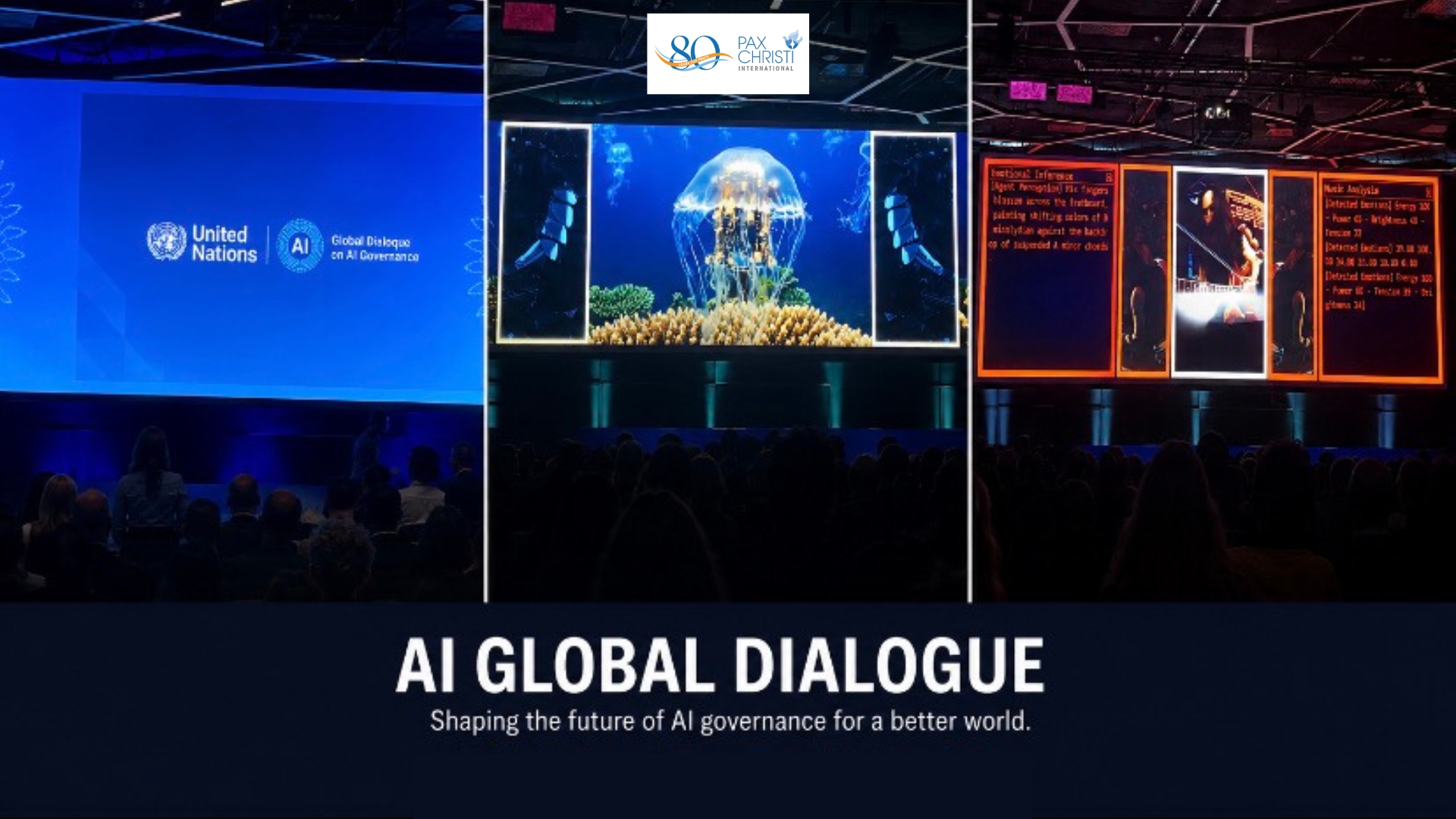
From 6 to 10 July, Geneva hosted the inaugural UN Global Dialogue on AI Governance and the AI for Good Global Summit. Pax Christi International followed both meetings, represented by Mattia Tosato, Additional Representative in Geneva. The two events reflected a growing recognition that artificial intelligence can no longer be addressed through fragmented national approaches. They also offered an opportunity to observe how civil society, young people and Indigenous representatives are seeking a more active role in shaping the emerging framework.
Opening the Global Dialogue, United Nations Secretary-General António Guterres argued that AI is advancing faster than governance frameworks can adapt and urged governments to move from broad principles to practical implementation. Building on the findings of the Global Scientific Assessment of Artificial Intelligence, he outlined several immediate priorities, including an AI Child Safety Pledge, broader access to AI infrastructure and computing capacity, stronger international scientific cooperation and oversight mechanisms capable of keeping pace with technological change.
Although the Dialogue was devoted to civilian applications, Guterres observed that the same technologies are increasingly shaping military affairs and security, and he renewed his call for international action on lethal autonomous weapons.
The distinction between civilian and military AI is becoming difficult to sustain: the computing infrastructure, the models and the technical expertise are largely the same, and only the intended use differs. Discussions on autonomous weapons have continued for more than a decade within the framework of the Convention on Certain Conventional Weapons, along an entirely separate track.
The President of the United Nations General Assembly, Annalena Baerbock, echoed the need for a multilateral response, arguing that technologies operating across borders require institutions capable of bringing together governments, international organisations, industry, academia and civil society. She also emphasised that AI policy must address the unequal distribution of both opportunities and risks. Alongside calls to reduce the digital divide and expand access to AI capabilities, she highlighted the growing impact of AI-enabled abuse against women and girls, including the proliferation of non-consensual synthetic content and other forms of technology-facilitated gender-based violence. In her view, protecting fundamental rights while ensuring that the benefits of AI are shared more equitably should become a central objective of international cooperation.
The exchanges that followed showed broad agreement on the need for international cooperation, while revealing different priorities. Several Member States supported the proposed AI Child Safety Pledge. Others argued that international policy should address not only risks but also unequal access to computing infrastructure, research capacity and technical expertise. For many countries, the key issue was not simply how AI should be governed, but how all countries could participate in its development rather than remain dependent on technologies designed elsewhere.
Youth representatives argued that they should be treated as contributors to policymaking and not only as beneficiaries of protection measures. Representatives of Indigenous communities took the question further, asking whose languages, knowledge systems and cultural perspectives are reflected in AI models. Systems trained on a narrow selection of languages and worldviews will reproduce that narrowness at scale, in education, in public administration and eventually in decisions affecting communities far from where the models were developed. What is at stake is therefore how the models are built, not only who is granted access to them.
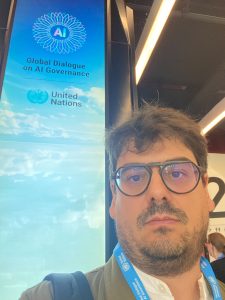
Mattia Tosato at the UN Global Dialogue on AI Governance
These discussions were informed by the first Global Scientific Assessment of Artificial Intelligence, prepared by the newly established Independent International Scientific Panel on AI. The report recognises AI’s potential to accelerate scientific discovery, improve healthcare, strengthen education systems and contribute to sustainable development. At the same time, it warns that these benefits are unlikely to be distributed evenly. Access to advanced AI increasingly depends on computing infrastructure, data availability, energy resources, research capacity and highly specialised expertise, all of which remain concentrated in a limited number of countries and companies. Beyond these structural inequalities, the Assessment identifies challenges that extend across borders, including algorithmic discrimination, disinformation, cybersecurity risks and the growing integration of AI into security-related applications.
The Panel also drew attention to behaviours observed in advanced systems during evaluation, including cases in which models appeared to align their responses with what evaluators seemed to expect rather than reporting their actual capabilities. Separately, concerns were raised about the effects of conversational systems on users in situations of psychological distress.
If the Global Dialogue focused primarily on institutions and public policy, the AI for Good Global Summit turned to practical applications. Across the plenary sessions, speakers presented uses of AI in healthcare, disaster response, food security and humanitarian action, illustrating that deployment is running ahead of any agreed framework.
Among the examples discussed was the World Food Programme‘s use of AI, satellite imagery and predictive analytics to strengthen food security assessments and humanitarian logistics. By processing large volumes of environmental and operational data, these tools can support earlier identification of emerging crises and more targeted humanitarian responses. Other demonstrations explored autonomous vehicles designed for humanitarian operations in remote or disaster-affected areas. The same technological convergence, applied to different purposes, also underpins the increasing automation of weapons systems.
The process launched in Geneva will continue through two complementary tracks. The next UN Global Dialogue on AI Governance will take place in New York in May 2027. On 21–22 June 2027, Switzerland will host the Geneva AI Summit, the next meeting in the international AI Summit series, held back-to-back with the ITU’s AI for Good Global Summit.
For Pax Christi International, the week confirmed that artificial intelligence can no longer be considered solely through the lens of technological innovation. The concerns raised by the Secretary-General and the President of the General Assembly, from child protection and equitable access to international cooperation and effective oversight, point to the need for institutions capable of guiding technological change rather than simply reacting to it. What holds these concerns together is a single question: whether human judgement remains responsible for a decision, or is quietly transferred to the system that prepares it. That question applies as much to a model that allocates food assistance as to one that selects a military target.
In Magnifica Humanitas, Pope Leo XIV describes artificial intelligence as one of the defining transformations of our time and argues that humanity stands at the threshold of a technological revolution whose direction is not predetermined.
The instruments already exist: the Universal Declaration of Human Rights. The Council of Europe’s Framework Convention on Artificial Intelligence and Human Rights, Democracy and the Rule of Law. UNESCO’s Recommendation on the Ethics of Artificial Intelligence. Article 36 of Additional Protocol I, which requires States to determine whether a new weapon would be prohibited under international law. What is missing is not another framework, but coordinated governance across the ones already in place, and the willingness to apply them where doing so is inconvenient.
International humanitarian law has usually been written after the harm was done. Applying that pattern to artificial intelligence would be catastrophic. Neither States nor companies are governing this technology according to democratic principles or the requirements of international law, and neither can yet say what its consequences will be. Uncertainty is not the problem. Uncertainty without rules, and without strong international governance, is. Pax Christi International will continue to press this point across each of these fora, carrying into them the concerns of vulnerable communities.

Leave A Comment