
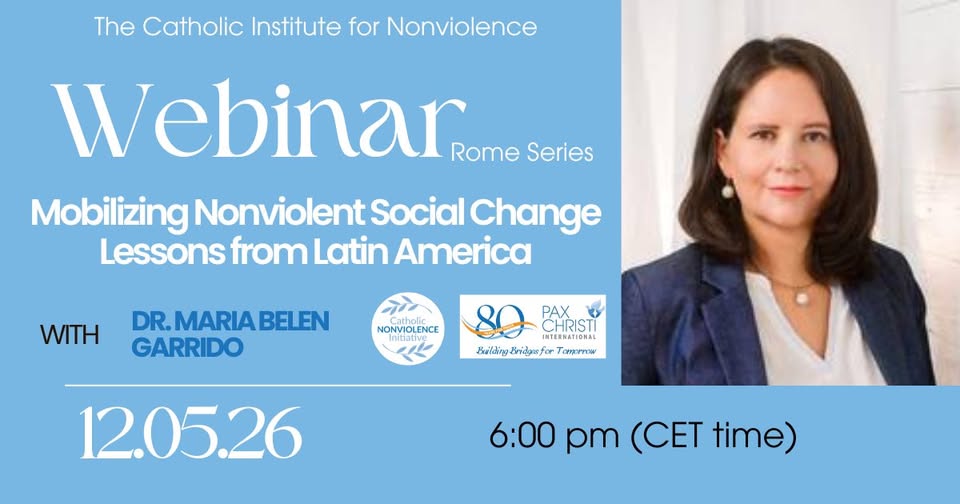
The webinar
This presentation examines the dynamics and impacts of nonviolent social movements, which constitute the foundation of the teaching and training developed by the Regional Institute on the Study and Practice of Strategic Nonviolent Action in the Americas. The Catholic Institute for Nonviolence’s approach draws on a wide range of theoretical contributions from both global and Latin American scholars, integrating these perspectives into practice-oriented learning. These insights are translated into courses built around empirical cases from Latin America, supported by materials produced through the Institute’s blogs and podcasts.
In a second part, the presentation highlights a key case study from the region: the Indigenous nonviolent movements in Ecuador. Between 1990 and 2008, Indigenous and campesino mobilizations organized large-scale uprisings that combined marches, political participation, and demands for collective rights. These movements contributed to significant social and political transformations, including the recognition of Indigenous territories, expanded political participation, and the constitutional redefinition of Ecuador as a plurinational and intercultural state.
The Ecuadorian case also illustrates the broader impact of nonviolent action in moments of political crisis, such as the presidential breakdowns of 1997, 2000, and 2005. In line with existing scholarship, it reinforces the argument that nonviolent movements can be highly effective in achieving structural change while reducing the likelihood of large-scale violence. The case further underscores the importance of alliances and external actors in shaping movement outcomes.
The speaker
María Belén Garrido is an Ecuadorian German academic specializing in peace and conflict studies, with a particular focus on civil resistance movements in contexts of armed conflict and hybrid democracies. She holds a PhD in Social Sciences from the Catholic University of Eichstätt-Ingolstadt (Germany), a master’s degree in Peace Studies, and a degree in Sociology with a specialization in Social Sciences applied to International Relations.
She currently directs the Regional Institute for the Study and Practice of Nonviolent Action in the Americas and is Coordinating Associate for the Institute Section on Contextual Experiences of Nonviolence at the Catholic Institute for Nonviolence. She also serves as Principal Researcher at FLACSO Ecuador and as a Senior Fellow at UMass Boston, where she co-leads the Nonviolent Action and Social Change Lab.

Leave A Comment