Last November, a Pax Christi International delegation joined the Kairos Palestine Conference in Bethlehem, where the new Kairos II document was presented. During the visit, the delegation also met with a variety of local organisations, learning about their work, challenges, and the lived realities of Palestinians under occupation.
The delegation’s experiences included visits to Pyalara, Wi’Am, Arab Educational Institute, Aida Youth Center, L’Arche, Tent of Nations, Comboni Sisters, Balasan Initiative for Human Rights, YMCA Rehabilitation Programme, EAPPI.
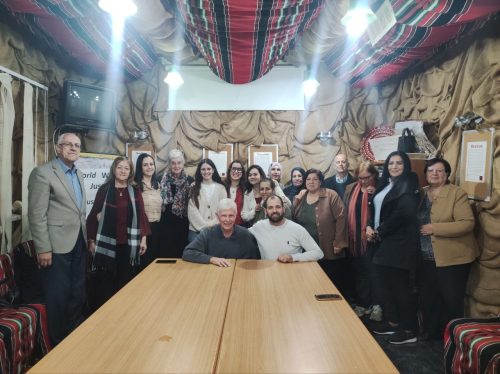
Arab Educational Institute - Pax Christi
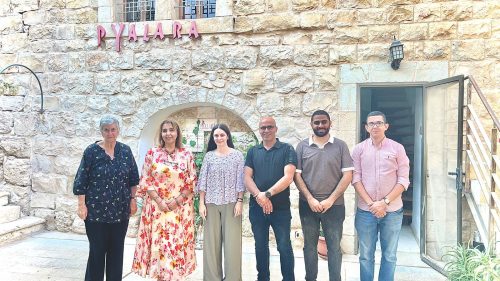
Pyalara
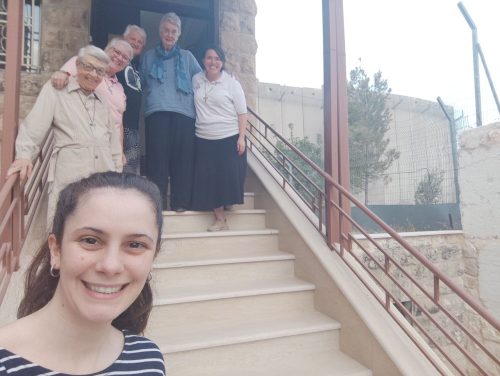
Comboni Sisters
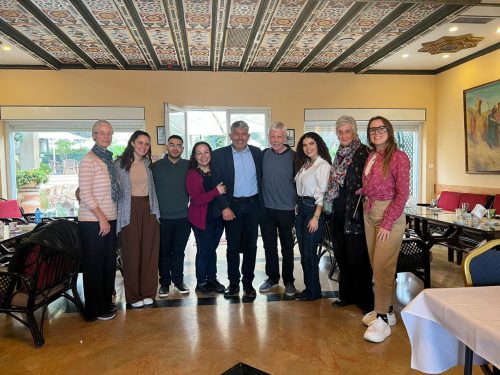
Tent of Nations
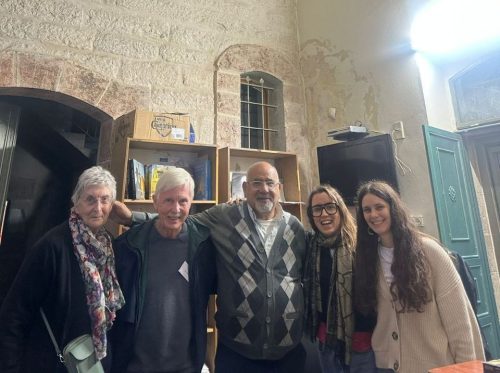
Wi’Am: the Palestinian Conflict Transformation Centre
The Kairos II Conference

The conference, hosted at Bethlehem Bible College, brought together over 200 participants. Key voices included Palestinian leaders, theologians, and activists who addressed the ongoing occupation, apartheid, and the importance of faithful resistance rooted in justice and nonviolence.
The Kairos II document is the latest statement from Kairos Palestine, building on the original 2009 Kairos document. It articulates a contextual theology grounded in the lived reality of Palestinians under occupation, apartheid, and settler-colonial pressures.
Speakers at the conference highlighted the moral responsibility of international communities and churches to act in support of Palestinians, not merely observe their suffering. Kairos II is both a call to faith-inspired action and a testament to resilience in the face of ongoing injustice.
The meeting with H.E. Michel Sabbah
In a private audience with H.E. Michel Sabbah, former president of Pax Christi International, he reflected on the foundation of Pax Christi International’s witness for just peace.
He observed that this mission is sustained through three essential disciplines: prayer, advocacy and perseverance. These are not theoretical ideals, but practices that must be lived consistently.

Conference speeches
The Kairos II Palestine document, following the publication of the first document in 2009, once again seeks to be a cry of hope that can make itself heard even in a time and context where hope feels distant.
Through its publication, the Palestinian Christian Ecumenical Initiative reaffirms its faith in God and its love for its land, reiterating its commitment to nonviolent struggle for the Palestinian people.
Reflections from the Delegation
Ahead of the publication of the visit’s reports, the Pax Christi International delegation shared here their reflections, combining personal insights, spiritual reflections, and witness accounts. These reflections are written to invite contemplation and empathy, providing both a spiritual and practical understanding of the challenges faced by Palestinian communities. Read the reflections from:
🔹Ann
2026 Reports
Starting in mid-January 2026, the delegation’s detailed reports were published weekly, offering:
-
In-depth analysis of the organisations visited, including updated data and programme outcomes.
-
Descriptions of lived realities observed in Palestinian communities.
-
Theological and ethical reflections connecting the delegation’s observations with the Kairos II themes.
-
Opportunities for advocacy and engagement, linking local realities to international action and solidarity.
Each weekly report focused on a specific organisation or theme, allowing readers to explore the complexity of life under occupation, while highlighting initiatives of resilience, education, and nonviolent action.
These reports complement the delegation’s reflections, creating a layered, informative, and accessible resource for anyone seeking to understand the ongoing situation in Palestine and the role of faith, solidarity, and international support.
Report on the Arab Educational Institute – Pax Christi Bethlehem
Written by the Pax Christi International Delegation to the Holy Land | November 2025

We returned to the Arab Educational Institute – Pax Christi Bethlehem (AEI) at a time when life in the West Bank feels narrowed, heavy, and increasingly fragile. Founded in 1986 and affiliated with Pax Christi International, AEI has for nearly forty years been a place where women, children, and young people gather to learn, reflect, and tell their stories. Importantly, AEI works with both Christian and Muslim families, creating shared spaces where communities divided by politics and pressure can meet as equals. Its work has always been rooted in sumud, not understood as heroism, but as the daily, disciplined choice to remain present, human, and nonviolent under occupation.
Over many return visits, we have listened as people described how conditions have worsened, but this time the atmosphere felt different. There was a depth of exhaustion and fear that seemed to have settled into everyday life. The stories we heard were the most distressing we have ever encountered, not because they were dramatic, but because of how ordinary they had become.
We met again at the SUMUD Story House, AEI’s community space just a few minutes’ walk from Checkpoint 300, the main pedestrian crossing on the road between Bethlehem and Jerusalem. Checkpoint 300, also known as the Bethlehem or Gilo checkpoint, has stood in that place since the 1990s as part of the West Bank barrier and is one of the few crossings where people holding Palestinian Authority ID cards with valid permits can enter East Jerusalem or Israel. By 2025, however, entry requirements had tightened even further. Only children under 12, women over 50, and men over 55 are routinely permitted to cross, while many others are simply turned back. Both pedestrian and vehicular access operate entirely at the discretion of Israeli security staff, and its operation is marked by unpredictable closures, biometric checks, and long waiting times that can stretch from forty minutes to several hours.

Inside AEI, staff and participants spoke quietly but openly about how this narrowing of movement has reshaped daily life. The violence seen on screens in Gaza has seeped deeply into the West Bank. Armed settlers and the military move with confidence and apparent impunity. Incursions now take place day and night across the West Bank, including in Bethlehem itself. Sleep is light and easily broken. People listen for the sound of military vehicles, waiting to hear where they will stop, which street they will enter, which home will be forced open. There is a sense that even the buildings hold their breath, and that the silence afterwards is almost as heavy as the noise.
In this context, AEI continues its work with quiet determination. Children between the ages of six and thirteen come regularly to take part in indoor and outdoor activities that offer moments of safety, play, and creative expression. These programmes are designed to allow children to experience something close to normal childhood, even as disruption presses in on all sides. AEI also works with partner organisations to organise educational trips, including visits to historical and cultural sites, helping children remain connected to their heritage in a reality where freedom of movement is increasingly rare.During the summer holidays, AEI’s summer school offers children a rare and vital escape. Through play, creativity, and shared activities, it gives them a sense of safety and joy, allowing them, even briefly, to experience freedom and simply be children.
For women, AEI remains a place where stories can be spoken and held. Christian and Muslim women meet together regularly, sitting together, sharing tea, and unfolding what life has become in a way that resists both silence and despair. Storytelling is central, not as therapy alone, but as a way of naming experience and reclaiming agency. Christian and Muslim women read, share, and discuss Christian and Muslim religious texts, and they share Christian and Muslim prayers together. Women spoke of how quickly an ordinary journey can become frightening, of how calm and restraint have become skills learnt through repetition rather than choice. Others reflected on how homes no longer feel entirely private, and how every gesture must be weighed against the risk of escalation. These stories emerged slowly, woven with humour, fatigue, clarity, and an unspoken understanding of what is left unsaid.
AEI’s educational approach often begins with shared reflection. Through a programme known as Read, Reflect, Communicate and React, participants read passages from religious texts, reflect on their meaning together, and respond through creative expression or action. These reflections include both Christian and Muslim religious texts. Faith and lived experience are brought into conversation, not to escape reality, but to face it honestly. Workshops on historical memory, particularly the Nakba, invite reflection on displacement and loss, often through simple symbolic acts such as holding a key, gestures that carry both grief and continuity.
During the World Week for Just Peace, organised by the World Council of Churches, AEI facilitates public actions that combine prayer, readings, and song in the open areas near the wall. These gatherings are carefully placed, not too close to the barrier, shaped by the need for safety, yet visible enough to be seen. They are embodied acts of nonviolent resistance, grounded in faith and presence rather than confrontation.
Again and again, conversations returned to the changing meaning of sumud. What once felt collective and sustaining now feels fragile, stretched thin by years of pressure. Many spoke of working simply to survive, with little space left for imagining a future. There was also a deep weariness with words, with statements that lead nowhere. What was expressed was not despair, but an insistence on honesty and on the need for action.
They spoke about the broader impact of the occupation: “We don’t have the sumud of the past. The feeling has changed. I look for the future in another way. Palestine is not safe. I can survive, but my children and grandchildren… I feel sorry when I look at them. Children abroad are free to do everything, but they know if they come back, they are not free anymore. […] We need to be real. In the past we were wearing masks to protect our children. Now we see the truth and we are very tired of words. We need action.”

Young people, in particular, struggle to imagine a future for themselves. AEI works closely with youth who live with uncertainty, limited opportunity, and widespread unemployment. Some take part in international exposure programmes, including short educational visits to Europe, which offer new perspectives and skills, but also sharpen the painful awareness that many believe safety and dignity may only be possible elsewhere.
And yet, in the midst of all this, Palestinian warmth and hospitality remain unwavering. We were welcomed, as always, with a generous meal prepared by the women themselves. We ate together, shared memories of earlier visits, and spoke of people and places that link past and present. These moments of ordinary kindness felt quietly radical.
There was deep concern about the future of Christian life in Bethlehem and the wider West Bank. Palestinians have long insisted on the importance of Christian families remaining rooted in the land as a living presence of history and faith. This commitment has come at immense cost. Under current conditions of extreme violence, expanding annexation, and near-total economic collapse, many families are leaving. Around 200 Palestinian Christian families have left Bethlehem, and approximately 4,600 Christians have left the West Bank. Teachers and municipal workers often go unpaid, as Israel withholds tax revenues from the Palestinian Authority. Bethlehem feels emptied; shops, cafés, and hotels stand closed, and the absence of visitors is stark.
Environmental pressures deepen the crisis. This year’s olive harvest was devastated by drought. Combined with settler violence and theft, many families chose not to harvest at all, as the effort and risk outweighed any return. Even reaching olive presses has become difficult, if not impossible, for many.
Along the Separation Wall itself, near Aida Refugee Camp and Checkpoint 300, AEI’s work takes visible form in what has become known as the Wall Museum. The Wall Museum stands in an area that was once among the liveliest in Bethlehem. Hebron Road, passing by Rachel’s Tomb, sacred to Muslims, Christians, and Jews, was the city’s main gateway. Shops, workshops, and cafés lined the street, and life moved freely through it.
That life was steadily erased. During the 1990s, the area became a military zone, and after the second Intifada the Separation Wall was built around Rachel’s Tomb, annexed to Jerusalem. Today, the street is quiet, almost empty. What had once been a place of movement and encounter is now dominated by the Wall and checkpoints, symbols of confinement and restriction.
In response, the Arab Educational Institute opened the Sumud Story House in 2009, creating a space for women and neighbours to gather, reflect, and reclaim public presence through cultural acts. From this grew concerts, inter-religious prayers, festivals, and performances held in the shadow of the Wall itself. The Wall Museum emerged from these efforts. Its name is deliberately in inverted commas: it is not meant to be permanent, but to challenge the Wall’s permanence.
Between 2011 and 2013, 270 stories were displayed, speaking of loss, resilience, and the longing for home, rejecting the silence imposed by occupation and reclaiming Palestinian narrative. Among them are two posters, in English and Arabic, marking the Pax Christi International Global Gathering of 2015, connecting local stories to international solidarity.

Today, many of the panels are faded, damaged, or partially torn, reflecting the harshness of the environment. Yet they continue to speak. Reading the stories along the Wall remains a powerful act of witness, and for many, a quiet pilgrimage, a reminder of endurance and hope in a landscape shaped by confinement and restriction. These stories of humanity stand in contrast to the concrete presence of this Wall. While the Wall is built to divide, control, and endure, the Museum attached to it was never imagined as permanent. In the Palestinian understanding, the Wall Museum exists only for as long as the Wall itself stands. It is meant to fall together with it, one day.
In the midst of fear, exhaustion, and uncertainty, the Arab Educational Institute continues to hold space for truth, memory, and dignity. Through education, storytelling, reflection, and nonviolent engagement, AEI remains a place where people are seen and heard, and where humanity is quietly defended, even as the weight of occupation grows heavier with each passing day.
If you wish to support the activities of the Arab Educational Institute – Pax Christi Bethlehem, find more here: https://aeicenter.org/donate/
Report on Wi’Am, the Palestinian Conflict Transformation Centre
Written by the Pax Christi International Delegation to the Holy Land | November 2025
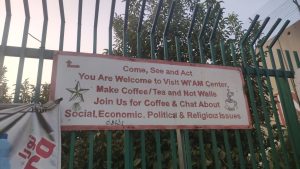
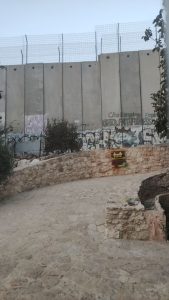
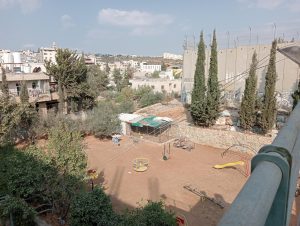
Situated at the foot of a military watchtower, next to one of Bethlehem’s main checkpoints and the Israeli Separation Wall, Wi’Am, the Palestinian Conflict Transformation Center, occupies a space where the pressures of occupation are immediate and visible. Its community garden and play area, overlooked by surveillance and skunk-water sprayers, are daily reminders of the challenges Palestinian families face. Raw sewage pumped from nearby settlements has rendered once-thriving vegetable plots untended, while military raids and watchtowers loom over children’s playgrounds. Yet Wi’Am has created a sanctuary of resilience, learning, and principled action, a place where community life continues despite these daily threats.
The centre’s location, near Rachel’s Tomb, a holy site for Jews, Christians and Muslims, underscores the daily restrictions on Palestinians. The tomb, annexed by Israel despite being in Bethlehem, sits behind the Separation Barrier. Access for Palestinians is heavily restricted, while Israelis can travel freely to the site. The surrounding area has become a “ghost neighbourhood,” with hundreds of businesses closed, military bases, and watchtowers casting a shadow over the city. Soldiers enter nearby Aida Refugee Camp weekly, often arresting children, who may be subjected to interrogation and coerced confessions, highlighting the pervasive impact of occupation on ordinary life.
Wi’Am was established in 1994–1995 in Bethlehem as a grassroots civil society organisation in direct response to the profound social and political void created by Israeli occupation across the West Bank. At that time, there was no clear Palestinian political authority outside Gaza and Jericho, and many of the traditional village leaders (mukhtars), appointed under Israeli administration, had lost legitimacy within their communities. In this context of uncertainty and weakened local structures, Wi’Am opened its doors to strengthen relationships and provide peaceful means for conflict resolution and social cohesion. The name Wi’am means “cordial relationships” in Arabic, reflecting the organisation’s foundational mission to improve the quality of relationships within Palestinian society and to promote peace, justice, and reconciliation at the grassroots level.
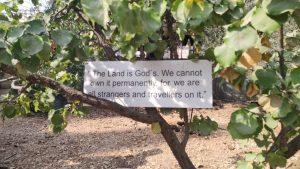
At the heart of Wi’Am is a philosophy of nonviolence and steadfastness. Zoughbi’s mother, whose teachings continue to guide the organisation, emphasised “unharmed struggle”, resisting injustice without inflicting harm. She would say, “When you are entertaining strangers, you are entertaining angels.” From its first programmes, designed for women inspired by her vision, Wi’Am has fostered spaces where individuals and communities can develop resilience, confidence, and hope. Everyone is welcome, except for weapons that are not allowed within the centre where dialogue, reflection, and ethical action are the tools for engagement. Zoughbi himself notes that nonviolence is not passive: it is a form of perseverance, a way to continue living with dignity and commitment despite the challenges of occupation. His own children have chosen to remain in Palestine, a testament to the values of resilience and rootedness that Wi’Am promotes.
At Wi’Am, displaced anger, whether from local conflicts or frustrations carried by newcomers, is treated not with retaliation but with reflection, restorative justice, and structured dialogue. It is crucial to work on oneself before trying to change others, and the organisation encourages networking, learning, and ethical leadership across communities.
Restorative justice is central to Wi’Am’s work. Staff help participants mediate disputes, address conflicts arising from domestic tensions, youth delinquency, or neighbourhood disagreements, and break cycles of violence. The centre recognises that personal and community conflicts are inseparable from the wider realities of occupation, restricted freedoms, and social strain. By addressing these tensions thoughtfully, Wi’Am strengthens the resilience of both individuals and the wider community.
A particularly significant practice is Sulha, the traditional Arab form of mediation that Wi’Am has preserved and adapted. Sulha, which means “reconciliation” or “making peace,” focuses on restoring relationships rather than assigning blame. Mediators bring together the parties in dispute, guiding dialogue that encourages empathy, accountability, and understanding. Combined with modern conflict transformation methods, Sulha is used to resolve family, community, and youth conflicts, providing a locally rooted and culturally legitimate way to achieve justice without violence. In a context where legal recourse is often inaccessible or constrained, Sulha offers Palestinians a meaningful, nonviolent alternative to protect relationships and community cohesion.
Interfaith dialogue is another cornerstone of Wi’Am’s approach. Muslims and Christians meet to explore shared values, study scripture, and discuss ethical dilemmas. Religion, when thoughtfully applied, becomes a unifying force, fostering understanding and countering rising extremism and radicalisation across all faiths.
Youth and children are central to Wi’Am’s vision. Workshops and safe spaces nurture creativity, critical thinking, civic awareness, and ethical reflection. Arts, drama, music, and sports provide tools for processing trauma and expressing identity, while international exchange programmes expose young people to broader perspectives, which they bring back to enrich their communities. Women’s programmes combine leadership, storytelling, and skills development, empowering them to act within families and society. Storytelling and intergenerational dialogue link generations, helping young people understand the experiences of elders while fostering empathy and social responsibility.
At Wi’Am, nonviolence is lived daily, not as an abstract principle but as a form of perseverance, reflection, and ethical action. The centre remains a sanctuary, a school, and a community hub, where resilience, dialogue, and principled engagement are practised, modelled, and passed on. In the shadow of watchtowers, the Separation Wall, and a neighbourhood transformed by occupation, Wi’Am demonstrates that hope, human connection, and steadfastness can thrive even under the most challenging circumstances.
If you wish to support the activities of Wi’Am, find more here: https://www.alaslah.org/donate/
Report on Aida Refugee Camp
Written by the Pax Christi International Delegation to the Holy Land | November 2025
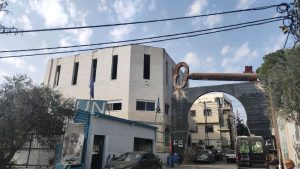
We would like to begin by expressing our sincere thanks to Usama Nicola, who guided us through the Aida Refugee Camp and shared his knowledge of its history, daily realities, and community initiatives. His insight was invaluable in understanding the complex interplay of historical displacement, occupation, and local resilience.
During our visit, Usama began by situating the camp’s existence within the legal and political context following the 1948 Palestinian displacement. He recalled that UN General Assembly Resolution 194 established the principle of the right of return, or compensation for those unable to return. In the early years, the UN gathered displaced families in large canvas tents, and UNRWA rented extensive stretches of land to host thousands of refugees. Near the camp entrance stands a café owned by a woman named Aida, whose name means “return”; Israeli soldiers often avoid using the café because of its symbolism.
By 1956, the tents had been replaced with simple UN housing units with shared outdoor bathrooms. These units had no electricity or water system, and one small unit often had to accommodate an entire family. Fathers sometimes slept on rooftops to make space indoors for women and children, and as families grew, additional rooms were added incrementally. Long queues formed daily for the limited shared facilities. Today, UNRWA registers roughly five thousand refugees living inside the camp, though many more reside just outside its boundaries.
Many middle-class refugees, both Christian and Muslim, initially refused to settle within the official camp, believing the right of return would be realised soon. They felt that moving into camp housing would be humiliating and instead resettled in adjacent areas. The theme of return continues to shape identity in the camp, visible in murals, youth projects, and even in an Israeli-developed mobile app called “I Return.”, which aims at enhancing understanding of the Palestinian Nakba. For residents, this broader issue reflects the ongoing struggle for restorative justice, and how to address both the original loss and its decades-long consequences.
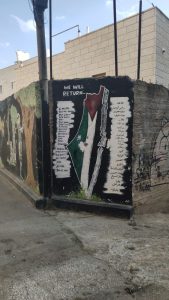
Administratively, Aida is not part of Bethlehem municipality but falls under UNRWA’s coordination. Funding cuts by several states have sharply reduced the agency’s capacity, leaving many programmes, including employment initiatives, unrealised. Israeli banking restrictions further constrain financial transactions. Residents note that current pressures are only the beginning of potential crises, while also pointing to rising settler violence and emphasising the importance of international attention.
Walking through the camp, the separation wall looms large in both physical and symbolic terms. Jenin and Bethlehem were among the first areas to experience its construction. Each kilometre costs millions of dollars, whether made of concrete or fencing. Some olive trees along the route date back to Roman times. Although officially approved by Israel in 2000, the wall’s conceptual origins date to the early 1990s with the development of checkpoint systems. Its zig-zag path compresses Palestinian neighbourhoods while expanding settler space. Wall heights vary between 5, 8, and 12 metres. At the camp’s main entrance, UNRWA’s distribution centre provides essential support for daily life.
Aida and surrounding areas, including Wi’am, are among the most heavily tear-gassed zones in the world. Some canisters are found unexploded, but most are expired; fragments are often repurposed into jewellery that tells the story of survival and history while symbolically “repaying” the harm done.
Residents elect a committee under PLO supervision, and activists from various political factions participate in local governance. UNRWA focuses mainly on waste collection, healthcare, and education, while a private kindergarten and several small-scale family enterprises operate within the camp. Some households maintain sheep and goats on lower floors to produce milk and cheese for the family.
The camp hosts the Aida Youth Centre, a cornerstone of community life. Inside, young people have built a space that documents the historical background of the occupation and the Nakba. The centre includes a shop and bar to support its operations, while also providing a gathering place for young people to meet, socialise, and organise awareness activities both for the camp and for visitors. The centre runs educational, cultural, and recreational programmes, giving young people access to art, drama, music, sports, and leadership initiatives they would otherwise lack.
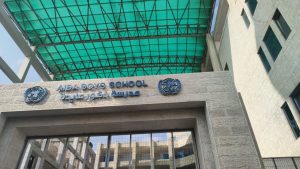
The camp also hosts a UNRWA elementary school, funded by Saudi Arabia. Some male students have been imprisoned in the past, considered potential threats. Soldiers required windows to remain closed during periods of unrest, yet children sometimes continued to throw stones, resulting in temporary relocations to the girls’ school.
The history of the camp is inseparable from the broader context of Palestine’s modern history. On 14 February 1947, the British formally withdrew from Palestine, leaving to the UN the management. The UN Partition Plan (29 November 1947) allocated 55% of Palestine to a Jewish minority who comprised only one-third of the population, including most fertile lands. Between 30 March and 15 May 1948, roughly 200 villages were occupied and expelled, producing over 250,000 refugees. Another 90 villages were wiped out by June 1948. The village of Deir Yassin saw the massacre of 170 residents, including women and children.
By the end of the 1948 war, roughly 150,000 Palestinians remained within the territory that became Israel, while 4,244,776 acres of land were expropriated. In response, the UN created UNRWA in December 1949, originally intended as a temporary measure. Its mandate has been renewed repeatedly, as a durable solution for Palestinian refugees has never been realised. The Aida Camp itself was established in 1950: early conditions were overcrowded, with poverty and disease widespread, and UNRWA’s budget of approximately $35 million per year left very little per person.
During the years following the war, Israel actively prevented refugees from returning, labelling those attempting to do so as “infiltrators.” Between 1949 and 1956, it is estimated that 30,000 to 40,000 Palestinians returned, yet most faced detention or deportation. Palestinian villages were replaced by Israeli settlements, often adopting Hebrew names derived from Arabic originals, e.g., Lubya became Lavi, Saffuriya became Tzipori.
The Six-Day War (5–10 June 1967) further shaped the refugee landscape. Israel seized the West Bank, Gaza Strip, Sinai, and Golan Heights. Refugees swelled, with approximately 385,000 Palestinians displaced, including 130,000 already displaced in 1948. Military laws and administrative restrictions have since governed Palestinian lives under occupation, while settlers enjoy civil law privileges. Military courts can detain Palestinians for extended periods, while illegal settlements expanded with state support.
Despite these pressures, the Aida community has built a culture of resilience. Children and youth assert their dignity through arts, sports, education, and public memory. Murals along alleyways feature the names of lost villages, historical narratives, and messages of hope. Residents emphasise assertiveness over aggression as a strategy for survival.
A recent challenge highlights the ongoing struggle: the camp’s football pitch in Khallat Hamama faces demolition by Israeli authorities. The seven-a-side field, used by more than 500 children, including girls, represents one of the few open spaces for play, training, and communal gatherings. Community members emphasise that bulldozing the pitch would “destroy dreams” and silence young people’s aspirations.
Those wishing to support the campaign can sign the petition here: Don’t Bulldoze Our Pitch
Report on Tent of Nations
Written by the Pax Christi International Delegation to the Holy Land | November 2025
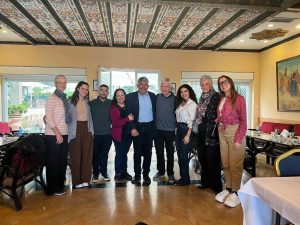
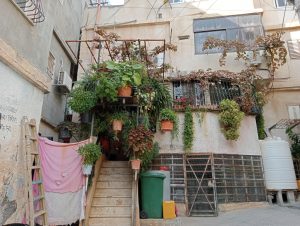
After attending Mass in Bethlehem, we met the Nassar family. They are the owners of the Tent of Nations, a family farm and community project near Bethlehem that has come to symbolise nonviolent resilience. The family, the only Palestinian Christian family in the area, has remained on their land despite decades of pressure, consistently affirming their commitment to legality and to a principled practice of Nonviolence, which they understand not as passivity, but as an active and deliberate choice shaping every aspect of their presence on the land, applied through Sumud and rooted in their Christian faith.
The Tent of Nations is located in an area under full Israeli control, where access to basic infrastructure is severely restricted. The family emphasised that their long legal struggle is not new, but part of a broader, decades-long attempt to challenge their ownership and continued presence on the land, despite their having respected all legal requirements. This prolonged uncertainty affects daily life and long-term planning, as legal victories have repeatedly failed to translate into protection or enforcement.
The family described the increasing pressure they face from Israeli settlers, creating ongoing difficulties for the family. In response, the Nassars continue to insist on nonviolence, stressing that any provocation or reaction could be used to justify further pressure and undermine their legal and moral position.
The broader context of Bethlehem highlights the pressures surrounding the family. The city is encircled by approximately 90 iron gates, often the first step towards permanent cement barriers, while more than 1,000 gates exist across the West Bank. Settlement outposts are widespread, with over 200 in the surrounding area. At one checkpoint, settlers painted the phrase “no future” in Arabic, a deliberate message aimed at instilling despair, particularly among young Palestinians. This environment contributes to high levels of migration and a deep sense of hopelessness among the local population, reinforcing the importance of visible, grounded examples of nonviolent perseverance such as the Tent of Nations.
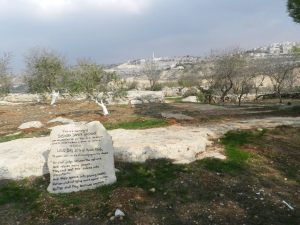
A central goal of the Nassar family is to make the farm self-sufficient. They are implementing solar and wind power, rainwater filtration systems, and biogas production. An olive press has been established to support agricultural production. These projects are practical necessities, but they are also deliberate acts of nonviolent resistance. By sustaining life, work and community on the land, the family affirms presence without confrontation and resilience without retaliation.
The Tent of Nations runs a variety of programmes and projects that embody its philosophy of Nonviolence and community building. These include annual workcamps, tree planting campaigns, wheat and fruit harvesting, cave renovation and specialised children’s programmes. The workcamps, usually lasting ten days, combine practical farm work with educational sessions, orientation on the local situation, documentaries, and weekend excursions to Bethlehem and its surroundings. Volunteers sleep in tents or caves, share traditional Palestinian meals, and participate in both the labour and the learning, fostering a sense of collective responsibility and international solidarity.
The farm’s seasonal projects include tree planting campaigns in March, weeding and wheat harvesting in May, cave renovation and fruit harvesting in June, almond and fruit harvesting in August, grape and fig harvesting in September, and olive harvesting from late October to early November. Each project is designed not only to sustain the land but also to engage volunteers in the rhythms of farming, care for the environment and the practice of Nonviolence.
The children’s summer camp, held every July, provides a safe and playful environment for 40–50 children aged 10 to 16. Activities include games, sports, art, music, theatre, creative writing and environmental education, all framed by the farm’s values of cooperation, respect and Nonviolence. International volunteers help lead small groups and facilitate intercultural learning, providing children with exposure to different cultures, languages and ways of thinking.
Additional projects include the LandArt “Angel of Cultures”, a collaborative art installation designed to promote intercultural and interreligious understanding. Volunteers and visitors contribute stones to form a visible angel, symbolising collective hope for peace and encouraging reflection on shared responsibility for the future.
The Tent of Nations has also become a focal point for international advocacy. By sharing how they have respected every rule and court order, the family hopes their case can serve as a reference point for others facing similar situations. Their advocacy is rooted in transparency and accountability rather than accusation, reflecting their belief that Nonviolence must extend beyond actions on the ground to the way their story is told and shared.
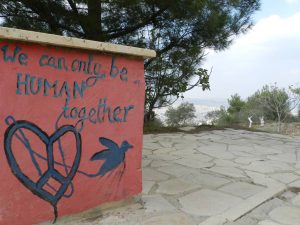
Despite these pressures, the Nassar family consistently emphasised hope and perseverance. As Palestinians, they believe it is essential to lead their own movement and remain rooted in their own vision. They described the current moment as a crossroads, raising the question of what vision exists for the future. Material projects such as those developed at the Tent of Nations are seen as practical tools to sustain the community and create leverage, while also prompting deeper reflection on the “why” behind remaining, resisting despair, and continuing to build through nonviolent means.
Volunteer presence remains vital. During the last olives harvest, 32 volunteers worked on the farm, the highest number since 2020. Currently, around 13–14 volunteers are present. Their presence helps reduce settler violence by increasing international visibility and attention.
Education in Nonviolence is another priority. Leadership is needed to teach both its meaning and its daily practice, particularly to younger generations. Prayer also plays an important role, offering moments of relief and healing for a community living under constant pressure. The family spoke about the process of de-Palestinianisation and its impact on children. Many children grow up too quickly in this environment: their first words are often related to military presence. Childhood is shortened under the weight of conflict, and projects like those developed at the Tent of Nations play a crucial role in responding to this reality. Through educational activities, summer camps, harvest projects, and participation in environmental and art initiatives, children engage directly with the land, learn practical skills, experience collective responsibility and internalise the principles of nonviolence, hope and community care.
In a context marked by pressure, fragmentation and uncertainty, the Tent of Nations stands as a living example of nonviolent perseverance. The Nassar family’s presence on the land is sustained not through confrontation, but through consistency, legality, and a deliberate refusal to be drawn into cycles of provocation and despair. Their work raises a fundamental question about the future: not only what can be built under such conditions, but why remaining, cultivating, educating, and choosing nonviolence continues to matter. The Tent of Nations offers no simple solutions, but it provides a clear and grounded vision of resilience rooted in dignity, responsibility and hope.
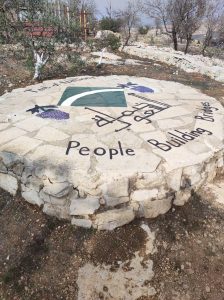
Those wishing to support the Tent of Nations can do so in several meaningful ways. Volunteering on the farm is one of the most direct forms of support, while donations contribute to self-sufficiency projects, educational programmes, children’s activities, legal costs and the upkeep of the farm.
By engaging with the Tent of Nations, supporters are invited to accompany the family’s commitment to nonviolence, justice and hope, standing alongside a project that cultivates not only crops but dignity, community and the possibility of a future rooted in Just Peace.
Report on Balasan Initiative for Human Rights
Written by the Pax Christi International Delegation to the Holy Land | November 2025
The second day of our Pax Christi International Delegation visit opened with a detailed presentation by Balasan Initiative for Human Rights, a dynamic and independent Palestinian organisation founded and led by young Palestinian Christians. Balasan presented itself not simply as a “small initiative,” but as a consciously structured and politically intentional one: remaining lean, community-rooted and closely connected to realities on the ground, in contrast to larger institutional actors often distanced from lived experience. Despite its size, Balasan plays a significant role in the human rights landscape, combining field documentation, legal advocacy, research, policy analysis, monitoring of violations, and international advocacy across the occupied Palestinian territory. Central to its work is the refusal to rank or compartmentalise abuses: guided by the principle that all violations are violations, regardless of the perpetrator, Balasan approaches the occupation as a single, interconnected system of domination. Its name, Balasan – an indigenous tree deeply rooted in the land and traditionally used for healing, reflects the organisation’s understanding of human rights work as both political and restorative: an effort to document harm while tending to the wounds inflicted by prolonged occupation.
Current focus: Bethlehem as a laboratory of annexation
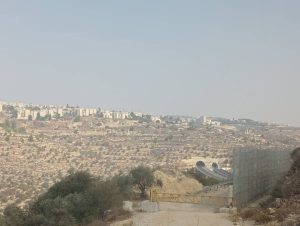
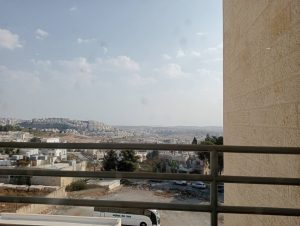
While Balasan’s scope is national, its current focus lies on the Bethlehem governorate, identified as one of the most vulnerable and strategically targeted areas in the West Bank. According to Balasan’s analysis, Bethlehem functions as a blueprint for what the organisation describes as annexation by stealth – a process that does not rely on formal declarations, but on the accumulation of military orders, bureaucratic procedures, planning restrictions, and administrative decisions that permanently alter reality on the ground.
During the field-based discussion, it became clear that annexation is not a future project but a lived present. It manifests through daily routines of restriction, fragmentation, and degradation that limit access to work, education, healthcare, land, and family life. These measures are often presented in technical or administrative language, masking their political intent and long-term consequences. Observed from the ground, however, they form a coherent strategy of territorial and social control.
Checkpoints as instruments of domination
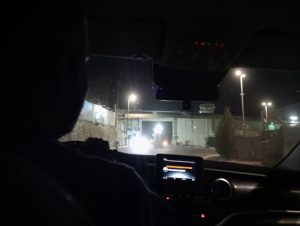
One of the strongest themes emerging from the encounter concerned the role of checkpoints. Balasan stressed that checkpoints are not neutral security mechanisms, but tools of daily domination and fear management. They restrict access to essential services, create arbitrary delays, render movement unpredictable, and exert psychological pressure that extends far beyond the moment of crossing. Power at checkpoints is exercised not only over mobility, but over dignity.
Particular attention was given to the gendered dimension of checkpoint violence. Drawing on extensive documentation and testimonies, Balasan highlighted how checkpoints often become sites of systematic humiliation and abuse against Palestinian women. These include invasive body searches, verbal degradation, forced undressing, public exposure, and intimidation. Such practices are not random or exceptional, but structural- embedded within a system where militarised power, patriarchy, and racialised control intersect. Women’s bodies become sites where sovereignty is enacted, mirroring the occupation’s control over land itself.
The impact of this violence is intergenerational. Children who witness their mothers and sisters being humiliated internalise fear and anger, while communities experience a gradual erosion of trust and cohesion. At the same time, Balasan emphasised women’s continued movement through checkpoints as an act of resilience: each crossing a refusal to disappear, each testimony a form of resistance.
Settler violence and systemic impunity
Balasan situated settler violence within the same architecture of domination. Attacks on Palestinian homes, farmland, and communities are not isolated acts carried out by “extremists,” but part of a broader system that enables, protects, and normalises such violence. Impunity is central: accountability is rare, investigations are minimal or absent, and the cumulative effect is the forced displacement of Palestinian families and the consolidation of territorial control.
A system defined by occupation, apartheid and annexation
In its concluding analysis, Balasan described the current reality as the convergence of occupation, apartheid, settler colonialism, and both de facto and de jure annexation. These are not parallel phenomena, but mutually reinforcing processes that shape every aspect of Palestinian life. The accumulation of restrictions, violations, and bureaucratic controls has led many observers and residents to describe the situation as a form of “silent genocide” – not a single event, but a sustained process of erosion, dispossession, and enforced vulnerability.
The final appeal addressed to the delegation was clear and direct:
“The only thing that can stop Israel is the application of international law and the end of impunity.”
Delegations were urged to share what they had seen, to raise awareness, and to support concrete measures – including sanctions – described as necessary, lawful, and fully consistent with international legal obligations.
Balasan’s work stands as a rigorous, grounded, and courageous effort to document reality as it is lived, resisting euphemism and depoliticisation. By insisting on the indivisibility of rights and the centrality of accountability, the initiative challenges the international community not to look away, not to fragment injustice, and not to normalise a system that is designed to endure through silence.
Find the recent reports of the Balasan Initiative for Human Rights here.
Report on PYALARA
Written by the Pax Christi International Delegation to the Holy Land | November 2025
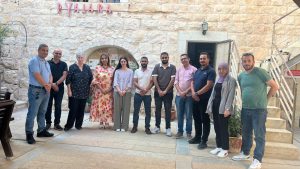
The Palestinian Youth Association for Leadership and Rights Activation (PYALARA) was established in 1999. It is a Palestinian youth-focused non-governmental organisation working across the West Bank, including East Jerusalem and Gaza. Its mission centres on empowering young Palestinians through leadership development, digital and media literacy, and rights-based education, with a strong emphasis on participation in public life and decision-making processes.
Their main headquarter is located in Jaba Village, Area C, complementing the other office they already maintain in Gaza Strip. Their Gaza office was partly destroyed, counting victims among the team, yet their colleagues there remain active and deeply committed to their work.
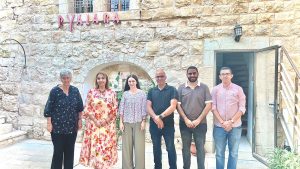
Pax Christi International works with PYALARA in the joint participation to the Global Solidarity for Peace in Palestine Coalition, composed of over 100-150 international, faith-based, and civil society organisations united to uphold human rights and international law in Palestine.
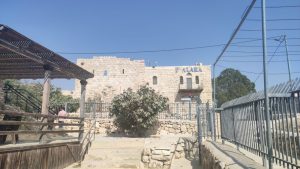
As Pax Christi International Delegation, we visited their centre in Jaba’, housed in a striking building originally constructed in 1920 by the Abdul Hafeez Twam Family. It was then renovated by the Riwaq – centre for architectural conservation in 2014. The structure rests on the foundations of an old Roman building, giving it a distinctly layered historical character. Inside, the thick stone walls resemble natural grottos, and the building opens onto several terraces overlooking the surrounding landscape. From this vantage point, the view stretches towards the nearby settlement of Geva Binyamin, the East Jaba’ Bedouin community , and the open valley beyond. The openness of the landscape makes it immediately clear how exposed the area is, and how visible every movement and potential threat would be, especially visible are the consistent attacks of settlers towards the Bedouin community.
Much of PYALARA’s work centres on what they refer to as the Digital Village (The Interactive MIL Center), an initiative that places the organisation at the forefront of Media and Information Literacy (MIL) in Palestine and the MENA region. The program is designed as an immersive learning environment where young people can acquire skills and develop critical awareness of the digital world. Developed with the support of advanced technologies, including AI-informed design, the Digital Village is intended to be self-sustaining: PYALARA trains youth, who then pass their knowledge on to others. The organisation works closely with the Palestinian Ministry of Education, the Ministry of Higher Education, the Ministry of Communication and Technology, and the Prime Minister’s Office and many international and local organizations. Their activities target a wide range of groups, including students, young people, women, and parents, with particular attention to those aged 12-17 and those over 17, while remaining open to anyone who may benefit and later become a resource for their community.
Their programmes go well beyond technical skills. PYALARA places strong emphasis on Media and information literacy (MIL) as a tool for strengthening critical thinking, and they use gamification to keep participants engaged and willing to engage with complex and sensitive topics.
A significant part of PYALARA’s mission focuses on awareness-raising and advocacy. They work extensively on youth rights, grounding much of their work in UN Security Council Resolution 2250 and related frameworks addressing the role of youth in peace and security. One project involved developing a simulation that enables young people to explain the lived experience of the separation wall.
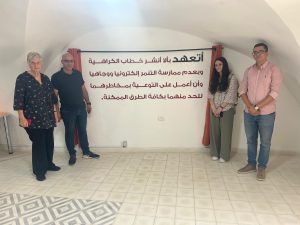
Another major focus is violence against women. PYALARA’s work on violence against women forms part of a broader initiative aimed at increasing social responsibility and strengthening accountability in addressing gender-based violence within Palestinian society. Implemented in cooperation with the Women’s Centre for Legal Aid and Counselling and funded by UNTF, the programme combines awareness-raising, advocacy, and youth engagement. A central element of this work is the use of innovative storytelling and digital tools to confront communities with the realities of violence against women and femicide. Through the “Talking Coffins” installations, symbolic coffins equipped with audio testimonies recount the stories of victims, inviting audiences in universities and public spaces to engage directly with these experiences and reflect on collective responsibility.
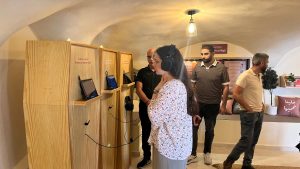
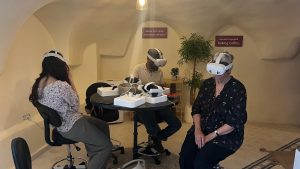
Complementing this, PYALARA produces awareness videos and, in collaboration with universities, organises competitions that have led to the creation of virtual reality films by students. Each VR headset in the Digital Village presents a distinct story, many deeply painful and based on real cases of women killed as a result of violence. The production shown to us depicts three women being detained and mistreated in prison, including a young girl who was recently arrested for posting on Facebook., filmed inside a former prison facility where the original writings of prisoners remain visible on the walls, adding a powerful layer of authenticity. This initiative culminated in the first Palestinian VR drama, using immersive storytelling to foster empathy, deepen understanding of structural and social dimensions of abuse, and spark public dialogue. Alongside these media productions and campaigns promoting legal protection frameworks, PYALARA places young people, particularly young women, at the centre of advocacy efforts, training them as storytellers, digital creators, and community leaders. Through this multidimensional approach, the organisation seeks not only to raise awareness but also to challenge harmful social norms, strengthen access to rights, and promote long-term cultural and institutional change.
Alongside this work, PYALARA provides psychological and legal support to those in need. Their overall approach weaves technology together with social awareness and rights-based advocacy in a way that is distinctive within the Palestinian context, using digital tools not as an end in themselves but as a means of enabling young people to understand, articulate, and act upon their rights.
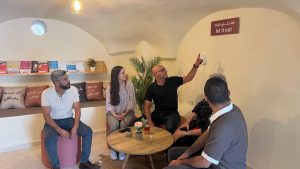
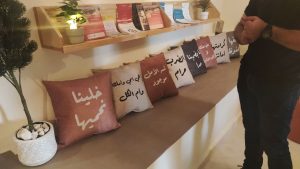
In meeting PYALARA, we encountered not only an organisation, but a living example of creativity and steadfast commitment to youth empowerment under extraordinarily difficult circumstances. Their work demonstrates how education and technology can become powerful instruments for dignity and hope. Despite the ongoing insecurity, PYALARA continues to nurture spaces where young people can learn, express themselves, and claim their role in shaping their society. The visit left our delegation with a profound sense of respect for their courage and innovation, and with the conviction that supporting youth-led initiatives such as PYALARA is essential for building pathways toward justice, peace, and sustainable social transformation.
Report on EJ-YMCA Rehabilitation Program
Written by the Pax Christi International Delegation to the Holy Land | November 2025
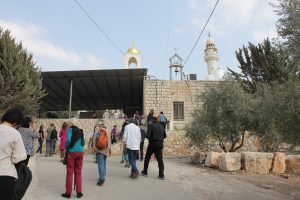
On January 21, 2025, Israeli soldiers stormed the Palestinian refugee camp Jenin in the northern West Bank and forced the inhabitants onto the streets. Apache helicopters, drones, bulldozers, armored vehicles and ground troops were deployed. This military operation took place just a few days after a temporary ceasefire had been reached in the Gaza Strip. The Israeli government expelled 32,000 people from Jenin and two other refugee camps, destroying and occupying their homes. Since then, the internally displaced persons have not been allowed to return to their homes. According to the international human rights organisation Human Rights Watch, this forced displacement is a war crime and a crime against humanity.
With Kairos Palestine, we travel to the Christian-dominated Zababdeh near Jenin, where displaced Palestinians from Jenin have found temporary shelter. They receive rehabilitation support from the East Jerusalem Young Men’s Christian Association (EJ-YMCA) founded in 1948, which is an independent, neutral and professional organisation, affiliated with the global YMCA movement. As a member of the World Alliance of YMCAs, the EJ-YMCA is committed to a unique vision of community, based on the universal values of human dignity, peace and justice. Their Rehabilitation Program was initiated in 1989 by the YMCA East Jerusalem, to provide quality rehabilitation services for the youth injured due to the political violence during the first Palestinian uprising “Intifada”. The goal was to re-integrate the youth into their communities and enhance their living conditions. The Rehabilitation Program has evolved through the years to become one of the leading rehabilitation services on the national level that address mental health and economic independence for Persons with Disabilities survivors of political violence. The program adapts a holistic approach for the provision of services, which includes psychosocial counselling, vocational training, community mobilization and advocacy initiatives.
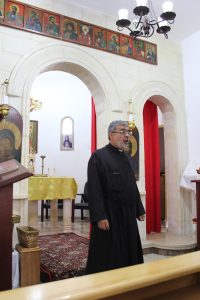
The road on which our bus travels to the north is lined for miles with Israeli flags. Jewish settlers use these to make clear their claim to Palestinian land. In Zababdeh, we are welcomed by the Melkite priest. The Melkites are united with the Roman Catholic Church. The town has about 4,000 Christian inhabitants and 2,000 Muslims. The pastor reports, “We have no freedom of expression and no freedom of movement. If I want to go to Jerusalem, I need a visa. In the last four years, I have only been to Bethlehem once.” He asks us, “Tell people about us, pray and donate. Sometimes you don’t want to hear who we are.” He begs for pastoral care for the poor. His teaching is not to respond to hatred with hatred, nor to violence with violence.
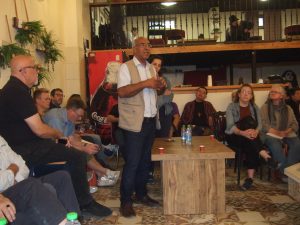
In Zababdeh, we also meet refugees from Jenin. Ten months ago, the army expelled 19,000 people from the Jenin refugee camp in one night and destroyed houses and infrastructure. “We have no choice but to resist,” explains the representative. “The expulsion from Jenin was a message to all Palestinians, creating an uninhabitable environment. In June, the same thing happened in Talkarem.” The CVYM in Jenin and Tubas is caring for the 3,000 refugees from Jenin who have found temporary shelter in a student dormitory in Zababdeh. “All families have to start from scratch. Their needs are even greater than those of the local population. We have never experienced anything like this before. It is new.” In partnership with the local population, they have been reasonably successful in meeting the basic needs of the refugees.
Before being expelled by the Israeli army, hundreds of families had been working in the Jenin refugee camp, and hundreds more in Israel. Both groups have lost their income. It is not possible for the YMCA to meet all needs. “We prioritise,” says the YMCA. “The most important thing is to find accommodation for the families. The idea of seeing them living in tents again is impossible for us. That’s why we work tirelessly.” Food is needed. Education is needed. UNRWA provides schools for the children. “Our people have lost their normal lives. We want to be visited so that this injustice is brought to the attention of the international community,” says the member of the self-government, “we want the Israeli government to be held accountable for these crimes against the Palestinians. We seek your solidarity”, is the appeal to us.
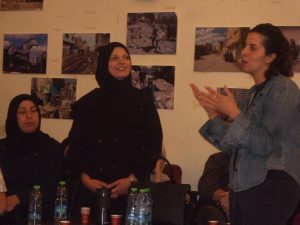
The refugees also talk about their trauma and suffering: “Suddenly, without warning, on a cold January night, we were all outside. It was particularly traumatic for the children.” The YMCA staff report that even after ten months, many of the families still need therapy. The parents have become aggressive towards their children. “We looked at how we could reduce their stress and taught them mechanisms for resilience. The struggle has not stopped.”
A man, around 35 years old, is hopeful: “It is our belief that we will return soon. The refugee camp has spiritual significance”. In Tulkarem, the refugees marched to their refugee camp in protest. A 17-year-old girl describes: “My soul is in the refugee camp. I want to return, but my house has been destroyed. My school is now a military base. We are grateful to have found shelter here, but it is very small. We hope that you will support us.“ A 12-year-old boy reports: ”My grades are getting worse. A psychologist is helping us.” A student describes the cramped conditions in which she now has to study: “We need space to be able to study.” Another refugee complains: “Those who live in student dormitories no longer receive any help from the government. Job opportunities are very limited. On January 25, 2025, my family’s life came to an end.” The student dormitory in Zababdeh houses 500 families in 77 rooms.
According to Article 49 of the Fourth Geneva Convention, which applies in occupied territory, the displacement of civilians is prohibited unless it is temporarily necessary for compelling military reasons or for the safety of the population. Displaced civilians are entitled to protection and adequate accommodation. The occupying power has a duty to ensure the return of displaced persons as soon as there is no more fighting in the area.
Israeli authorities told Human Rights Watch that Operation Iron Wall was launched “in light of the security threat posed by these camps and the growing presence of terrorist elements within them.” Human Rights Watch did not receive a response to inquiries about when Israel would allow Palestinians to return. Finance Minister and Minister in the Defense Ministry Bezalel Smotrich said in February that the camps would become “uninhabitable ruins” if the residents “continue their terrorist acts” and that “the residents will be forced to emigrate and seek a new life in other countries.”
The United Nations Relief and Works Agency for Palestine Refugees in the Near East (UNRWA) established the three camps in the early 1950s for Palestinians who had been expelled from their homes or forced to flee after the establishment of Israel in 1948. These refugees – the displaced persons and their descendants – had been living there ever since.
You can support the activities of EJ-YMCA here.
Report on Ma’an Lil-Hayat (Together for Life) – L’Arche Community
Written by Ann Farr, part of the Pax Christi International Delegation to the Holy Land | November 2025
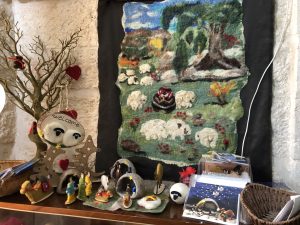
One of the highlights of my visits to Palestine over the years has always been to go to Ma’an Lil-Hayat, the L’Arche Community in Bethlehem and it is always a delight to introduce others, as was possible during our Pax Christi International Delegation visit in November 2025.
Founded in Bethlehem in August 2009, Ma’an Lil-Hayat (Together for Life) is a member of the International Federation of L’Arche Communities, created in 1964 in France and is the only project in Palestine that brings together people with and without Learning Difficulties, Assistants and Core Members, to share daily life and to work together on the creative, felted, textile products that are now so familiar to so many of us.
From my very first visit to the Community’s beautifully restored old Bethlehem House, overlooking the rolling, green countryside towards Herodian, I was touched by the relationships, the respect and the fun that we found there and were invited to share. As a retired teacher, having specialised in teaching young people with Learning Difficulties, I was very impressed with the way in which everything was planned and organised to ensure the security and the confidence of everyone and to see the shared responsibility for tasks.
Each day’s timetable includes shared meals, prayer and work and every birthday is celebrated with great gusto, singing and dancing. It is easy to see how each person and their gifts is valued and seen as having the capacity to give and receive as needed.
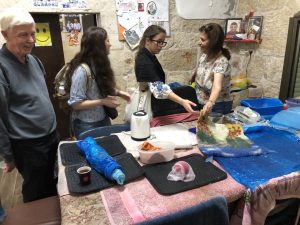
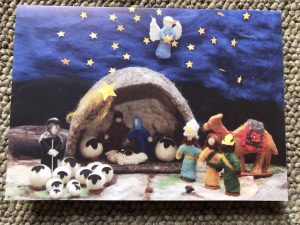
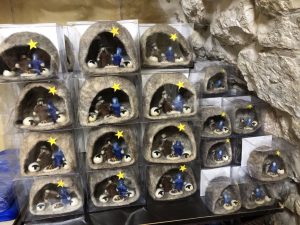
The felted goods that are made are unique in Palestine and the raw wool is bought from the women shepherds who keep sheep in the fields of villages surrounding Bethlehem. Piles of the wool at various stages of preparation can be seen under the house as you approach. Inside, each room is dedicated to a particular part of the process, from making the felt panels, using soap and water, to all the pieces needed for the array of goods that we see at the end of the line. These include colourful wall hangings and cushion covers with Palestinian scenes and flowers, handbags, purses, cosy slippers and all the characters of the Nativity story. The sheep and the nativity sets always prove to be very popular on stalls and no visit is complete without filling up with as many items as we can to bring back to the UK. This time my Palestinian stall also includes bright yellow, felted chicks for Easter.
The Community also reaches beyond itself to care for others. The visits of Sana, a Core Member, to a local hospital for cancer treatment has, since her death, led to regular visits to those undergoing chemotherapy, to chat and take snacks for the patients as these were not normally available. The result was that patients felt it became a little community of friends who care and support each other. As Sana said, “But who will make them smile if we aren’t there?’
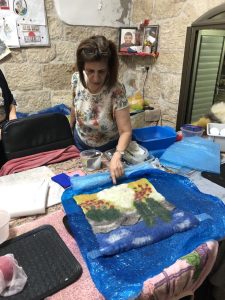
Almost every visit to the Community means meeting other visitors and volunteers. We are all welcomed with enthusiasm and invited to share whatever is going on. I have taken part in the morning worship and community time with singing and lots of sharing of news and ideas, which is followed by breakfast organised by whoever is in the team responsible that day. My attempts at ‘helping’ to make the outside cave of the nativity scenes is usually met with great laughter, as of course I am no way gifted in the process, which is actually hard work.
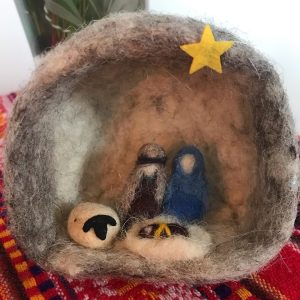
There are often volunteers in the house. Partnerships with local Universities mean that students of special education, physiotherapy, occupational therapy and business studies come to share in all aspects of the community life and I suspect not only use their developing skills but take away the huge lessons of all they have seen of diversity, respect and the value of every human being.
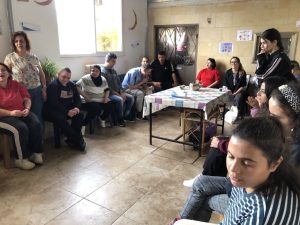
Our last visit was an unusually short one but we were welcomed into the sharing circle, invited to introduce ourselves and listen to those who wanted to tell us their news. It was good to meet both Core Workers and Assistants that I have known for many years and to meet the Little Sister of Jesus who was there from the Community that lives in Milk Grotto Street.
We all came away with bags of felted goodies as gifts or stock items for stalls back home. The situation in Bethlehem and the whole of the West Bank is dire for all Palestinian families. There is very little work and very little income. The buying of the L’Arche goods helps to keep the community going in times that are beyond difficult and they depend on both purchases and donations to continue their work. If your community can help, then please follow them on Facebook and check out their website and catalogue.
We also came away with a great sense of joy at being welcomed so generously by everyone at Ma’an Lil-Hayat and with a hope that the community and its outreach will be valued well beyond their house in Bethlehem.
Find the L’Arche Bethlehem catalogue here.
Report on EAPPI Handover Service, St Thomas’ Catholic Patriarchal Church
Written by Ann Farr, part of the Pax Christi International Delegation to the Holy Land | November 2025
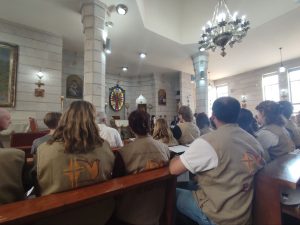
Fifteen Years ago, with two colleagues from EAPPI UK and Ireland, I joined other Human Rights Observers in International Group 38, in Jerusalem, as part of the World Council of Churches’ Ecumenical Accompaniment Programme in Palestine and Israel – EAPPI. We were each to serve in one of seven placements, living alongside Palestinian communities under threat from Israeli settlers and the Israeli occupation forces and to work alongside Palestinian and Israeli Peacemakers. Having received intensive training, led by the Quakers in London, we continued our training, whilst living in the hostel at St Thomas’ Catholic Patriarchal Church, in Jerusalem. So, it brought back many memories when, as members of the Pax Christi International Delegation to Palestine, we gathered on November 15th 2025, in the beautiful Chapel at St Thomas’ to take part in the EAPPI Handover Service, as Group 100 handed over their work to Group 101.
The Chapel was full as Ecumenical Accompaniers, friends, supporters and local clergy heard Dr Kenneth Mtata, WCC Programme Director for Life, Justice and Peace, refer to Elijah and Elisha and the transition in moving from working at a structural level to working with people struggling in the community. He said, ‘We are called to accompany the Palestinian People as individuals and families.
“It is a deep joy and honour to share in this sacred moment — here, in the heart of Jerusalem, where faith, hope, and history converge,” he said. “This is my first time in Jerusalem, and it has already been a profoundly transforming experience. The transition of the former accompaniers to the new ones is a sacred moment. This handover is not merely administrative, it is spiritual.” Dr Mtata noted that Ecumenical Accompaniers have walked the dusty roads, stood at checkpoints, shared in the tears of communities under pressure, and witnessed to peace where hope is fragile. “Your presence has been a sign that the world has not turned away”, he said. “You have borne witness to the humanity and dignity that no wall can suppress.”
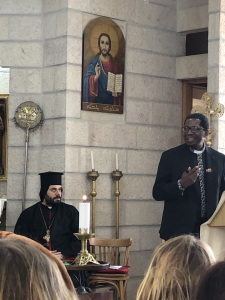
He commented that the new accompaniers inherit not only the experience but also the spirit of those who came before you. “The task remains the same: to see, to listen, to stand, to accompany,” he said. “But as you take up this mission, may you also receive a double portion of grace — grace to discern God’s presence in the small moments, grace to endure when the road feels heavy, grace to remain hopeful even when peace seems distant.”
After the Psalm and a Reading from Isaiah, Fr Dave Sullivan from St Anne’s Church talked about the differences in all the people that God created and the importance of respecting differences and having respect for each person. In quoting the Beatitudes, Blessed are the Peacemakers, sons and daughters of God, he said that peacemakers enter directly into God’s Dream and that EAs work directly with God’s Spirit to make the dream come true, to make it a reality. ‘Believe in your mission, face challenges creatively and if you fail, so did Jesus.’
Rev David Hardman, from the Methodist Liaison Office in Jerusalem, gave out copies of a photo of an image from the Bethlehem side of the Israeli Separation Wall near the checkpoint, with the single word, HOPE. On the back was a photo of the nearby Aida Refugee Camp. He spoke about the dark and the times when hope is in short supply and the light doesn’t shine very brightly. He said that God created the world in darkness, that Jesus was born in the darkness of the night and there was the darkness of the tomb. He urged the EAs to take with them the hope they had seen and to share the big picture. He said, ‘We face our fears, witnessing the reality of this land – own it. Take the fear and the love with you and pass them on so that others may see and know that it will shine brightly.’
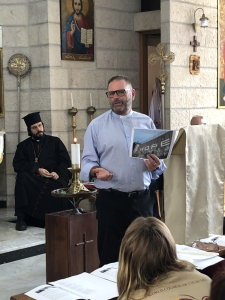
During the service, in a very moving action, each of the sixteen departing accompaniers stood in their placement group with lit candles and handed the light, and their work, on to the new group who made a commitment to continue the work of accompaniment in the communities they would serve for three months, in Jerusalem, Bethlehem, the Jordan Valley and the South Hebron Hills.
Iskandar Majlaton, programme coordinator for the WCC Ecumenical Accompaniment Programme Palestine and Israel, expressed gratitude to everyone there for the shared commitment to peace and justice. “Thank you for joining us at this significant handover ceremony, where we honour the service of one group and welcome the arrival of the next,” he said. “Your presence strengthens our collective mission and reaffirms the power of accompaniment.”
Addressing the departing and new EAs he said, ‘Your presence strengthens our collective mission and reaffirms the power of accompaniment.
‘Today, we extend our deepest gratitude to the 16 members of Group 100. For the past three months, you have been the hands and beating heart of the EAPPI program in Jerusalem, Bethlehem, South Hebron Hills, and the Jordan Valley. You have stood as witnesses, offering a protective presence to communities facing the daily realities of occupation. The scripture reminds us to “Speak up for those who cannot speak for themselves, for the rights of all who are destitute. Speak up and judge fairly; defend the rights of the poor and needy” (Proverbs 31:8-9). You have lived this verse, embodying the active, visible love that our faith calls us to. Your service has been a vital link in an unbroken chain of solidarity that stretches back to 2002, a legacy of the World Council of Churches’ profound commitment to this land and its people.
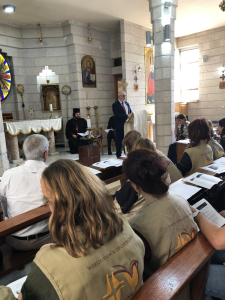
‘As you prepare to return to your home countries, your mission is not ending; it is transforming. You came, you saw, and you bore witness. Now, you return as ambassadors for peace, carrying with you the stories and struggles of the people you have accompanied. Your advocacy will be a powerful force for change, and we pray that you carry the light of this experience with you, inspiring others to join the call for a just peace in Palestine and Israel.
‘Now, we turn our hearts to welcome the 16 members of Group 101. We are overjoyed to welcome you, a sign of the growing strength and importance of this programme. You arrive at a time of great need and great hope. You follow in the footsteps of those who have served before you, and you bring with you new energy, new perspectives, and a renewed commitment to the principles of ecumenical accompaniment.
‘Your journey as an accompanier will be demanding. It will require courage, resilience, and an unwavering belief in the dignity of all people. You will be called to stand with the vulnerable, to document injustice, and to be a sign of hope in places where hope is often scarce. But you do not walk this path alone. You are guided by the profound truth in Matthew 25:40: “Truly I tell you, whatever you did for one of the least of these brothers and sisters of mine, you did for me.” You are surrounded by a community of faith, both here and around the world, that will support you, pray for you, and uphold you in your work.
‘As you receive the light from Group 100 today, may you also receive a double portion of their spirit—double the compassion, double the dedication, and double the hope. May you go forth from this place of worship renewed in your purpose, fortified by your faith, and united in the love of God and your neighbour.’
EAPPI advocates for justice, equality and an end to the military occupation of Palestine and there are a number of ways to become more aware of their work and to support them.
- WCC – EAPPI https://www.oikoumene.org/what-we-do/eappi
- Sign up for eyewitness stories and newsletters https://www.eyewitnessblogs.com/
- Invite a returned Ecumenical Accompanier to give a talk to your parish, school or community, in person or online; in the UK Ireland the office will find you a speaker https://www.quaker.org.uk/action/palestine-and-israel/get-involved
- Make a one off or regular donation to enable the work to continue https://www.eyewitnessblogs.com/donate/
- Become an EA – recruitment takes place annually for the three months service. Recruitment has started now, in February 2026. Conditions vary in different countries – check the websites and talk to EAs to find out more.

Very nice compilation of your experiences. Many thanks for sharing them to us. God bless!